

A 4.0% Official Cash Rate (OCR) for Christmas is virtually signed and sealed. We just need to wait for it to be delivered.
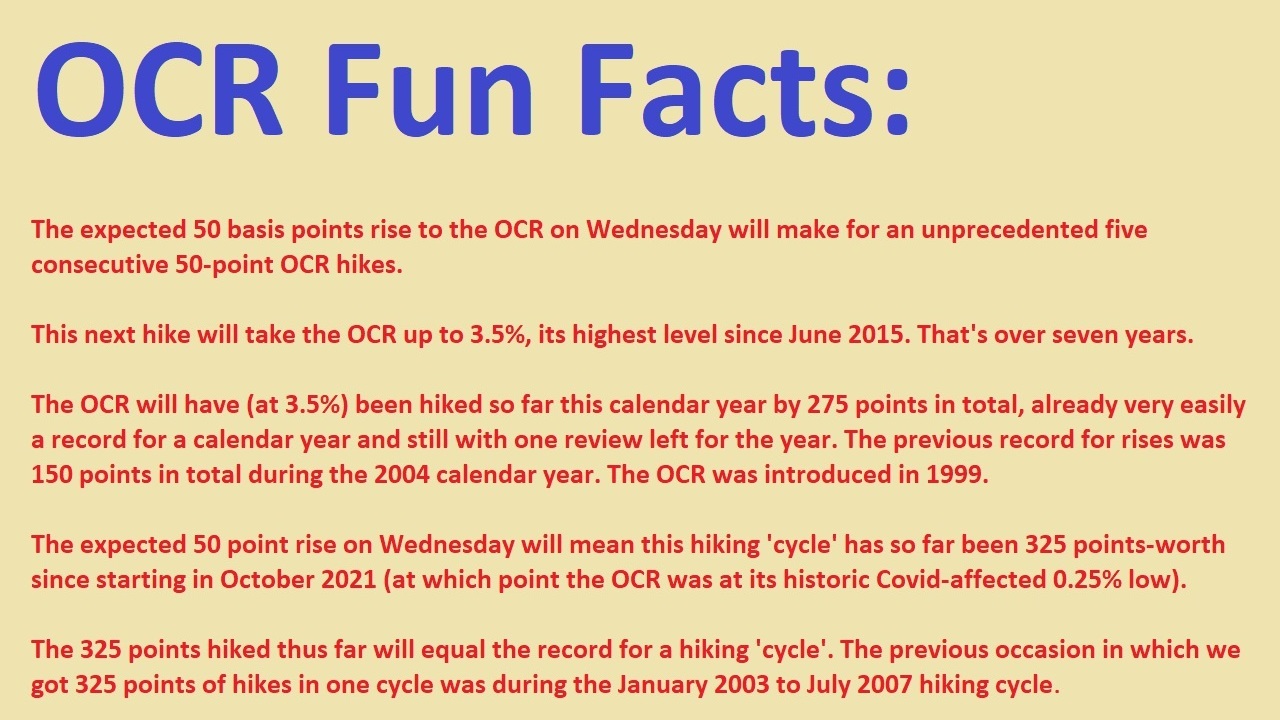
The first instalment will be in the coming week (Wednesday, October 5), when the Reserve Bank is universally expected to crank up the OCR by another 50 basis points (making FIVE such rises in a row) to 3.5%, unless something very untoward happens between time of writing and Wednesday.
(And of course, with 'untoward' events almost commonplace at the moment, we shouldn't rule out anything. Remember, in August 2021 the RBNZ's start of this OCR hiking 'cycle' was hijacked by the outbreak of Delta in Auckland. So, the first hike was in the end not till October.)
However, all things being equal, we will get the 50 point rise this week and another to follow on November 23 - which is the last OCR review for the year.
The first review for 2023 doesn't come till February 22. A long time between drinks, as they say.
I have carped previously about the fact the gap between the last OCR review in one year and the first review in the next year is now so long - I mean, three months, basically.
On THIS occasion, however, the RBNZ may well relish the opportunity to sit on the beach for a few weeks and watch what the world does before coming back afresh to decide whether it's up, down or sideways for the OCR next year.
And it is fair to say that market thinking on this subject is now becoming quite spread.
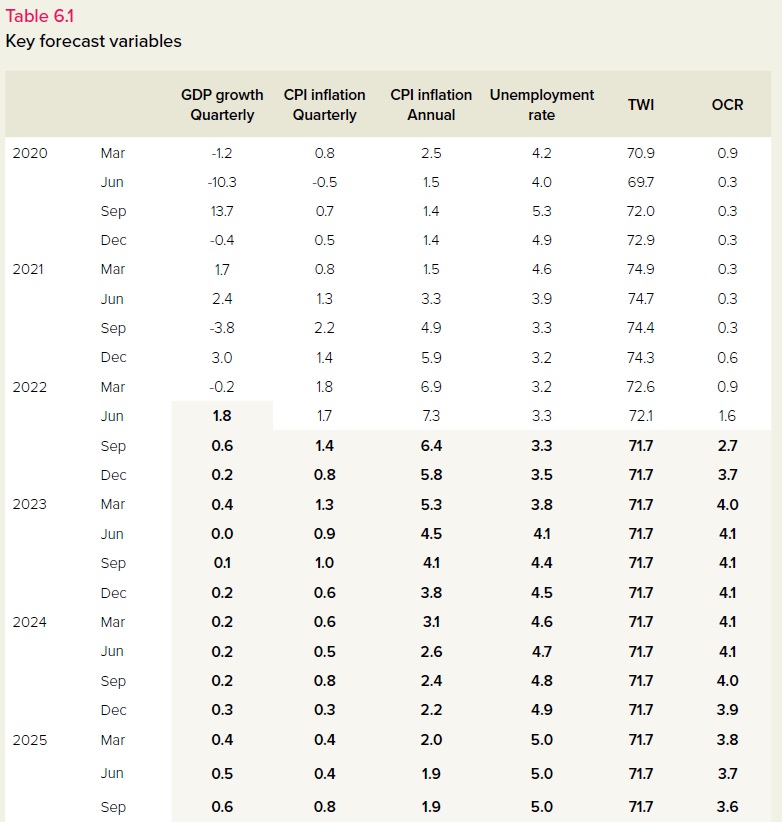
The context, lest we forget, is an annual inflation rate that hit 7.3% as of the June quarter. That's a bit on the high side for a central bank attempting to keep inflation in a 1%-3% range, with an explicit target of 2%. According to the table of economic forecasts in the RBNZ's last Monetary Policy Statement in August, the central bank's not seeing inflation creeping back under 3% till June 2024.
Between its last OCR review in August and now, the RBNZ hasn't had too much major economic news to digest.
The GDP figures for June, released earlier this month, were a surprise (+1.7% for the quarter) to a lot of people - but NOT the RBNZ. It actually had a market-leading pick of +1.8%.
There's been no Consumers Price Index inflation figures out recently, but the August food price figures showed a whopping 8.3% annual rise. So, inflation is still very much with us.
As per the August Monetary Policy Statement forecasts, the RBNZ is picking a 'terminal' OCR of 4.1% by the middle of next year. So, at the moment, it is hedging its bets a little between a peak OCR of 4.0% and one of 4.25%, although Deputy Governor Christian Hawkesby subsequently conceded to media that a 4.25% OCR was certainly possible.
Of course, the markets are now running ahead. At time of writing the wholesale interest rate markets were actually pricing in an OCR of 4.75% by the middle of next year. ANZ economists are now picking a 4.75% peak, while other economists have also been moving up their forecasts, with probably the most common perception now around 4.25% - but with 'upside potential'. Fixed mortgage rates - which had eased back a little - have been rising again.
An unwelcome development in the past couple of weeks has been the rampant rise of the US dollar in reaction to an even more 'hawkish' than previously US Federal Reserve. Our gallant little Kiwi has been getting eaten alive, along with most other global currencies. At one point the NZ dollar dropped under US56, though at time of writing it was back up just above US57c.

A falling currency increases the cost of imports - and that leads to more of that nasty old inflation. So, the suddenly much weaker Kiwi dollar is unhelpful.
It was perhaps instructive that RBNZ Governor Adrian Orr directly referenced the decline of the Kiwi against the US currency in a speech in Wellington in the past week. In fairness, Orr seemed pretty relaxed about it, but the real point I think is that if an RBNZ Governor is talking about the Kiwi dollar at all then they are probably not comfortable with the situation.
For the moment though, Orr is maintaining that the OCR tightening cycle is very mature and "well advanced", with "a little more to do" before the RBNZ can drop to its "normal happy place" of watching, worrying and waiting.
These comments would appear consistent with a central bank at the moment still maybe seeing its work done with an OCR of 4.0% before the end of the year.
But I think there's no doubt that could change. The global situation is now looking even more volatile. And therefore the statement on Wednesday, October 5 is going to be heavily scrutinised for any perceived changes of emphasis.
Remember, this week's OCR review will not be accompanied by a full Monetary Policy Statement. For the next one of these, we have to wait till the November 23 review.
The key thing to watch from this week's statement will be any sign that the RBNZ is veering away from what it forecast in the August MPS.
I would expect the RBNZ at this stage will maintain a straight bat and make a comment along the lines that it is:
comfortable that the projected path of the OCR outlined in the recent Monetary Policy Statement remains broadly consistent with achieving its primary inflation and employment objectives - without causing unnecessary instability in output, interest rates and the exchange rate.
That last bit of text is actually verbatim from the RBNZ's July OCR release, when the bank was looking to convey that it effectively had not changed its forward projections for the OCR track.
I could be wrong of course. And the cat would be well and truly put among the pigeons if the RBNZ threw in a sentence saying the opposite of the above.
But I would be surprised. And if the RBNZ does want to change its mind about the future path of the OCR then it will likely want to wait till November 23, at which point it will be producing a full Monetary Policy Statement and can explain itself at length.
Another good reason for waiting will be that after the October 5 OCR review we will see the release of the September quarter inflation figures (on October 18) and the September quarter unemployment and wage figures (on November 2). Both of these things will be huge and will have an enormous influence on the RBNZ's thinking.
So, it is well and truly the time for keeping eyes and ears open.
For the week ahead we can anticipate a move up for the OCR to 3.50% from 3.00%, accompanied by a 'steady as you go' message from the RBNZ.
Then on November 23 we will see the OCR moved up to 4%, accompanied by, I suspect language that will leave the door open for at least a 25 basis point rise in February.
And then after the RBNZ's had those weeks at the beach the fun all starts again next year. What is the global situation going to be looking like at the start of 2023? Do we really want to know? Which way for the OCR? Up? Down? Or sideways? Oh, decisions, decisions.
*This article was first published in our email for paying subscribers early on Friday morning. See here for more details and how to subscribe.
We welcome your comments below. If you are not already registered, please register to comment
Remember we welcome robust, respectful and insightful debate. We don't welcome abusive or defamatory comments and will de-register those repeatedly making such comments. Our current comment policy is here.