

Recession? What's that?
New Zealand easily avoided the 'R' word with a 1.7% rise in GDP for the June quarter. This reversed a 0.2% fall in GDP in the March quarter and meant we avoided two consecutive quarters of a shrinking economy, the 'technical' description of a recession.
The latest figures were strong enough to have ASB economists quickly revising their forecasts of the likely peak Official Cash Rate. They now see it peaking at 4.25% early next year, having previously forecast 4.0%.
ASB chief economist Nick Tuffley said the second quarter GDP "was stronger than our expectations, with signs that momentum in the second half of 2022 will be also stronger than we have been anticipating. This adds up to the risk that inflation pressures will be even more persistent."
The Reserve Bank (RBNZ) has had some pretty big misses with some of its recent economic forecasts, but it was closer than most of the economists to picking this result. It had picked 1.8%. The average forecast rise among economists was 1.0%. Westpac economists were close, also, with a 1.6% pick.
The latest figures will presumably give the RBNZ a lot of comfort that its current monetary policy stance - including a whole heap of recent 50 point rises to the Official Cash Rate, taking it to 3.00 - is the right one to have been taking, with more still needed.
Thursday's GDP result therefore is a clear green light for another 50 point rise in the OCR at the next review on October 5.
As Kiwbank chief economist Jarrod Kerr said, the GDP outcome doesn't mean much for monetary policy.
"It simply confirms what we know," he said.
"The RBNZ is not yet done. They’ve made that unambiguously clear."
Kerr said the RBNZ is "on an inflation fighting path" with an end goal an inflation rate back at target. The RBNZ targets inflation between 1% and 3% with an explicit targeting of 2%. As the June quarter annual inflation stood at 7.3%. Figures for the September quarter are due out on October 18.
Getting inflation back on track requires domestic demand to ease back, restoring balance in the economy, Kerr said.
"Between weak confidence and deteriorating firm investment intentions, signs of slowing domestic demand are already emerging. But the RBNZ has signalled that further increases in the cash rate are needed.
"We expect the RBNZ to deliver its fifth successive 50bps hike at the monetary policy review in October. And we see the cash rate reaching 4% by the end of the year."
Economists' estimates varied widely due to the Covid-related volatility expected in the figures, but the average of the forecasts was for a 1.0% rise. The Reserve Bank's 1.8% forecast rise was top of the range.
The latest GDP figures show a clear bounce-back from the impact of Covid.
Statistics New Zealand said the services industries, which make up about two thirds of the economy, were the main contributor to the GDP increase, up 2.7%.
"The reopening of borders, easing of both domestic and international travel restrictions, and fewer domestic restrictions under the Orange traffic light setting supported growth in industries that had been most affected by the COVID-19 response measures," national accounts – industry and production senior manager Ruvani Ratnayake said.
"In the June 2022 quarter, households and international visitors spent more on transport, accommodation, eating out, and sports and recreational activities."
Overall household spending declined by 3.2%, driven by lower spending on goods such as used motor vehicles and audio-visual equipment, with a similar fall seen in retail trade activity. Specifically, spending on durable goods was down 8.6%, while non-durable goods spending was down 2.3%.
Key facts June 2022 quarter compared with the March 2022 quarter:
- GDP was up 1.7%
- expenditure on GDP rose 2.1%
- service industries rose 2.7%
- goods producing industries fell 3.8%
- primary industries rose 0.2%
- GDP per capita rose 1.7%
- real gross national disposable income rose 1.0%
- average annual GDP to June 2022 rose 1.0%
- current price expenditure on GDP rose 3.4%
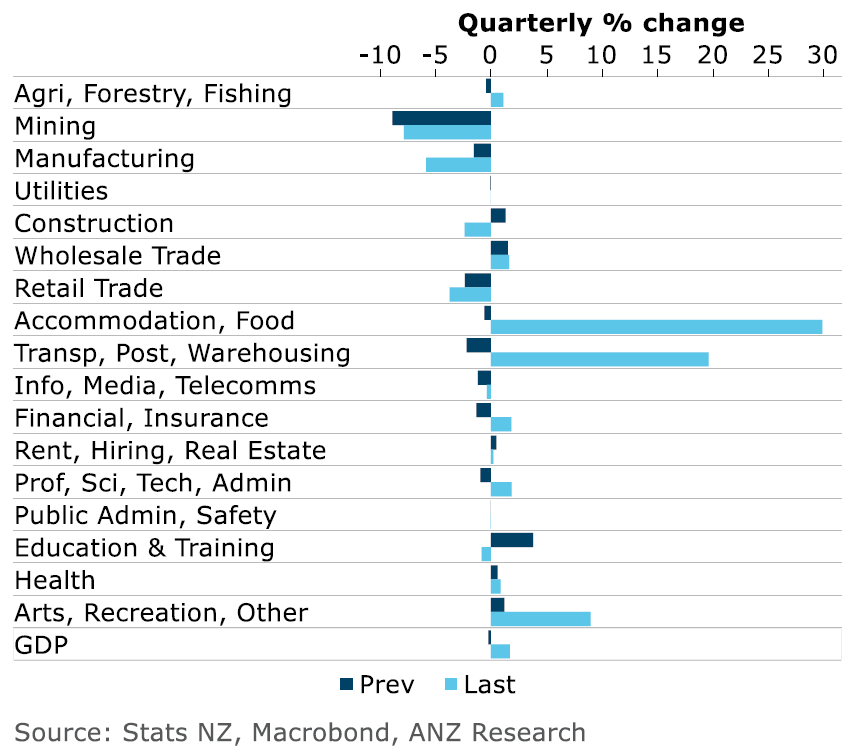
ANZ economists provided this table highlighting the various sectoral changes ('Last' refers to June quarter, 'Prev' the March quarter)
We welcome your comments below. If you are not already registered, please register to comment
Remember we welcome robust, respectful and insightful debate. We don't welcome abusive or defamatory comments and will de-register those repeatedly making such comments. Our current comment policy is here.