

By Gareth Vaughan
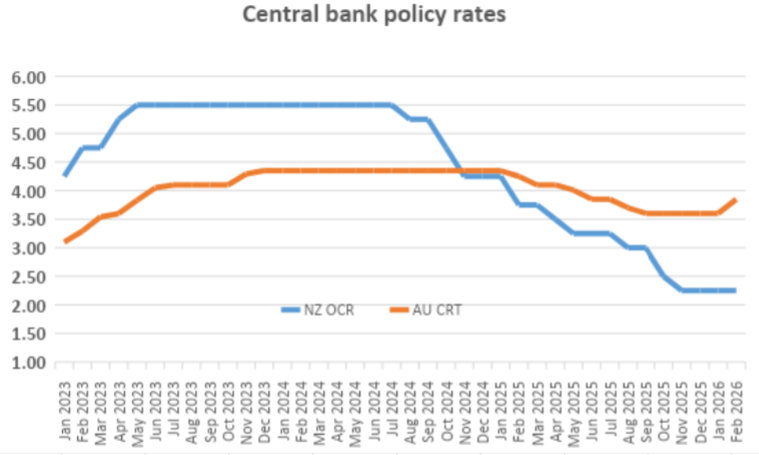
The Reserve Bank of Australia's decision to lift its cash rate 25 basis points this week means it's now 160 basis points higher than the Reserve Bank of New Zealand's official cash rate highlighting differing levels of assertiveness between the two central banks, Imre Speizer, Head of New Zealand Strategy at Westpac, says.
The RBA's cash rate is now at 3.85% with the RBNZ's OCR at 2.25%. Speaking in a new episode of the Of Interest podcast, Speizer says it has been 13 or 14 years since there has been such a gap, with the two economies tending "to cycle together most of the time."
"It comes down to a different central bank approach. The RBA has deliberately maintained a fairly dampened approach to tackling either low inflation or high inflation. So when it has needed to hike or cut, it has done [so] in a very cautious and drawn out manner. And by doing so it hasn't had to flip around as much as the likes of some other countries," says Speizer.
"The central bank of New Zealand has been pretty much an activist in terms of tackling inflation. So when inflation was high in the most recent cycle it went fairly hard and hiked rates a lot to bring it back down again, and that then amongst other things did help to engineer a brief recession."
"It paid a cost to do so but it got inflation under control. Now we're basically coming out of that era and [economic] growth is starting to pick up. And so the Reserve Bank [of NZ] is now faced with the task of thinking; well at what point do we need to start thinking about pushing rates up to prevent inflation from running away?"
"I guess it just means the assertiveness of the relative central banks is probably explained [in] why we've ended up with such big differences between New Zealand interest rates and, say the Australian interest rate. In time that will rectify itself and will get back to something that looks a bit more normal, I.E. Kiwi rates a little bit higher than Aussie rates. But I think it's going to be some way down the track," Speizer says.
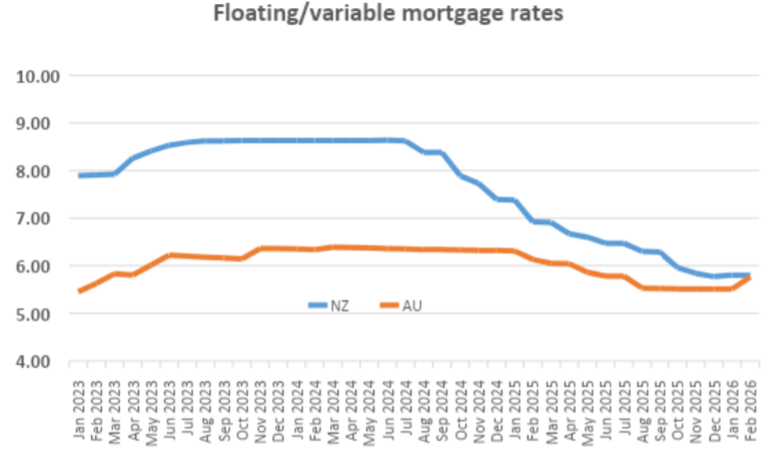
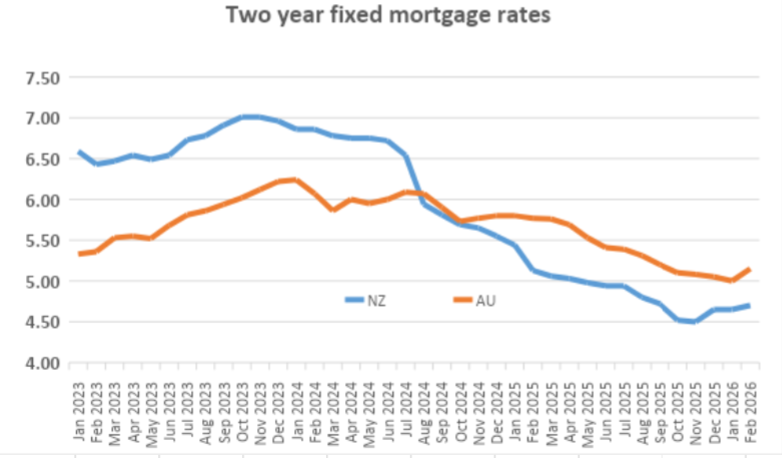
He says lots of people are asking how the cash rate differential between New Zealand and Australia might play out with mortgage rates.
"There shouldn’t be any direct impact if the cause of Australian rate rises is unique to Australia. But much of the time, there is a common global factor at play, so New Zealand rates do follow Australian and US term rates," Speizer says answering a follow-up question to the podcast interview.
"Also, if the strong Australian economy is seen as eventually benefitting New Zealand’s economy, New Zealand term rates could rationally follow Australian rates higher in dampened fashion."
In the podcast audio he also speaks about the direction of swap rates and what it means for mortgage rates, what the yield curve's suggesting at the moment, the outlook for NZ government bonds, the impact the volatility of US President Donald Trump's administration has on the US dollar and financial markets more broadly, incoming Federal Reserve Governor Kevin Warsh, the impact of US government shutdowns on economic data availability, geopolitics and more.
*You can find all episodes of the Of Interest podcast here.

We welcome your comments below. If you are not already registered, please register to comment
Remember we welcome robust, respectful and insightful debate. We don't welcome abusive or defamatory comments and will de-register those repeatedly making such comments. Our current comment policy is here.