
Summary of key points: -
- Current Kiwi dollar correlation to the Dow Jones Index likely to be temporary.
- Stabilisation of the NZD/USD rate at 0.6000 will not last long according to the technicals.
- NZ share market performance defies doom and gloom from economists.
- Time for the medico’s and politicians to stand aside and let the business entrepreneurs get on with it.
Equity markets response to US company earnings releases key for the Kiwi dollar
The “risk-on/risk-off” investment market sentiment and appitite that has been the main driver of the NZ dollar movements over recent weeks since the Covid-19 pandemic hit the global economy in March, is starting to reduce in intensity as a determinign factor. Equity markets remain vulnerable, however overall the markets are settling and volatility reducing.
Extreme over supply and collapased demand has caused some scary pressure points in the crude oil market, however those gyrations have not impacted too much on currency movements.
The substantial reduction in the oil price does mean that the amount of US dollars that oil importing countries have to buy across the forex markets is considerably less. A lower oil-related demand for USD’s should be negative for its currency value.
The vulnerability of the US equity markets to another major sell-off has centred around the release of decimated 2020 corporate earnings. If the reduction in profits and size of the losses are a lot worse than what the equity markets are currently pricing, the sellers will hold sway. The next week sees a large number of US listed companies reporting their earnings from Caterpillar to Amazon. It should not be a surprise to the markets that many sectors will be a sea of red ink (oil, hospitality, transport, manufacturing), however many others will not be so hard hit (technology, pharmaceutical, health). The risk of another large leg down in US equity markets, that would send the NZD/USD exchange rate lower, appears to be dissipating as we have not seen any concerted selling ahead of these crucial earnings annoucements.
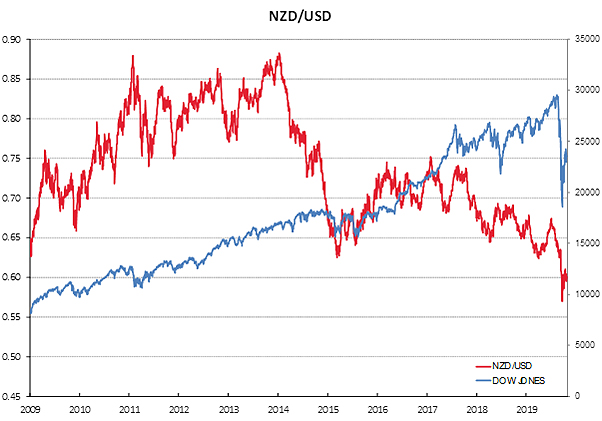
While there has been a very close correlation between the movements of the Dow Jones Index and the NZD/USD exchange rate over the period since 19 February when the share markets tanked and the Kiwi plummeted in unison to 0.5500, history tells us that there are very long periods when the NZ dollar is not driven by equity market sentiment (refer first chart below).
Commodity prices, monetary policy changes, economic performance and appreciation/depreciation of the US dollar itself against all currencies (particularly the AUD and EUR) are more influential variables. If the Dow Jones Index settles around the 24,000 region over coming months, the NZD/USD exchange rate direction will return to being determined by the other drivers, as has been the case for most of the last ten years.
Short-term crunch point ahead for the NZD/USD rate
Another week in the NZ dollar FX market, another pull-back lower into the 0.5900’s and instructively another recovery back above 0.6000.
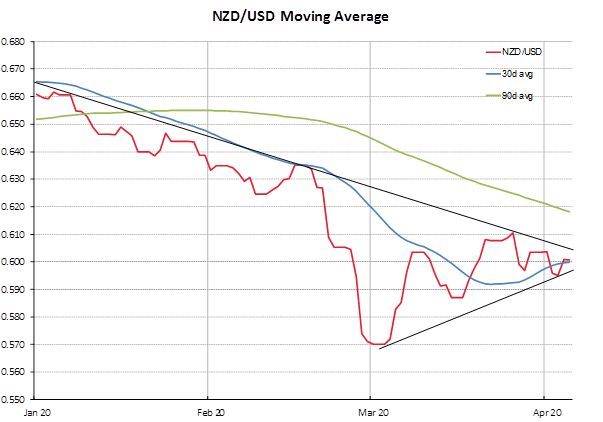
As the second chart below depicts, the converging triangle pricing formation indicates that the Kiwi is headed for a break-out higher if it trades above 0.6050 and is at risk to lower levels if it trades down below 0.5950 and 0.5900. Gains to above 0.6200 would see the Kiwi trading above its 90-day moving average and from a technical perspective, short NZD position holders would have a signal to buy their Kiwi back.
It seems that local USD exporters who were not bold, quick or organised enough to sell USD/buy NZD as future hedges during the brief dip to 0.5600/0.5700 from 20 to 23 March, now have larger orders placed to buy the Kiwi between 0.5600 and 0.5900. A failure of the NZD/USD rate to return to those lower levels over coming weeks may well see the FOMO (Fear of Missing Out) syndrome kicking in and the exporters entering hedges off higher spot rates.
The Kiwi dollar has held its value fairly well over the last week in an environment where the USD has strengthened from $1.0900 to below $1.0800 against the Euro. The EUR/USD exchange rate is very much in the bottom-end of its trading range at $1.0800 and the probability has to be higher for a move back upwards (weaker USD) from here given the bazooka USD money printing by the Federal Reserve.
Investment markets more optimistic on the future than economists
A number of weeks ago this column highligted the three potential NZ economic scenarios for the recovery (or not) from the Covid-19 pandemic. A month ago the panic equity market sell-off suggested an economic outcome somewhere between the “U” and “L” shaped recoveries.
The rapid recovery of the equity markets from the abyss (and thus the Kiwi dollar) over recent weeks may now suggest an economic recovery between the “V” and “U” shaped scenarios. Admittedely, this will not be the case for the tourism, travel and hospitality industries. However, China is back to work and very soon Australia and New Zealand will largely be back to work. For this reasons it is difficult to be negative on the NZ dollar outlook, as in relative terms we are just so far ahead in the recovery stakes than Europe and the US.
Australia and New Zealand are being recognised and admired by the rest of the world for how we have taken tough decisions to control the pandemic and thus reduce its longer-term economic impact.
In my view, it is always preferable to take more note of what the financia/investment markets are telling us about likely future economic conditions than what economists and politicians are telling us.
The NZ equity market and the potentially the NZ dollar FX market are not pricing-in a prolonged economic recession. However, here in New Zealand there appears to be a weird competition amongst the various economists as to who can have the most doom and gloom in their forecasts for unemployment and GDP growth. One prominent “media economist” who has predicted an economic downturn every year for the last ten years (and has been totally wrong!) now has his day in the sun – however not for the reasons he based his previous forecasts on.
Next economic phase requires less State involvement, not more
A potential inhibitor of the NZ economic recovery over coming months is that the Government themselves, who has had a taste of calling the shots as to what industries/companies can operate and who cannot, carry on with excessive State partcipation and intervention in the economy.
Many commentators and business leaders believe we require a different economy going forward (effetively replacing the decimated tourism sector). However, that new economic activity will come from entreprenurs and risk takers, not politicians and bureaucrates in Wellington. Therefore is was disappointing (but hardly suprising) that the Prime Minister responded with a idealogically driven “No” last week to a question about innovative policies to attract international bilionaires to New Zealand to establish new businesses and thus jobs. New Zealand has a unique opportunity to sell itself as a safe-haven sanctuary for global businesses – a “Switzerland of the South Pacific”. The Government’s role in the new economy is to enact the policies to allow the private sector to make their own decisions and get on with it.
It is near time for the medico’s, politicians and bureaucrats to step aside and allow our innovative and smart business entrpreneurs shape the new economy with private capital from whereever we can get it. Otherwise, we will all be burdened with the responsibility of sending our grandchilren the massive bill for the current economic rescue (Government and private sector debt).
Daily exchange rates
Select chart tabs
*Roger J Kerr is Executive Chairman of Barrington Treasury Services NZ Limited. He has written commentaries on the NZ dollar since 1981.
We welcome your comments below. If you are not already registered, please register to comment
Remember we welcome robust, respectful and insightful debate. We don't welcome abusive or defamatory comments and will de-register those repeatedly making such comments. Our current comment policy is here.