
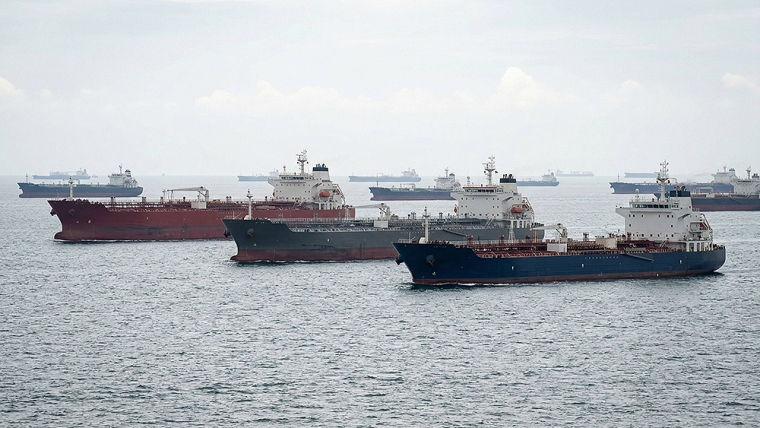
The latest US bombing campaign against Iran entered an eleventh day, with strikes extending to a new area in the north-west of the country. Iran continues to retaliate with attacks against US allies in the Gulf region. Brent crude has risen on seven of the past eight days, reaching a high of almost USD95.50 last night, and is currently trading near USD94. After Iran’s interior minister visited Pakistan, a spokesman said, “There are no negotiations — it’s only possible for there to be an exchange of messages.”
On social media, President Trump vowed that the US would bomb and destroy one bridge or power plant whenever Iran shoots at a ship in the Strait of Hormuz. Iran responded that it would strike infrastructure and bridges in the region, including energy facilities in which the US has interests. It added that Iran would not abandon its resolve to control the strait, which it considers essential for the strait’s long-term security.
While Brent crude is up more than 30% month-to-date, European gas prices have risen even faster, up about 44% over the same period, not helped by Europe’s heatwave. Reserves are lower than usual, raising concerns about whether supplies will be sufficient to get through next winter.
Against the backdrop of higher oil prices, US Treasury yields continue to grind moderately higher. The 10-year rate has reached 4.65%, up a couple of basis points on the day and within a few basis points of the May high. The 2-year rate traded at its highest level since early 2025, reaching 4.31%. Higher oil prices increase the odds of Fed tightening, and the market is back to almost fully pricing a hike by the September meeting, with two full hikes priced by March.
UK annual CPI inflation fell to 2.6% y/y in June, its lowest level in over a year. This was a tenth below consensus, while core and services inflation were a tenth higher than expected, although all figures slightly undershot the BoE’s April forecasts. The market reaction was muted, with little change in BoE rate hike expectations, which imply a hike by November and two hikes by February.
Currency markets show only modest movements. The NZD is on the weaker side of the ledger, with recent strong gains fading. It trades at 0.5815 this morning and is slightly weaker on the key crosses. The AUD is just under 0.70, while NZD/AUD has drifted down to 0.8315.
Yesterday, as USD/JPY rose through 163, Japan’s MoF Katayama repeated the often-used line that “we will take appropriate and bold action at any time, should the need arise”, to which the market gave a collective yawn. There was more reaction after Bloomberg reported that BoJ officials are open to raising interest rates at a faster pace than the consensus among economists — roughly one hike every six months — as the yen’s continued weakness adds to upside inflation risks, according to people familiar with the matter. USD/JPY fell 40 pips to 162.70 but soon recovered, and this morning is trading close to 163.15. NZD/JPY is slightly weaker at 94.9.
US equities are relatively flat as investors await the first of the Mag 7 earnings reports, with Alphabet due to report after the bell.
Global forces pushed NZ rates higher yesterday, although the moves were a little smaller than those seen in Australia and the US. Swaps and NZGBs rose 1–2 bps across the curve, with the 2-year swap rate closing at 3.67% and the 10-year rate at 4.39%.
On the economic calendar, consensus expects Australian labour market data to show a modest 15k lift in employment in June, leaving the unemployment rate unchanged at 4.4%. The ECB meets tonight, and the market ascribes little chance to a back-to-back hike but a high chance of the next hike coming at the following September meeting.
Daily exchange rates
Select chart tabs
Jason Wong is the senior currency Strategist at BNZ Markets.
We welcome your comments below. If you are not already registered, please register to comment
Remember we welcome robust, respectful and insightful debate. We don't welcome abusive or defamatory comments and will de-register those repeatedly making such comments. Our current comment policy is here.