

Summary of key points:
- RBNZ “go slow” on interest rate hikes is just making the inflation control job harder
- Oil prices are key to US inflation outcomes
- Japan readies for further Yen intervention
A marginally higher inflation result than forecast in the US for the month of October has proven sufficient to drive the sentiment in financial markets to yet again higher US interest rates and a stronger US dollar value. The US dollar has appreciated against the Euro to $1.1020, its strongest level since President Trumps tariff “liberation day” announcement in April 2025. Along with all other currencies against the USD, the NZD/USD exchange rate has depreciated to 18-year lows of 0.5525. At the height of the GFC in 2009 when New Zealand’s export commodity prices were collapsing, the Kiwi dollar hit a low of 0.4950 against the USD. Over recent years, the NZD/USD exchange rate last traded close to 0.5500 in April 2025 (liberation day) and in October 2022 (UK “gilt” bond crisis). Since the 2020 Covid related spike lower in the NZ currency, it has managed to recover back up to over 0.6000 and above on five or six separate occasions. However, it will require something to reverse the FX market sentiment against the US dollar to save the Kiwi dollar from depreciating further on this occasion.
Despite the New Zealand economy now performing at a stronger GDP growth rate than many other countries, the Kiwi dollar will not attract any global investor interest whilst the RBNZ continues its “go slow” approach to adjusting monetary policy settings. The official US Fed Funds interest rate is already well above our OCR interest rate (3.90% versus 2.75%) and US interest rate market forward pricing has moved out again to now price-in four x 0.25% hikes over the next 12 months.
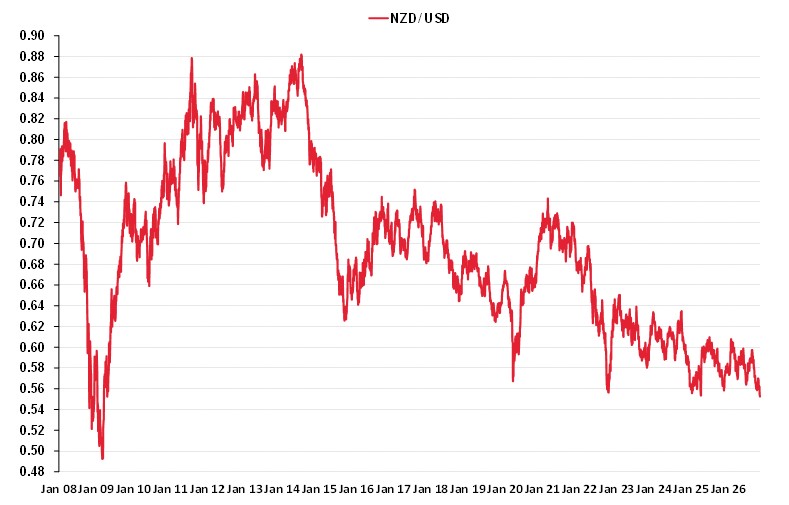
Unless the RBNZ step up to the plate and abruptly abandon their overly cautious “go slow” approach of adjusting monetary policy from the current “loose” setting at 2.75% to somewhere near “neutral” at a 3.75% OCR, the Kiwi dollar will continue to depreciate against the higher yielding US dollar. The RBNZ has been roundly criticised in the past for being too slow to increase interest rates when inflation is rising and too slow to reduce interest rates when the economy is weakening and inflation is decreasing. The only justification for holding monetary policy settings at a “loose” 2.75% OCR level is if there is a risk and a reasonable probability of inflation decreasing to below the 1.00% floor of the target range. That is certainly not the case today with annual inflation at 3.70% to 30 September and forecast to increase to between 4.20% and 4.50% when the December 2026 figures are released in mid-January. Higher oil prices and a lower exchange rate value being the major causes of the inflation increase. The RBNZ must believe that the inflation increase will be very temporary to justify their current “go slow” stance. The US Fed made a monetary policy blunder in 2021 relying on inflation being “transitory” (temporary).
The RBNZ’s own chief Economist, Paul Conway, in a speech in Sydney last week, highlighted the risk of being too slow to increase interest rates can cause more economic pain later when interest rates have to be pushed sharply higher to get inflation back under control. Australia is experiencing that exact pain today of tight monetary policy conditions, largely because the Reserve Bank of Australia (“RBA”) was not prepared to increase interest rates above 4.00% in 2023 when both the US and New Zealand hiked interest rates to 5.50%.
The following extracts from Mr Conway’s Sydney speech succinctly describe the issues in front of the RBNZ: -
- “Inflation had been above the 1% to 3% target band for 16 of the past 20 quarters or the past five years”
- “55% of items in the CPI basket increased by 3% or more in the September quarter, up from 40% in the June quarter”. “This suggests that inflationary pressures are becoming more broad-based across the economy.”
- “The longer near-term inflation stays above our 1% to 3% target band, the more likely it is that medium-term inflation pressures increase, and of course that would mean higher policy rates for longer”.
- “The weak NZ dollar was adding to inflation pressure and not just because import prices were higher”. “A lower exchange rate also tends to increase prices for goods that are produced in New Zealand but traded internationally, such as food.”
The above analysis of current inflation risks and monetary policy responses can only result in a conclusion that the RBNZ will need to hike the OCR by 0.50% at their next meeting on 9th December to catch up on their dilly dallying with OCR hikes over recent months. Any continuation with reluctant increases and too much caution will result in an even lower NZ dollar exchange rate and resultant higher inflation next year. The current two-speed economy and uneven nature of New Zealand’s GDP growth (rural versus city) should not be of concern to the RBNZ. Their sole remit is inflation controlled between 1.00% and 3.00%, not consumer spending, not GDP growth and not jobs. Someone needs to remind Governor Breman of this very specific and narrow focus, so that she backs her own Chief Economist and hikes interest rates much more aggressively. Only then will the Kiwi dollar find some independent buying support that will help bring inflation down in 2027.
An argument from some quarters that a rapid appreciation in the Kiwi dollar (from aggressive 0.50% OCR interest rate hikes) would only hurt our main growth engine, the export sector. The economic commentators making this claim are poorly informed, as outside beef and lamb exporters, the majority of exporters are currently heavily hedged forward on the NZD currency risk for multiple years. If the RBNZ are indeed close to the coalface of businesses throughout New Zealand, they will be aware of this fact.
In addition, the view that significant interest rate increases will hurt the economy is also misguided. Home mortgage borrowers and companies alike have fixed their interest rates. Therefore, the economy is not as interest rate sensitive as what the Kiwi dollar exchange rate is.
Oil prices are key to US inflation outcomes
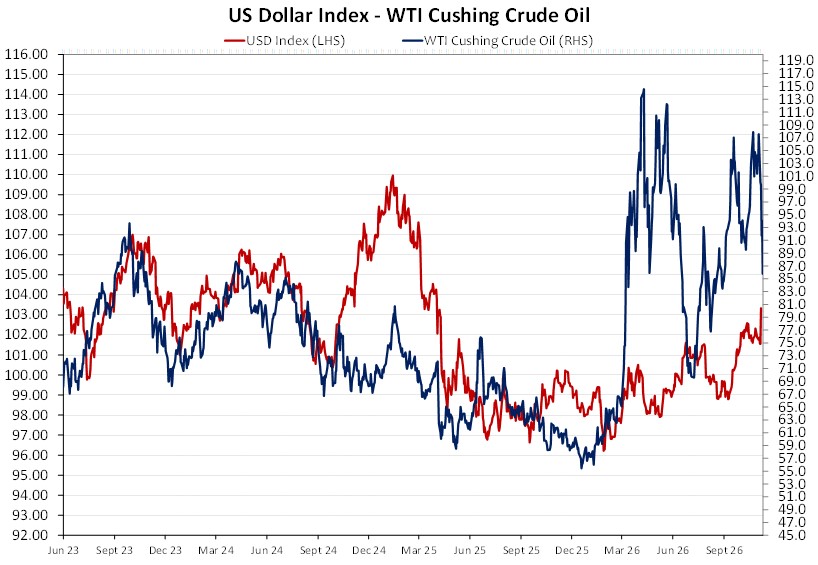
US headline inflation increased by 0.40% in the month of October because WTI oil prices increased by 21% from US$82.50/barrel in early September to US$104.00/barrel by the end of October. Not only do gasoline pump prices increase on the US public when crude prices lift, but also airfares and other public transport prices. The elevated oil prices have been a problem for nine months now and it seems the Federal Reserve have completely lost patience at these cost increases holding US inflation well above their 2.00% target. The Fed cannot control oil prices, all they can do is increase the price of money (interest rates) to slow demand in the economy and hopefully that prevents other prices in the economy from increasing. The US dollar Dixy Indes has appreciated to 21-month highs of 103.30 as a result of US market interest rates being pushed back up on the October inflation result.
What the currency markets seem to be conveniently forgetting (for the meantime anyway) is that crude oil prices have dramatically reversed direction from $104.00/barrel at the end of October to US$89.00/barrel today (down 14%). Should oil prices continue to fall over coming weeks, the November headline CPI result is likely to be a negative number. The annual headline rate of inflation in the US will therefore decline sharply from 3.90% in October to 3.50% in November. Looking further forward, on the assumption that oil prices continue to decrease, the annual inflation rate looks set to decrease further to somewhere near to 2.00% by May 2027 as the large monthly increases in March to May 2026 drop out of the annual figures. Off course, there is no guarantee that oil prices will continue to decrease as an end to the Iran/US war is by no means assured. What we do know is that volumes of oil currently being shipped through the Strait of Hormuz are back to pre-war levels. Should some form of peace deal be struck with Iran, the US blockade if Iranian oil ports will come to an end and that will add another 4 million barrels of oil to global supplies. The possibility of oil prices returning to pre-war levels of US$70.00/barrel over coming months should not be discounted. Should the much lower oil prices transpire into reality, the Fed and the US interest rate markets will need to rapidly reassess their expectations of where US inflation will be next year.
The November CPI inflation results are not released until 10th December, the day after the Fed’s next meeting on 9th December. The markets are now fully pricing-in a 0.25% hike in the Fed Funds interest rate at the 9th December meeting. A negative inflation number the following day has the potential to reverse sentiment on the US dollar as the likelihood of higher interest rates in the US in 2027 diminishes. The smart money may start to take profits on long USD positions well ahead of the early December releases.
In addition to oil prices being the dominant influence over US dollar direction in currency markets, the other big unknown is whether the AI equities bubble bursts badly or deflates slowly. It is somewhat reassuring to see that human frailty can still have a massive influence over share market values in a high-tech world (Jensen Huang exiting Nvidia). Should there be a major correction downward in US equity markets before Christmas, the US dollar is more likely to be sold lower as foreign funds exit the market.
For the US dollar to continue to make gains over coming weeks, oil prices would need to reverse upwards and US economic data print stronger than prior forecasts. The opposite also applies. The US interest rate markets in pricing four more 0.25% interest rate hikes by the Fed are effectively placing a one-way bet that oil prices do reverse back up again. If and when the opposite occurs, US interest rates and the US dollar will be rapidly reversing their recent gains.
Japan readies for further Yen intervention
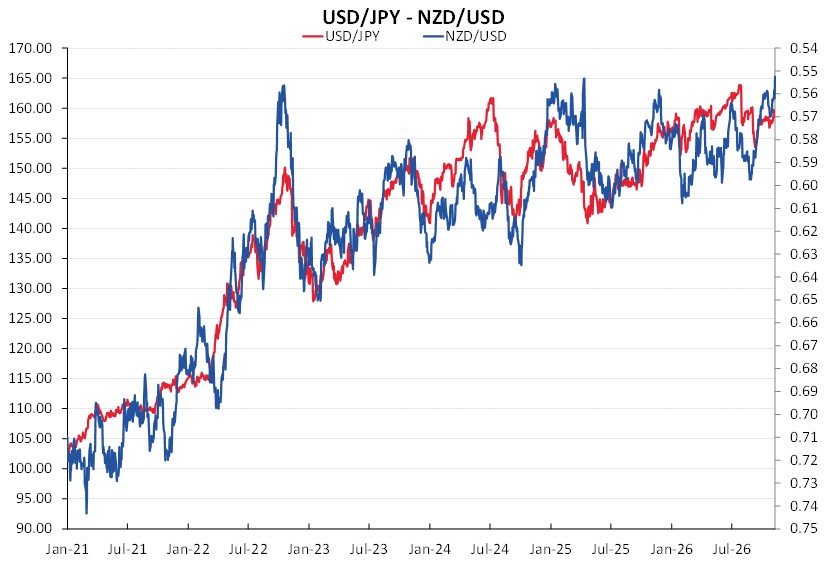
Japan’s top currency diplomat, Atsushi Mimura warned FX market participants last Thursday that it is “too early to forget” last summer’s intervention, as the Japanese Yen exchange rate edged towards the key level of 160.00 against the USD. That was a warning shot aimed at the FX markets in an attempt to halt the latest Yen selling. The question the FX markets are now asking is whether the US Government will again support the Japanese authorities with direct intervention in the USD/JPY exchange rate to stop the Yen depreciating, as they did back in July and August. The Japanese Finance Minister, Satsuki Katayama has stated that they stand ready to act again after that record US$96 billion intervention in July/August. It is now transpired that the US contribution to the July/August joint currency market intervention was much less than the US$10 billion amount Treasury Secretary, Scott Bessent wrote on his notepad as an action reminder. In reality, the US Government only sold the Euro equivalent of US$0.50 billion to buy Yen at the time. The markets are reading that the limited support from the US last time means that there is less chance of the Japanese being successful with intervention this time around.
Japanese inflation is on the increase again (very similar to New Zealand) with higher oil prices in October and a lower currency value against the US dollar. The Bank of Japan has been slow to hike interest rates this year (again similar to New Zealand); however, they will be increasing their official interest rate by 0.25% to 1.50% when they meet on 18th December.
The USD/JPY rate of 160.00 remains as a key level to trigger intervention again from the Bank of Japan. However, they have to pick their timing carefully to catch the FX market heavily oversold the Yen to have maximum impact. Should the Japanese succeed with intervention to prevent the Yen weaking above 160.00 and turn it around to move towards 155.00and 150.00 again over coming weeks, the Kiwi dollar might find some support from a source not typically focused on by the FX markets.
Daily exchange rates
Select chart tabs
*Roger J Kerr is Executive Chairman of Barrington Treasury Services NZ Limited. He has written commentaries on the NZ dollar since 1981.
We welcome your comments below. If you are not already registered, please register to comment
Remember we welcome robust, respectful and insightful debate. We don't welcome abusive or defamatory comments and will de-register those repeatedly making such comments. Our current comment policy is here.