

Summary of key points:
- US Fed members feeding market volatility, the opposite to what Chair Warsh wants
- Oil prices still hold the key for US inflation, interest rates and the dollar
- Trans-Tasman tables turn
A major reform and new initiative Kevin Warsh introduced to the US Federal Reserve, when he commenced his term as Chair back in May 2026, was to stop the Fed providing “forward guidance” to the markets in respect to what their strategy was with monetary policy settings and the trends in the economy they were watching that would force a change in monetary policy.
By making this fundamental change to the Fed’s operations and relationship with the markets, the Fed wanted the markets responding to economic data as it evolved, rather than the markets looking to the Fed and its interpretation of the economic data. We highlighted at the time in this column that one likely result of the forward guidance change was increased volatility in interest rates and the US dollar exchange rate as the markets reacted, over-reacted and under-reacted to US economic data as it was released. Attempting to figure out how the Fed see the data trends remains as important as ever.
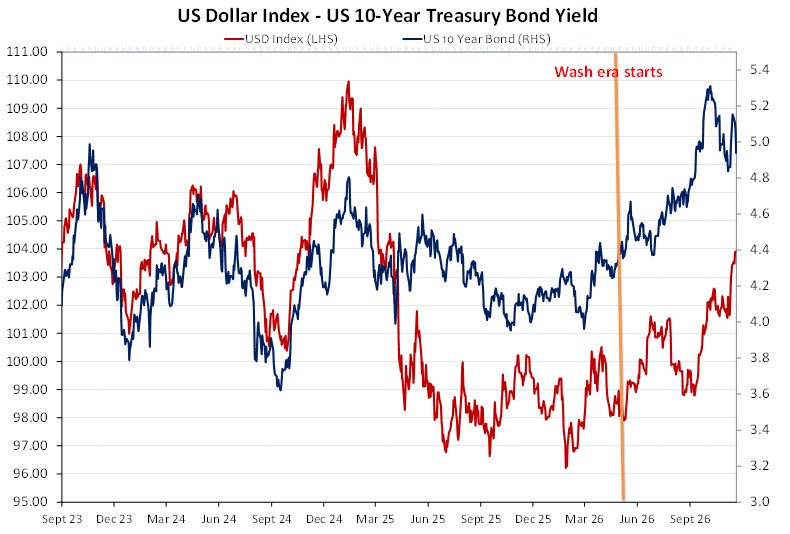
We have certainly seen an increase in volatility in the US bond market with rapid and extensive increases in bond yields through August/September, a major correction back down in October and then higher yields again over recent weeks. The bond market has been reacting to oil price movements, US inflation figures and increased demand for debt by the builders of data centres for the AI revolution. Through all the middle of those bond market pressures is highly leveraged position-taking by hedge funds as they lay down bets on the next big move in bond yields. The bond market is lurching around from one economic release to the next with no guiding hand of the bigger picture of the US economy and their inflation rate.
Fed Chair Kevin Warsh in changing the Fed’s “modus operandi” by abandoning forward guidance to the market on likely future interest rate change also wanted his fellow Fed members talking less about the subject.
Unfortunately, his fellow central bankers seem to be talking more and that is adding to the market volatility.
According to the Bank of America there has been more “Fedspeak” over the past two weeks than in any similar periods since the start of 2025. Warsh has talked about “settling family fights” within the Fed, however he cannot be that happy at the explosion in public comments about monetary policy and interest rates by his colleagues.
The US dollar appreciated sharply last week following a speech in London by Fed voting member Christopher Waller. Mr Waller raised the possibility of the Fed hiking interest rates by 0.50% at the next meeting on 9th December. Other Fed members Beth Hammack and Austan Goolsbee made similar hawkish comments, adding to the US dollar’s upward momentum as the interest rate market priced-in an increasing probability of four 0.25% rate hikes over the next nine to 12 months. What was really surprising about Waller’s view on more aggressive monetary tightening was that he has a reputation as a “dove” within the Fed, being more caution about interest rates increases. Instead of the markets reacting to the emerging economic data as Warsh wants to see, the bond and FX markets are reacting to the extreme and often changeable views of his colleagues at the Fed.
It is difficult to see Chair Warsh supporting a 0.50% hike at the next meeting, therefore we should anticipate some unwinding of the US dollar buying to 103.80 on the Dixy Index ahead of, and after, the 9th December Fed meeting. It is also surprising that the currency markets have continued to buy the US dollar when oil prices have reduced so sharply from US$104/barrel to US$83/Barrel (down 20%) over the last three weeks. The much lower oil prices will be feeding into significantly lower gasoline prices at the pump through November, potentially resulting in very low or negative CPI inflation numbers for the months of November and December. The lower oil prices take the pressure off US inflation outcomes and should be forcing lower inflation forecasts by market economists. Therefore, given the time of year as well, we would anticipate a reversal of the US dollar gains in the weeks ahead leading up to Christmas.
The NZD/USD exchange rate has been forced to record lows at 0.5470 by the stronger US dollar and significantly weaker Australian dollar (for its own independent reasons). A belated recognition by the FX markets of what the lower oil prices means for US inflation over coming months should work to prevent the Kiwi dollar going any lower.
Oil prices still hold the key for US inflation, interest rates and the dollar
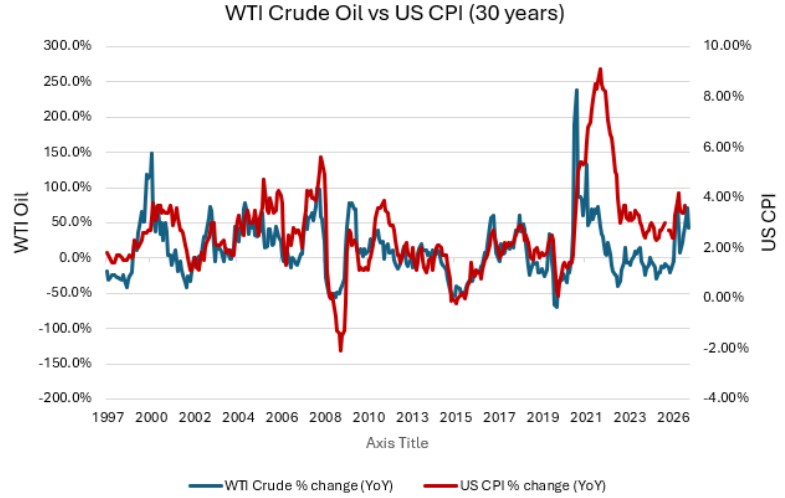
For an economy that is entirely dependent on fuel to move people and goods, it is no surprise that US inflation is highly correlated to oil price movements. The first chart below plots WTI oil prices (percentage change) with US CPI inflation over the last 30 years. Whilst housing costs (shelter) have a dominant weighting in the CPI Index, it is fuel costs for vehicles, airplanes, trains and heating that seems to move the dial on US inflation outcomes.
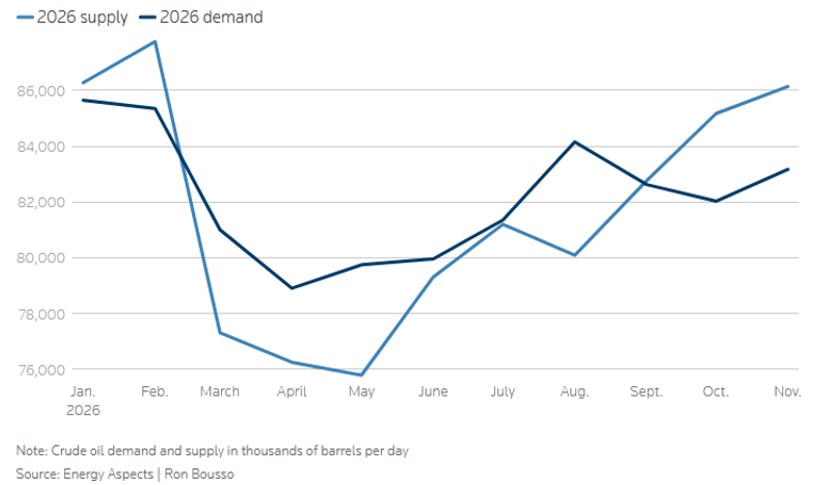
The second chart plots the demand and supply measures for crude oil over the course of this year. Global supply is now exceeding demand as oil tanker shipments through the Strait of Hormuz return to levels prevailing before the Iran/US war started in February. The plummet in oil prices over recent weeks is reflecting this dramatic shift in the demand/supply equation.
WTI oil prices seem to us to have a greater probability of continuing their recent slide over coming weeks/months, potentially moving well below US$80/barrel towards US$65/barrel where oil was trading before February. President Trump has not recommenced the missile attacks into Iran as he indicated he would do after the mid-term elections were over. The global geo-political risks are reducing, and the lower oil prices are representative of that change.
A return to US$65/barrel would see oil prices decreasing 38% from their US$104/barrel high in October. The blue line of WTI crude oil on the first chart will then be moving straight down to below 0% change. Such a shift (if it eventuates) points to US CPI inflation moving closer to 2.00% than staying at 3.50% into 2027. The FX markets and the Fed members cannot ignore for much longer the big influence of oil prices on US inflation.
Watch this space!
Trans-Tasman tables turn
The NZD/AUD cross-rate has moved higher over recent weeks as the Kiwi dollar outperforms the Aussie dollar against the stronger US dollar. The NZD/AUD exchange rate lifting from trading below 0.8000 at the end of October to 0.8265 currently. All the factors that caused the impressive gains in the Australian dollar earlier this year are now turning the other way and conspiring against it: -
- Australian interest rate markets are now pricing-in cuts by the RBA by mid-2027 as employment slumps and economic growth falters. The risk of higher inflation, that the RBA has been so concerned about, is now much reduced as the economy abruptly slows.
- The prices of Australia’s key commodity exports are falling away with iron ore, copper and gold all reversing downwards.
- House prices are also slumping as mortgage borrowers struggle with sharply rising interest rates.
Once seen as an attractive high yielding currency, the Aussie dollar is now being dumped by global investors and traders. The AUD/USD exchange rate has plunged six cents (8.30%) from 0.7220 in early September to 0.6620 at the Friday market close on 20th November. Over the same period the NZD/USD rate has depreciated just over four cents from 0.5900 to 0.5470.
The tables have certainly turned in the trans-Tasman comparison between the two economies and the two currencies. The New Zealand economy, driven by record high export prices and slowly improving consumer spending, looks set to expand at a +3.00% GDP growth rate in 2027. In contrast, the Australian economy is forecast to grow by somewhere between 1.00% and 1.70% in 2027 (RBA, OECD and bank forecasts). The interest rate differential between the two currencies, which widened out to NZ two-year swaps rates being 1.30% below those in Australia earlier this year, is expected to close-up rapidly over coming months as the RBNZ hikes rates again and the markets price-in cuts in Australia. The two-year interest rate swap differential could move back to 0.00% within a few months with NZ interest rates increasing to 4.20% (from 3.85%) and Australian two-year swap rates decreasing from the current 4.80% to 4.20%.
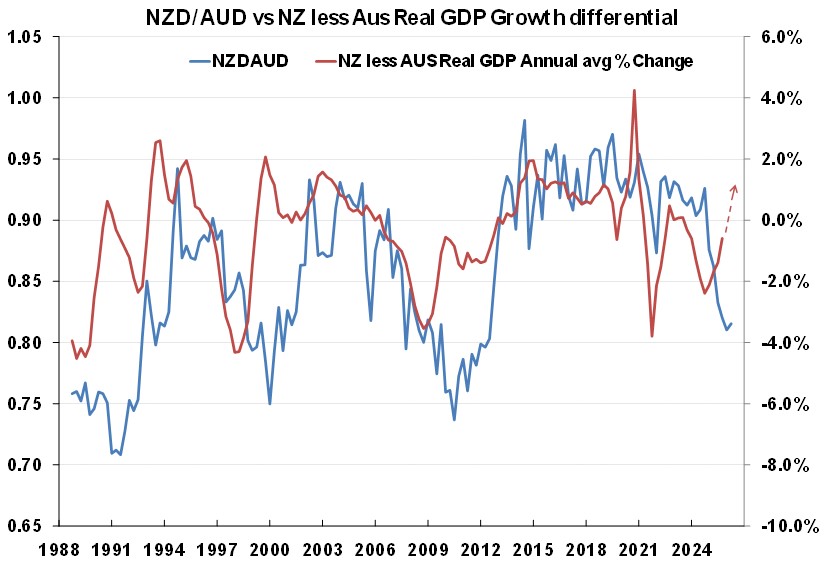
New Zealand’s GDP growth rate has been below that of Australia’s over recent years (red line below zero on the right-hand axis in the chart below). As a consequence, their inflation rate and interest rates have been higher. The New Zealand underperformance is now rapidly changing with our GDP growth likely to be close to 1.50% above that of Australia next year. The correlation between the NZD/AUD exchange rate and the GDP growth differential points to the NZD/AUD cross-rate returning to above 0.9000 in 2027.
Global FX markets have now returned to holding large “long USD” speculative positions in the expectation of several more interest rate hikes by the Federal Reserve. Continuing declines in crude oil prices and book-squaring before the end of the year by FX market participants may well see the US dollar give back some of its recent gains. Under this scenario, both the NZD and the AUD will recover back up against the USD, however the NZ dollar is expected to be preferred over the Australian for the reasons explained above. A key prerequisite for the NZ dollar finding a bottom against the USD and recovering higher is the NZD/AUD cross-rate turning around in direction. It now looks like that is happening with New Zealand’s superior economic performance being recognised as the Australian economy suffers a rare downturn.
An important aspect of the NZ dollar gaining an advantage over its Australian counterpart will be the RBNZ returning to a more definitive and stronger stance on adjusting monetary policy to neutral settings from the continuing loose settings at a 2.75% OCR interest rate. The RBNZ Monetary Policy Statement on 9th December needs a firmer theme of controlling inflation, moving away from the overly cautious and uncertain tone of the RBNZ statements of 2nd September and 28th October.
Daily exchange rates
Select chart tabs
*Roger J Kerr is Executive Chairman of Barrington Treasury Services NZ Limited. He has written commentaries on the NZ dollar since 1981.
We welcome your comments below. If you are not already registered, please register to comment
Remember we welcome robust, respectful and insightful debate. We don't welcome abusive or defamatory comments and will de-register those repeatedly making such comments. Our current comment policy is here.