
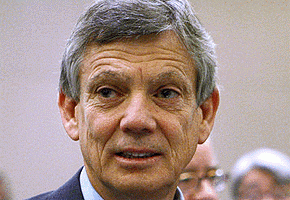
The case is growing for the Reserve Bank to cut the Official Cash Rate (OCR), although the New Zealand dollar will first have to rise further and the housing market stall, BNZ head of research Stephen Toplis says.
Markets were this morning pricing in about a 90% chance of the Reserve Bank cutting the OCR from its record low 2.5% sometime within the next year. Despite this, BNZ economists put the chance of a cut at 35%, reinforcing their view the OCR would stay on hold until December 2013.
While the vast majority of economists at the major banks and economic forecasting agencies are picking the OCR to stay on hold until the end of 2013 or early 2014, more talk is emerging of a possible cut before then.
The high New Zealand dollar, while hurting export returns, has kept pressure off the prices of imported goods. Consumer Price Index inflation figures to be released on Tuesday are expected to show a 1% rise in the year to September, according to a Bloomberg poll. That would be the same reading as in the year to June, and be right at the bottom of the Reserve Bank's 1-3% CPI target band.
However, most economists point to emerging price pressures from the Canterbury rebuild, rising commodity prices, and a resurgence in the housing market as reasons why the next move in the OCR will be a hike, not a cut.
The Official Cash Rate is closely correlated with floating mortgage rates and a cut in the OCR should be followed by a corresponding cut in these rates (although perhaps by not as much - see Gareth Vaughan's June article, Reserve Bank gives banks carte blanche to 'decouple' floating mortgage rates from the OCR; Says bank funding costs no longer tied to OCR and swap rates).
Banks have been fighting hard to undercut each others' fixed rates recently as they compete for market share. However, a quiet spot has been with floating rates, which have averaged about 5.75% all year.
Cut more likely
BNZ economist Stephen Toplis said on Monday that as each day passed, the green light allowing the Reserve Bank to lower the OCR grew ever brighter.
A very weak Performance of Manufacturing Index last week, followed by today’s weak Performance of Services Index, intimated that GDP figure for the September quarter might print very poorly indeed, he said.
"Consensus forecasts for global growth remain under pressure and, importantly, the demise of the western world is now having a very clear impact on emerging markets. The Australian economy is looking demonstrably shaky, resulting in grief for domestic manufacturers, and the RBA is easing," Toplis said.
"The NZD TWI sits stubbornly 1.4% above the RBNZ’s assumed Q4-average. And the annual CPI is about to print below the bottom edge of the RBNZ’s 1-3% target range. We, thus, now put the probability of an easing as high as 35%."
Toplis highlighted a number of factors currently stopping the Bank from cutting the OCR:
- While the global environment looks ugly, there are indications that Europe is stabilising and the first signs that the Chinese expansion may be rejuvenating;
- The currency might be higher than assumed but dairy prices are again rising and the overvaluation (relative to the Reserve Bank’s assumptions), is, at this stage, modest;
- The housing market continues to gain momentum;
- The medium term outlook remains for heightened inflation;
- The Christchurch earthquake rebuild appears to be starting in earnest;
- There are the first signs of credit growth; and
- The new Reserve Bank Governor has barely got his feet under the table and will not be keen to wave his wand until he knows exactly what he is waving it at.
"So we stick with our view that rates are on hold for some time to come but warn that the downside risk should not be ignored. The market certainly isn’t ignoring it, now pricing in around an 85% chance of a cut over the coming 12 months," Toplis said.
"It’s been pricing in a reduction in rates consistently for much of the last year and we have railed against it. While we think the odds are overdone, the situation has certainly changed sufficiently for us to be much less aggressive in our dissension," he said.
NZ$ will have to rise, housing market stall
For BNZ economists the catalyst for an easing was continued appreciation in the New Zealand dollar, accompanied by a stalling in the domestic housing market.
"Symptomatic of our softer view of the world, we have used this morning’s Performance of Services Index as the catalyst to lower our Q3 GDP forecast to 0.3% from 0.5%. The PSI slipped to 49.6 from 50.0 at a time when the PMI remained well into negative territory," Toplis said.
"In combination these indicators, by themselves, foretell annual GDP growth falling to near zero before year’s end. We simply don’t believe this but are loath to disregard the indicators completely – hence, our downward adjustment. We’ve also taken a point out of Q4 GDP bringing it back to 0.6% from 0.7%," he said..
"Be that as it may, this has limited immediate implication for our short term interest rate view. Cumulatively, we still have growth of 0.9% for the second half of this year compared with the Reserve Bank’s 0.8%."
Govt surplus under threat
"It’s also not that different to Treasury’s view of the world though we still believe that medium term growth will fall short of Treasury’s expectations leaving revenue flows shy and the 2014/15 surplus objective under threat," Toplis said.
"Tuesday’s Q3 CPI report may well announce the first time that annual CPI inflation has ever fallen below the bottom edge of the Reserve Bank’s target band. We are forecasting 0.4% for the quarter, 0.9% for the year," he said.
"We expect significant downward pressure on prices (or outright deflation) from the clothing and footwear group, household contents and services, and telecommunications. In contrast, prices in the food group and housing are expected to be up relatively sharply.
"The RBNZ has 0.5% for the quarter so a reading akin to our own will, again, have little impact on the Bank’s view of the world."
Dairy prices rising again
One of the factors preventing the RBNZ from easing had been the recent resurgence in dairy prices.
"Generally, we expect dairy prices to rise further, over time, driven by ongoing issues around the US drought. However, any move in world prices need to be weighed up against currency fluctuations to assess domestic cash flows," Toplis said.
We welcome your comments below. If you are not already registered, please register to comment
Remember we welcome robust, respectful and insightful debate. We don't welcome abusive or defamatory comments and will de-register those repeatedly making such comments. Our current comment policy is here.