

Well, it's time to take the pulse of the nation again and see if that economy of ours really is recovering. In truth, we might not yet get a definitive answer.
Stats NZ will be releasing GDP figures for the December quarter on Thursday, March 19.
And, yes, we can trot out the usual complaints about these figures being very late, coming out as they will almost at the end of the following quarter.
But they are what we have and obviously what we are looking for is signs that the fledgling economic recovery is taking hold.
Our recent pattern with the GDP figures has been very up and down, with large swings from plus to minus growth between quarters.
Economists have their views about what might be behind this pattern, and it is clear that our GDP figures have for whatever reason become a lot more 'seasonal' - when of course they are not meant to be. The whole point is that the seasonal adjustment process is supposed to cut through the impacts of seasonal variation to give us and apples v apples comparison between the quarters.
I had only two of the major bank economists' previews in front of me at the time I wrote this (BNZ and ANZ), but it appears from what I can see so far that the latest (December) quarter may again show that up and down pattern. Indications are that the December quarter might - so far as these Stats NZ figures tell us - have seen the economy somewhat 'stall' again.
If we recall, the outcome in the September quarter (reported in December) was a strong 1.1% rise, following a 1.0% (revised) fall in June.
This is the picture the Stats NZ figures are currently painting for the recent past of NZ's GDP:
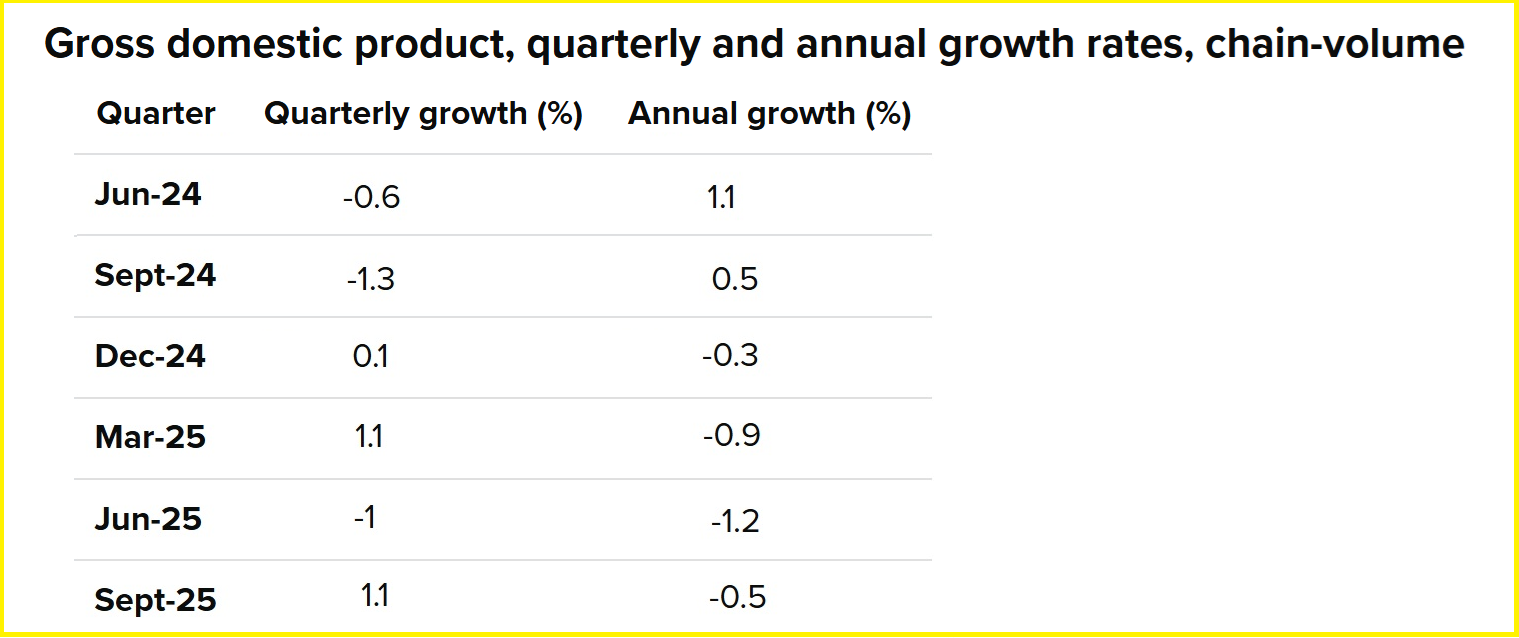
You can see that things have been very up and down.
The economy had the stuffing knocked out of it during the 2021-23 period in which the Reserve Bank (RBNZ) was raising the Official Cash rate from just 0.25% in the pandemic to a peak of 5.5%. This was of course all in aid of getting rampant inflation, which peaked at 7.3% in mid-2022, back under control.
The RBNZ (having pushed inflation back into the targeted 1%-3% range) began cutting the OCR again in August 2024. It's fair to say though that for a lot of time after that expectations of a pending economic recovery ran ahead of the reality. Business confidence surveys kept suggesting that businesses were seeing better times ahead - but those times were never quite arriving.
As a nation we simply seemed to have got out of the habit of spending. And, of course, if we don't spend, the wheels of the economy don't turn.
By the middle of last year there was a clamour for the RBNZ to accelerate its OCR cuts, in order to provide more impetus for a recovery.
Regardless of whether you thought it necessary or not at the time, (and I have to say I didn't actually agree with the move), the RBNZ's decision to do a jumbo 50 basis point cut to the OCR in August last year did seem to cheer everybody up, which was the clear intention.
Less intended though, of course, might have been what happened after the November OCR decision, when the RBNZ did, yes, cut the OCR again, but also indicated that the cut was likely the last one. The subsequent sharp rise in wholesale interest rates, accompanied by some mortgage rate rises, certainly appeared to knock the stuffing out of the housing market at the end of last year.
A recovery without houses?
And of course, the housing market has been largely missing in action. And one of the emerging themes has been can New Zealand have a meaningful economic recovery without a housing market boom?
Anyway, notwithstanding some renewed hesitancy caused by the end of interest rate falls, the general signs in the economy have been good. There are signs of the return of spending. But it's all still looking a bit uneven.
The RBNZ in its February Monetary Policy Statement (page 40), forecast a 0.5% rise in December quarter GDP, followed by a 1.1% rise for the March quarter we are currently in. The RBNZ's economic modelling 'Nowcast' forecast was, at time of writing, forecasting a rise of just a little under 0.5% for the December quarter.
As usual, we've had some clues ahead of time as to at least the direction of the figures principally through the key three so-called 'partial indicators'.
It's probably fair to say the results of all three have been a surprise - one pleasant surprise, two not so. And that's what is leading me to think that the apparent momentum shown (at least by Stats NZ figures) in the September quarter may be shown to have nearly stalled in December. Here is how the three 'partial indicators' turned out.
• Retailers have had a tough time but things are turning for the better. The 0.9% rise in volumes in the December quarter followed a particularly strong 1.9% rise in the September quarter and provides further evidence that the under pressure retail sector is beginning to recover as the economy strengthens.
• The volume of total manufacturing sales fell 0.5% in the December quarter, following an upwardly adjusted 1.2% rise in the September quarter. Wholesale trade sales rose a seasonally adjusted 1.1% in the December quarter after an upwardly revised 2.9% in the September quarter.
• The seasonally adjusted volume of building work done in the December quarter fell 3.1% compared with the September 2025 quarter, with residential falling 1.1% and non-residential down 6.5%. These figures were definitely an unpleasant surprise to economists. Adding to the unpleasant surprise was the revising down of the September 2025 figures from an originally reported 1.5% growth to a rise of just 0.2%.
Okay, so what to make of all that?
The economists speak
Well, BNZ senior economist Doug Steel is picking a 0.3% rise in GDP for the December quarter.
"It isn’t particularly strong, but it would be the second consecutive quarter of growth and support our thinking that a modest economic recovery was getting underway in the latter part of 2025," Steel said.
"If we are right then Q4 GDP will be softer than the 0.5% that the RBNZ projected in its February MPS.
"This would add to a theme of growth indicators looking softer than the RBNZ expected, while inflation indicators are looking higher than the Bank [RBNZ] projected. And, of course, all this is before the recent mayhem in the Middle East erupted, which is likely to reinforce the theme further. It presents a difficult balance for the Bank to assess from a policy perspective."
ANZ senior economist Matthew Galt is picking a 0.2% rise.
"The sectoral data released over recent weeks has come in weaker than earlier leading indicators had suggested, prompting us to revise down our forecast to 0.2% q/q (from our preliminary forecast of 0.7% q/q)," he said.
"Construction and food manufacturing activity over Q4 in particular fell short of our expectations. This may be down to a combination of house prices staying flat, lags in building activity, and quarterly volatility in meat processing. Indicators for a few services industries, such as professional services and wholesale trade, were also weaker than we had expected.
"However, the broader suite of sectoral data points to moderate growth across other parts of the economy in Q4, underpinned by rising spending in response to lower interest rates, solid farm incomes, and growth in tourism."
Galt said "a downside surprise" to the RBNZ’s GDP forecast of the size that the ANZ economists are forecasting would have only have a small impact on the RBNZ’s thinking.
"GDP data is lagged, telling us how the economy was during the October to December period (now three to five months ago). It has also been volatile lately and is prone to revision.
"What’s more, it covers a period well before the current conflict in the Middle East broke out and oil prices spiked, which is the biggest uncertainty in the economic outlook right now."
Bring on the next one...
Okay, if we assume the December quarter GDP figures do show slight growth, but slower than the September quarter, what of the current March quarter?.
As per its February MPS forecast, the RBNZ was expecting good things this quarter with its 1.1% growth pick. But the open question is how much the Middle East conflict has knocked and will continue to knock things back.
Ultimately it all depends how long the Middle East situation rumbles on for. Certainly with our annual inflation having been sitting at 3.1% in the December quarter - so, outside the RBNZ's 1% to 3% target range - we've got little room to move.
The other side to that though is whether the uncertainty may just cause people to go back in their shells again and causing the economic recovery to wither.
And if the December quarter GDP outcome turns out to be not particularly good, will that cause a knock to confidence and hesitancy with spending?
The upshot is that our economy is, for the moment, actually looking in reasonable shape (finally) for a decent sort of recovery to develop. But this whole Middle East situation is once again a stark reminder of how small we are and how easy it might be to blow us off course.
*This article was first published in our email for paying subscribers early on Friday morning. See here for more details and how to subscribe.
We welcome your comments below. If you are not already registered, please register to comment
Remember we welcome robust, respectful and insightful debate. We don't welcome abusive or defamatory comments and will de-register those repeatedly making such comments. Our current comment policy is here.