

Summary of key points: -
- Pullback in the US dollar value expected to be short-lived
- No surprises expected from this Wednesday’s inflation numbers
- Lack of skilled immigrants hurting the NZ economy
Pullback in the US dollar value expected to be short-lived
Until a week ago, the expected trend of a stronger US dollar against the Euro on global FX markets was very much on-track with increasingly stronger US economic data propelling the EUR/USD rate from $1.2300 in January to $1.1720 on 30 March.
The pullback in the USD to $1.1980 over this last week does not represent a fair or accurate reflection of the current economic performance of the US compared to Europe.
As anticipated, all US economic data has printed on the stronger side with March numbers for retail sales, manufacturing, employment, consumer confidence and housing all well above prior forecasts.
Listed companies’ earnings reports have all been stronger on Wall Street as well, underpinning and evidencing the impressive recovery in the US economy at this time. Whilst some business confidence measures in Europe have improved, March and April economic activity is again suppressed by partial Covid lockdowns.
Over coming months with the rapid vaccine roll-out in the US allowing inter-state travel and family vacations for the first time in a year, the leisure, hospitality, hotel and gaming industries will be dramatically rebounding in terms of economic activity. In turn, that means large increases in re-employment in the lower-end jobs that were laid-off when the Covid pandemic struck last year. Watch out for the Non-Farm Payrolls jobs increase for the month of April to be a “whopper” when the data is released in the first week of May.
What caused the USD selling against the Europe that drove the rate up from $1.1800 to $1.1980 last week was a downward correction in US 10-year Treasury Bond yields.
The 10-year yields reducing from above 1.75% to 1.55% and therefore reducing the margin over the European bond yields and making the USD relatively less attractive. The dramatic increases in US bond yields this year being the main reason why the US dollar has been stronger against the Euro.
The Federal Reserve was partially responsible for causing the reversal back to 1.55% in bond yields as they reiterated their commitment to keep their monetary stimulus at current levels for a considerable further time yet.
That was hardly fresh news for the bond market, however after the steep climb in yields from 0.90% in early January to 1.75% at the end of March, the market was overdue for a correction on profit taking (by those that had short-sold bonds).
In the author’s view, nothing more should be read into this decrease in US bond yields other than a natural market correction following very large and rapid movement. Already the 10-year bond yield has lifted to 1.59% and further increases over coming weeks/months look likely as upcoming economic data releases confirm to speed and strength of the US recovery.
The recent reversal in bond yields is therefore expected to be short-lived, and thus the reversal in the EUR/USD rate to $1.1980 is also expected to be not that long lasting. There is considerable technical/chart resistance at the $1.2000 level that should hold.
The consequential conclusion from this analysis is that the spike upwards in the NZD/USD exchange rate last week to 0.7175 will also be very short-lived. A return of the EUR/USD rate to $1.1700 would see the NZD/USD reverse from the current spot rate of 0.7150 to 0.6950. Importers in USD should be taking advantage of this temporary blip and exporters can afford to be patient and stick with their orders to sell USD/buy NZD from 0.6950 downwards.
No surprises expected from this Wednesday’s inflation numbers
Do not expect any fireworks in the local financial markets from Wednesday’s CPI inflation numbers for the March quarter.
The price increases occurring across the economy have been well signposted and are expected. Inflation is forecast to increase by 0.80% over the quarter, however the annual inflation rate will remain stable at 1.50% as a large 0.80% increase recorded in the March 2020 quarter drops out of the figures.
Supply chain disruptions and increased freight costs will be behind the price increases in consumer goods, whilst electricity, rents, rates and commodity prices are all increasing.
The RBNZ are forecasting a 1.00% increase for the March quarter, a result below that may well be interpreted by the financial markets as slightly negative for the Kiwi dollar.
Whist there is no debate about what is causing the current increase in the inflation rate, the real debate is whether the price increases are merely caused by temporary factors (the RBNZ’s view) or whether they will be more permanent. Higher costs and prices feeding on themselves become permanent when the economy is strong, and demand outweighs supply.
For a variety of reasons the NZ economy is about to experience a double-dip recession following the Covid shock 12 months ago.
As we have stated previously, the export sector saved the NZ economy last year, however exporters are currently facing several business challenges that do not suggest continuing increases in production and investment.
Shortages of containers to ship the goods and shortages of skilled labour to produce the goods being the large and obvious impediments for our exporters. Local consumers had their splurge last year and this winter they will be spending their money on Australia holidays.
For these reasons, the near-term outlook for the NZ economy has turned decisively more negative, and thus the RBNZ may prove to be correct with their temporary inflation view as demand wanes. Therefore, the 26 May RBNZ monetary policy statement is expected to be more on the dovish side on the economic outlook than the neutral tone delivered by Governor Orr last week. The RBNZ will not be delivering to their employment growth target requirement if the economy is going backwards.
Lack of skilled immigrants hurting the NZ economy
It has become increasingly obvious over recent months that the current Labour Government is not up to the task of delivering/executing economic policy initiatives to invigorate the economy in the post-Covid era. There is a growing realisation that New Zealand is now rapidly falling behind other countries on the vaccine roll-out, opening its borders and returning the economy to a sustainable growth trajectory. The contrast between the current US and New Zealand economic trends is stark, worrying and negative for the NZ dollar.
What has become very evident over recent months is how dependent the NZ economy is on skilled immigrant labour.
The strong immigrant inflows over the years before Covid was due to New Zealand businesses demanding skilled people from offshore as they were not available locally.
The Labour Government had a policy to reduce immigrant inflows, which would have hurt the manufacturing and primary industry export sectors. Today, the Government displays absolutely no urgency in getting the nation vaccinated as soon as possible so the borders can re-open, and our export industries can maximise their potential with full workforces. Local technology companies like Vend and Seequent which were recently sold for extraordinary figures would not have grown their software solutions/products and global businesses if they did not have access to skilled and talented immigrant workers.
It is a sad indictment on the NZ economy when the outlook is negative despite the milk price being near to record highs above $7/kg milk solids for dairy farmers.
Instead of recognising the restrictions on our export industries and doing something pragmatic about it, the Ardern Government is sticking to their political ideology of redistributing the pie (instead of growing the pie) and running interference/intervention (Grant Robertson’s letter to Air New Zealand).
Global investors and traders will be recognising the lack of action and urgency by the NZ Government and in the short to medium-term this adds to the weaker Kiwi dollar outlook.
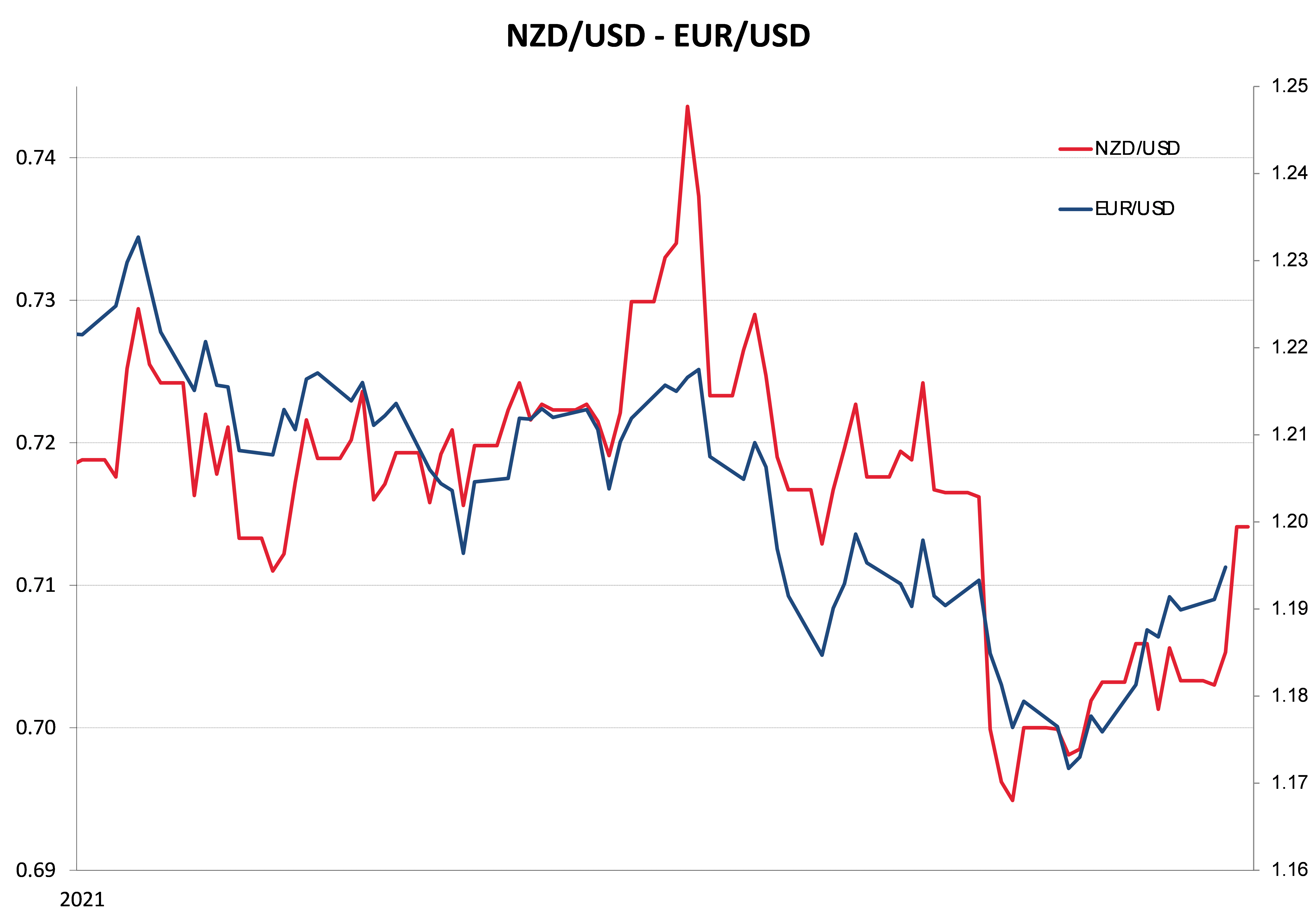
Daily exchange rates
Select chart tabs
*Roger J Kerr is Executive Chairman of Barrington Treasury Services NZ Limited. He has written commentaries on the NZ dollar since 1981.
We welcome your comments below. If you are not already registered, please register to comment
Remember we welcome robust, respectful and insightful debate. We don't welcome abusive or defamatory comments and will de-register those repeatedly making such comments. Our current comment policy is here.