

Summary of key points: -
- Impressive US jobs data has the stronger greenback trend back on track
- RBNZ to look beyond the short-termism of the local financial markets
- Debt funded “fool’s paradise” economy, will ultimately be paradise lost!
Impressive US jobs data has the stronger greenback trend back on track
The New Zealand dollar has already given back most of its gains of last week when a spectacular local employment figures propelled the NZD/USD rate up to 0.7085, its highest level since mid-June.
The strong jobs numbers for the June quarter, following higher GDP growth and inflation outcomes over recent weeks, was certainly positive news for the Kiwi dollar. It built in a total certainty (in the financial markets’ eyes) that the RBNZ will be the first central bank in the world on 18th August to increase interest rates in the post-Covid era.
The NZD/USD has yet again retraced lower to 0.7010 due to a stronger US dollar in global currency markets.
A higher than forecast increase in US jobs of 943,000 over the month of July released on Friday 6th August has sent the EUR/USD exchange rate back below $1.1800 to $1.1760.
The stronger pathway for the US dollar that this column has consistently expected through the middle of 2021 is now back on track following the disappointment of the lower than forecast +6.5% GDP growth result for the June quarter.
The massive return of workers in the leisure and accommodation sectors in the US economy was no great surprise as high Covid vaccination rates (in most states) allows the US economy to return to some form of normalcy.
The job numbers provides more ammunition to the case that the US Federal Reserve will very soon have to signal a progressive tapering back of their bond buying (money printing) programme as the economy is expanding on its own and no longer needs that monetary stimulus.
Watch for the US dollar to post further gains to $1.1600 against the Euro over the next few weeks as the FX markets anticipate a clear message from Fed Chief Jerome Powell at the Jackson Hole central banker’s symposium in late August that the US can now start unwinding their extraordinary monetary stimulus. In the absence of any further positive factors for the NZ dollar in its own right over coming weeks, a push to $1.1600 in the EUR/USD rate would pull the NZD/USD down to 0.6900.
RBNZ to look beyond the short-termism of the local financial markets
The local interest rate market has priced-in successive OCR increases over coming months and thus the Kiwi dollar has strengthened on its own accord due to the widely anticipated decision by the RBNZ on 18th August to increase the OCR.
As a result, at 0.7010, the NZD/USD exchange rate is one cent higher than where it would otherwise be trading on offshore USD and AUD movements.
The 0.25% OCR increase is therefore already fully priced into the NZ dollar exchange rate at 0.7010, further gains will only be minor when the RBNZ deliver to the expectation.
What will be more important to the future direction of the Kiwi dollar will be the commentary from the RBNZ on how they see the NZ economy tracking over the next six to 12 months.
All the bank economists see the NZ economy as currently overheating on strong increases in consumer spending, house prices and jobs. They are demanding immediate and substantial interest rate increases from the RBNZ so that the inflation is brought under control.
However, the banks are taking a very short-term view of New Zealand’s economic position. They are also not considering the significant risks in respect to the rapid spread of the delta Covid variant that is currently severely impacting the Australian economy.
A medium to longer term perspective on the NZ economy would incorporate the following counter-balancing arguments: -
- The strong consumer spending is entirely due to rising house prices (i.e. debt funded), lower mortgage interest rates and closed borders that are preventing households from spending on overseas travel/holidays. All three factors behind the retail splurge may be quite different in six months’ time. Hopefully, the RBNZ will also be looking a bit further ahead and assessing these likely changes.
- The very low unemployment rate of 4.00% has largely resulted from the closed borders to much needed immigrant labour. Whilst the Government has no plans or solution to alleviate this labour crisis, economic output will be constrained. The RBNZ should be adjusting their GDP growth forecast for 2022 lower due to this situation.
- The sharp pullback in oil and commodity prices over recent times does support the argument that part of the current high inflation may indeed be temporary/transitory. It would be unwise of the RBNZ to suddenly abandon their earlier stance to “look through” inflation increases that are caused by global forces outside their control. The supply chain, freight and shipping contribution to the higher inflation is however not temporary, but again outside anything the RBNZ can influence with monetary policy.
So, even though the RBNZ will probably go through with their 0.25% OCR increase on 18th August, their economic outlook should be much more clouded and uncertain than the financial markets currently expect. The implications for the value of the NZ dollar are therefore perhaps not as positive as an interest rate hike would typically suggest.
Debt funded “fool’s paradise” economy, will ultimately be paradise lost!
Looking back (in convenient hindsight!) over the last 12 months it has become clear that Adrian and Grant have both overcooked the economic stimulus and now face tough decisions to rein it back in.
The RBNZ have commenced that process and it is important that they do it in a measured way that does not send the economy spiralling the other way.
There is far less confidence that Finance Minister, Grant Robertson will pullback on his fiscal largesse anytime soon. The Covid economic emergency last year allowed the Labour government to enhance its political populism by splashing cash into the economy.
What is all too often forgotten is that the money is all borrowed and therefore the government must have a plan to grow the economy to generate the tax revenue to repay the debt.
There is no sign that this Government has any such plan.
In the end, offshore investors and agencies will observe that New Zealand’s current economic performance is too reliant on debt, we are too slow to vaccinate, and this “fool’s paradise” syndrome will ultimately bite us in the bum.
The conclusion for the exchange rate outlook is that the NZ dollar is unlikely to appreciate on its own bat, a higher NZD/USD rate next year will be entirely due to a weaker US dollar against all currencies.
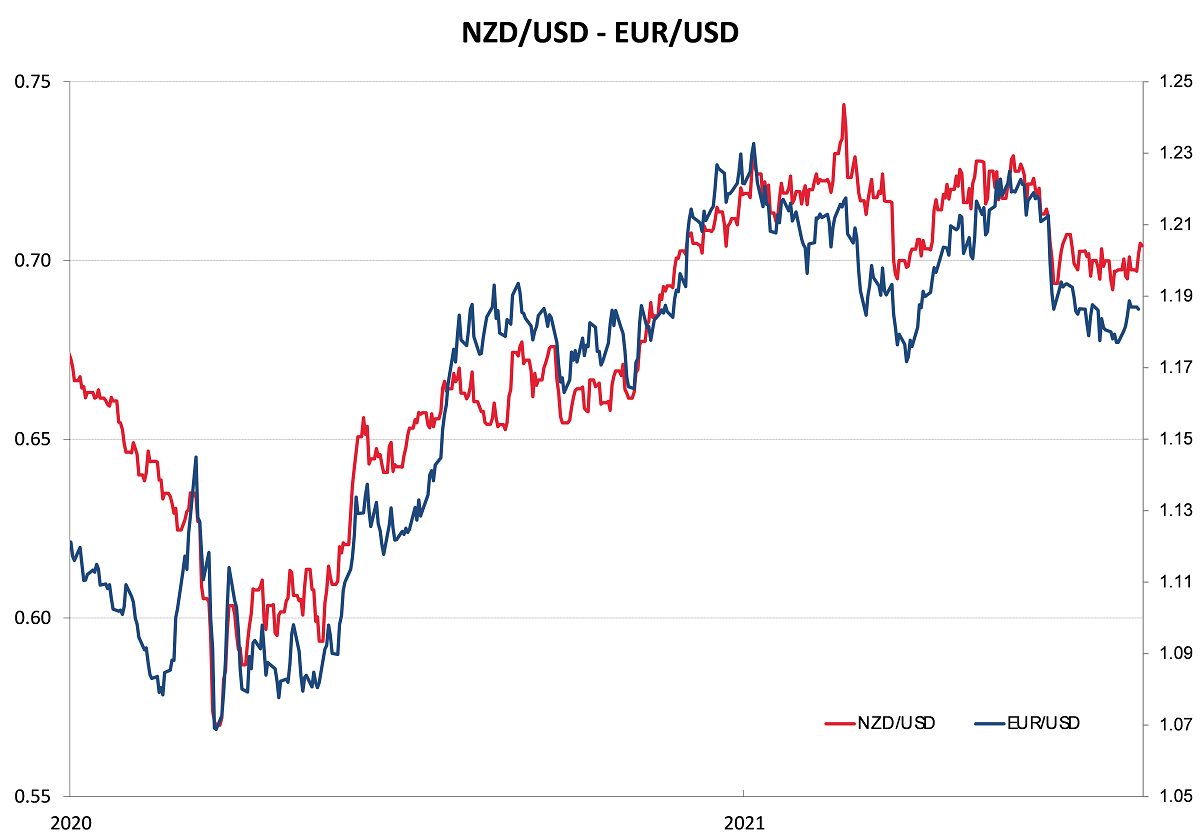
Daily exchange rates
Select chart tabs
*Roger J Kerr is Executive Chairman of Barrington Treasury Services NZ Limited. He has written commentaries on the NZ dollar since 1981.
We welcome your comments below. If you are not already registered, please register to comment
Remember we welcome robust, respectful and insightful debate. We don't welcome abusive or defamatory comments and will de-register those repeatedly making such comments. Our current comment policy is here.