
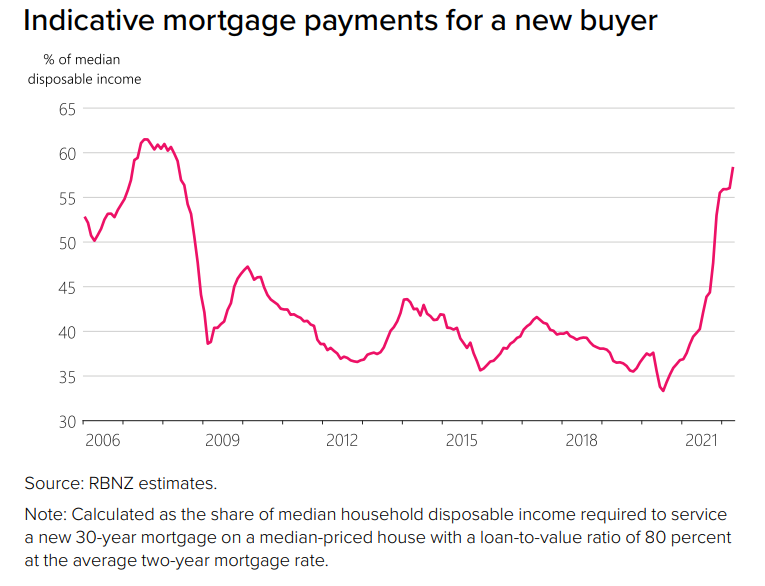
The Reserve Bank (RBNZ) says if home loan interest rates rise as it expects, a significant number of people who borrowed for the first time last year will find it hard to pay their mortgages and cover their other expenses.
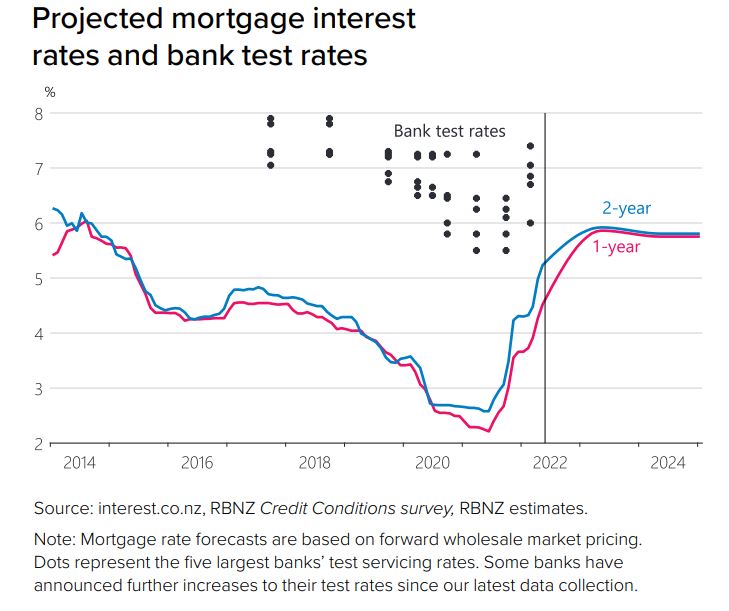
In its Monetary Policy Statement, detailing a 50 basis points Official Cash Rate (OCR) increase to 2%, the RBNZ says its current OCR projection, which sees a peak of 3.9% in June 2023, implies one-year and two-year fixed mortgage rates will hit about 6% over the next year. The average bank one-year mortgage rate is currently 4.361%, and the two-year average is 5.127%.
"If mortgage rates rise as forecast, there is a risk that a noticeable number of households that borrowed for the first time in 2021 will find it difficult to pay their mortgages and cover all their other usual expenses. This is because a 6% mortgage rate is close to the level at which borrowers were tested [by banks] during the COVID-19 period. There is a risk that these borrowers will need to cut back spending by more than currently assumed to meet their higher debt-servicing costs," the RBNZ says.
"Mortgage rates have not yet risen to a level that would cause many borrowers to have difficulty paying their mortgages. During 2021, major banks tested new borrowers’ ability to service mortgages at interest rates of 5.5% to 6.5%. These test rates are used to assess customers’ maximum borrowing capacity, and most will borrow less than the maximum. Therefore, mortgage rates up to these levels should result in relatively few borrowers having difficulty paying their mortgages. As a result, the reduction in aggregate household spending growth is expected to evolve as it has during previous monetary policy tightening cycles."
"Higher interest rates will reduce the disposable incomes of a large majority of mortgage holders, lowering household spending. Lower house prices will also weigh on consumption via the ‘wealth effect’. Typically people spend more as house prices rise, and less as they fall. Spending on long-lasting goods – such as whiteware appliances and furniture – will be particularly affected by a slowing housing market. Spending on these types of goods has been very strong throughout most of the COVID-19 pandemic," the RBNZ says.
According to the New Zealand Bankers' Association, about 56,000 new home loans were taken out between July and December last year at an average size of $407,000.
The Monetary Policy Statement notes that most mortgage borrowers have experienced higher mortgage rates in the past and have been tested on the ability to service their mortgages at interest rates north of 7%. Additionally, many have seen their incomes rise, at least in nominal terms, since they first borrowed.
"We expect that nominal income growth will continue to increase in the near term, given the strong labour market."
The major banks are now stress testing mortgage applicants' ability to service their loans at more than 7%.
14% fall in house prices seen
Separately, the RBNZ's latest house price forecasts show that the central bank is now expecting a peak annual decline of 8.1% by December of this year. That will be the peak, but house price growth is expected to remain negative till June 2024.
"From their peak in November 2021, we currently expect house prices to fall by about 14% by early 2024. While this seems like a relatively large decline compared to New Zealand’s history, it would bring prices back to only April 2021 levels. That said, the size and speed of the fall in house prices are highly uncertain," the RBNZ says.
"Although a 14% house price decline is large compared to New Zealand’s history, a 30% decline in house prices from their peak would be required to bring them back to their pre-COVID-19 levels. As a result, many homeowners have significant equity buffers (the value of their homes less their mortgage debts). A very small proportion of households – estimated at around 1% of total mortgage lending – would be in negative equity, where a home is worth less than its mortgage, in our central projection. If house prices returned to their pre-COVID-19 levels, we estimate that around 10% of housing debt would be in negative equity."
Fixed mortgage rates
Select chart tabs
82 Comments
Saints preserve us , Adrian .... did you not forsee this outcome as you were crushing the OCR through the floorboards ... at the same time as Grant Robertson went on the drunken sailors borrow & spend binge of all time ? ...
...any minute... an announcement of the covid 19 mortgage assistance recovery programme.
I'm sure there would be enough criteria on it to make sure that it only applies to the party faithful.
(Could be getting bitter as I am part of the 19% left to just have to grin and bear inflation with no government assistance. I am fine with it as have no need but at same time government paying super to people who also don't need it does grate a little)
Maybe they could just abate National Super payments away for the 30000 people earning over 100k per year and still collecting from WINZ every week. Only costs us half a billion dollars each year. 156 thousand children live in poverty. I bet none of them have grand parents in the +100K club. You could give each of those children $3200 worth of assistance with $500,000,000. But I guess it's better that the money gets spent on cruises and holidays in Raro.
Sounds logical, and if the data you used is publicly available then why hasn't it been acted on by someone? Seems like it would be hard to argue against on the campaign trail
"Rarrarararararaaararaa I PAID TAXES ALL MY LIFE"
So give up on trying to target that vote and target the ones that status quo isn't working for?
Isn't politics essentially just a popularity contest of who can offer me the best bribe at the expense of someone else now anyway?
Initially, I felt dejected when I marginally failed to buy the house I'm renting (new landlord then kept us on). Then I felt relieved as interest rates went up. Now it's moot anyway because my rent just went up ~20% presumably to cover the landlord's higher repayments. I try to be stoic about this, but this isn't looking good for FHBs or renters. Or anyone.
Why did you accept the rent increase?You could have said no.
???
If it's put to a level commensurate with the market then you can't say no.
You can certainly grumble about it. 20% hike seems rather steep. That's likely to be $100+ a week.
Yup 20% rent increase is about the true inflation rate. Wow, greedy landlords eh, they have no conscience. Hope they go bust and end up on winz scrapheap
The new interest deductibility rules are starting to come into effect, only going to get worse over the next few years. That at the same time as interest rates rising too. Ouch
Dont forget Orr said DTI was 6-9 months away, aka no later that xmas this year.
Let's speculate that it comes in at x5. Example... $1m house rented for $50k pa, you can only carry $250k of debt. The current seminar model has many at x12 earnings, as each new house is stacked on the paper equity of the last. Interest only ponzi debt stackers should spend this year getting to a high equity position. If they can.
With leverage now moving into reverse gear, next year will indeed be very telling.
should have spent the last two years getting to a high equity position***
Realise hindsight is key, however low interest rates are surely an incentive to reduce debt, mostly for small time investors.
I feel you mate, mine went up 250 per fortnight. Systematically punishing my new landlord for it by adopting a dog and demanding new goods are installed, then we are leaving with notice given the day before the rent increase kicks in. He can eat the cost.
For those saying "you can't say no", this is how people say no. Though, unfortunately it may be harder to find a new place with the dog. To be honest an air bnb might be cheaper than rent at this point.
Its so hypocritical for the RBNZ to say this as they pleaded with the banks to lend to anyone and everyone back in 2020 in order to avoid a depression....
Some people would be justified to feel that they've been used as cannon fodder by Orr and his team....
From aggressive cuts a few years ago to aggressive hikes now, this will crash the housing market and cause a recession. Orr is hiking like there is no tomorrow and Robertson is borrowing and spending huge amounts, I wonder what rate he has budgeted on for his borrowings?
It does almost seem like it was a deliberate plan to cause financial distress to as many people as possible.
1) Drop rates to encourage the most borrowing possible and force people with savings into other riskier investments by dropping TD rates to nothing
2) Raise the rates back up to make extra pressure throughout the wider economy
I think they did what they believed was in the interests of the greater good.....because what you may or may not realise, was that we were very close in 2020 to going into a depression....and we might do that just yet.....although I imagine they will just print even more money if we end up tracking towards deflation once more.....
But what could happen is money printing just causes even more higher and persistent inflation which will put a cap on real (inflation adjusted) asset prices as the cost of capital remains elevated.
Lets hope they remember come October 2023, I sure will.
No not cannon fodder.
Good patriotic kiwis. Stepping up the plate. Answering when called for. Taking it for the team!
We should send them flowers or chocolates. Thanks for keeping the economy pumping and all that. Just keep up the good work I mean payments.
.
Good for savings on TDs. I'm happy.
I pulled my Kiwi Wealth and Hatch investments recently, with clean pair of heals.
Happy to be a humble Depositor again.
Regular fixed income is back.
Until the government gives you a haircut to save a failing bank... there's still no deposit guarantee
Plenty of stuff has woken me up a 3am with a sweat, bank failure is not one them.
Yes it makes a big difference, that 1% was hopeless got a big pay rise when it went to 2.3% and fully expecting 4.8% come Feb 2023.
RBNZ C40 Borrower Number. Defined as number of monthly committed residential mortgage loans, which are finalised offers to customers to provide mortgage loans or to increase the loan value of an existing mortgage loan, as evidenced by the loan documents provided to the borrower.
That number for 2021 is 286,564 Borrowers.
Long time reader, first time poster. Happy to read the news today of an OCR increase. Lets see if they follow through and continue with increases.
No mention of the double hit of inflation and rising interest rates this is a combined menace for those with high mortgages. No one really has any idea of where inflation will top out lots of guess work but no Crystal ball is clear at this stage. Orr is only guessing at where neutral is , inflation is not likely to be controlled by a couple of small rises and it will go away , it's much more likely to be a prolonged period .
"From their peak in November 2021, we currently expect house prices to fall by about 14% by early 2024. While this seems like a relatively large decline compared to New Zealand’s history, it would bring prices back to only April 2021 levels. That said, the size and speed of the fall in house prices are highly uncertain,"
Actually, I watched the announcement and Paul Conway said that he doesn't have a crystal ball and doesn't know what the housing market will do.
In other words, "fall 14% by early 2024" is meaningless.
Refixed for three years in mid-2021 on 90%, thankfully. 10% coming off in the middle of this year. Also paying a little ahead to make the most of the rate we got. It's not much but it's realistically all we can do. Both looking at work options to find better pay if possible as well, but that will have its limits. At that point we've basically done all we can, counting on student loan being clear before we have any real disposable income not already budgeted for. Going to be a rough few years, just because we took the safe road and bought a modest house in cheap area, while some we know who took on as much debt as they could get and flipped for huge gains are now mortgage free. Makes you wonder why you even bother.
I wouldn't feel too bad about it. I'm in a similar boat. The choice was playing roulette with a live round, or taking the middle road.
I'm glad to have chosen the middle road, even if there's going to be some pain in the near term.
I'm not, ultimately. It sounds naff but I'm a finance professional, it's literally just money and I can make more of it if I need to. But the key is I'd rather spend some time with my young family and not be expected to work a 50h salary job AND pull pints or hop on a hoist on nights/weekends because 'it's always been hard' or whatever other excuse people come up with to defend this madness. To have made the academic and professional choices I have is and still end up living paycheque to paycheque is baffling, really
GV27
Same boat as you, if it comes down to it maybe we can get a jobshare forklifting?
Although the secondary tax is also crazy, who works multiple jobs because it's fun.
Sometimes feel like I turned up 30 years to late to the party and now all I get to do is help with the clean up!
Guys, the party is always on, there's lots of money to be made, but you have to know where to look and for that to happen, you first have to open your mind, that opportunities always exist.
Is there an opportunity to keep a roof over my family's head during the widespread economic fallout prompted by OCR hikes because unimaginative morons spiked property prices through the roof and the government sat back and did nothing?
I'm with you on this. While older, but having gone thru a divorce, which destroys you financially; along with the mad system of child support payments, means a week to week existence.
If those same morons had been kept in check, then we could have kept interest rates lower for longer helping everybody. But no, everyone has to be all in for those tax free capital gains.
Hope you weren't planning on having kids, those are luxury items nowadays
For some a luxury, for others a poverty indicator.
Subsidise what you want more off, tax what you want less of.
NZ apparently wants more solo parents and less young professionals.
Ha ha sorry, yes I forgot luxury item if you are paying your own bills
And more fat finance ministers
The RBNZ clowns are now trying to pick up the pieces deriving from their stupidly ultra-loose monetary policies of the last few years. It is time to pay the piper. The rates normalization process has now finally started, here as well as in the rest of the world.
Only borrowers that believed any of the hype, and didn't see things for what they really were, are going to get burned.
While I'm kicking myself for not getting 5 years at 2.99% when I could (didn't want to break my 1 year at 2.09%), I'm happy with 5 years at 4.89%.
But there will be plenty of people with their hand out because they were incapable of sound financial planning, just as there were companies failing during the pandemic because they ran their business too close to their cashflow, and used debt for everything else.
I just don't know why those who make good decisions and plan for disruptions keep having to cough up for those that are incompetent, stupid, ignorant, lazy, or lack common sense. Or are members of Government.
It's not rocket science.
I had 5 years at 3.05% on less than 1.5 household DTI. We were in a very small entry level house which did us just fine but the wife twisted my arm into trading up in December. Locked in 5 years @ 4.95% on 4 x HH DTI.
The financial prudence in me is kicking myself, but now we're in a much bigger place on 1/4 acre a 200m walk from our now 5 year old's school so it's well worth it. With the benefit of hindsight I'd not change a thing
I can't see any government of NZers standing by whilst first home buyers lose their houses. I don't think mortgagee sales will eventuate. Not in any significant numbers anyway.
I'm inclined to agree.
Perhaps the government should just buy those houses then and turn them into state houses eh?
Or do we just want to privitise profits and socialise losses once more......pretending we have free markets but slowly slip towards some strange form of communist economy.
Pretty neat summary of the status quo.
Looks like we have a more centrally controlled economy than anything else....especially the last 2 years.
Risk and free market theories have been thrown out the window....nobody losses....everyone wins....oh hold on!
You shall own nothing and be happy!
There are funds for rent to buy programmes. Convert those to help people who have had to sell. Some moral hazard in there, but the hazard has probably been mostly occurring anyway.
This is because a 6% mortgage rate is close to the level at which borrowers were tested [by banks] during the COVID-19 period.
That was last year, inflation being allowed to surge way above wages likely demolished the buffer Retail Banks had built into their calculations. The underlying assumption retail banks made was that Reserve Banks would act rationally to stem inflation rather than sit on their hands and talk about how it was all just transitory.
The article doesn't read that well.
There is a difference between having trouble paying the mortgage and having negative equity.
If the banks have stressed tested to 7% last year, then according to the banks you should be fine.
But of course, the stress test is a sham as it means that banks are fine up until that point, as long as you can pay the mortgage, even though you may have to forgo every other expenditure, then your happiness and any negative equity that you are still liable to the bank for is not their concern. Until you can't pay the mortgage.
Remember, when they say stress test, they are meaning your stress, not theirs.
If people are anything like me this must be causing a nagging and uncomfortable feeling of impending doom. I remember back in 2008 I calculated my wealth would be wiped out if house prices dropped 30% and it was pretty stressful as I had young children. I guess I would have been okay as I stayed in good employment since then but I thought to myself I wouldn't expose myself to such a risk again and sorted my affairs out in 2018. I am getting close to retirement after all. Enough to feel smug when COVID hit but later to have egg all over my face when the heavily leveraged seemed to be making a killing in property. I came very close to borrowing and buying a property late last year but the change in interest deductibility spooked me.
Now I am reasonably happy I made those changes in 2018 but I still feel a bit anxious. Not really for myself but I can sense how unpleasant it must be for others. I was angry they let house prices explode like that and I am still angry. It just didn't make sense.
Imagine the anger for those who:
a) are locked out of home ownership completely because they can't afford the deposit.
b) managed to get a deposit together and purchased but may see their equity disappear in a falling market/negative equity.
Either way its been very foolish, very poor regulation allowing a housing market become such a speculative mess.
Buying or not buying a house shouldn't have a high chance of ruining you financially in the short term (long term...sure). That we have got to that point shows just how bad/out of control things are/got to.
The human right of shelter being used as the back bone of the economy. Sad, actually its embarrassing.
Young people shouldn't have been put in the position of choosing to have a home of their own, or financial security, one or the other.
So house price bids should now be at dec 2019 levels, and every rate increase from here should lower you bid accordingly until we reach 3.75 OCR which is now 7 rate increases away..... does look like an Irish 45% crash
An Irish crash with high inflation tacked on.
The Irish had the benefit of low inflation and falling mortgage rates for most of their crash duration.
Three predictions that the RBNZ are getting wrong:
1) The NZ economy is not as resilient as they believe. The trifecta of an erased wealth effect as the property market drops, with the a stubborn cost of living pain, and more expensive credit will push us into recession much faster than Orr expects. A sharper peak of OCR at 3% with a modest drop by 2023 is my call.
2) The change in economic metrics within the property market are already dropping prices in Auckland City by over 10% in 3 months and this slide will become a run, and that will infect the provinces 6 months or so later. The changes will be deep (30% average with investor and apartments being ravaged) wiping out wealth sentiment and discretionary spending. Construction, cars, and so on will decline fast.
3) The NZD will settle at a lower value. Imports will be more expensive and overseas travel will again be restricted to the wealthy.
The big NZ economic reboot is under way.
I agree, i don't think the RBNZ will get to 3.75 but they have to make us think they will to get the inflation slowdown they require. But they will get the house price crash, as now there are no bidders mad enough to buy at these levels
Strewth. How did they let the number get to 10% if prices went back to pre-Covid? As much as I respect him, Bill English has a bit to answer for, refusing DTIs
What would it have mattered? The most meaningful response the RBNZ can manage under a crisis is writing letters to the finance minister or dropping rates through the floor. There's plenty of post-2017 RBNZ ball-drops you could focus on if you really wanted to.
DTIs in 2019 would have saved a lot of house price inflation, and a lot of pain in the years to come. Median houses could be $600k instead of $1m to take a punt.
For sake of saving those who bought in 2021, we cannot risk the future of 5 mill kiwis.
I hope sense prevails soon and the free flow of monetary policy will be controlled to curb inflation.
The opportunity in 2021 was 5 years for 2.8x%
The impact could be a lot worse.
E.g.
Using a simplistic approach, ignoring all other costs and taxes, and assuming everything else is equal.
Assume a property readily renting for 700 per week and the absolute lowest mortgage rate is 2.5% as of Nov 2021 from graph above.
Simplistically the implied capital value of the property at the very peak of the market is (700/7*365)/0.025 = 1,460,000.
Now in 2023, assuming the property is still readily rentable at 700/week, mortgage rates are expected to get close to 6%
(700/7*365)/0.06 = 608,333
The implied capital value falls to 42% of the peak value. (i.e. a 58% fall).
Because asset values are effectively proportional to 1/interest rate there is a strong argument for limiting the lowest OCR to around 4% (somewhere near the knee of the 1/x curve) and using other mechanisms to support the economy if lower interest rates are needed to support the economy.
You write with clarity and sense that is missing from the Herald, missing from the RBNZ and missing from the writings of every bank econo-mist in the country.
They are all still trying to bulls//t the masses with tales of 20% peak to trough falls.
The real numbers are stark. Unavoidable. Brutal.
Gosh I hope so. A 60-70% drop might see boomers jumping from buildings and free up spots up the corporate hierarchy and properties to buy. Greedy fools are getting what they deserve for the mania. The schadenfreude is immense.
While simultaneously reducing the Superannuation bill that's dished out to people still working, preventing career advancement for the next generation and potentially stifling innovation.
I agree with the potential of how bad it could get, and even worse as you're equating the mortgage rate with the yield rate.
Without any capital growth expectation, if the Govt. makes the necessary changes to stabilize housing affordability at the bottom, and of course with the removal of interest rate deductibility, depreciation, and ring-fencing of losses giving no further ability to generate an extra internal rate of return, then a rental investor would need a yield higher than what they would earn if the money was sitting in the bank.
So I think there is a greater potential to fall further than what you are saying, but not much as the value would hit the bottom of value-added only next best economic use line. This would take us back to the true 3x median income multiple when we last had a stable housing market circa 1992 and historically prior.
I doubt wages can rise fast enough, or will be able to (stagflation), to meet and arrest the fall halfway to still give a 3x median multiple but only a 30 to 40% house price fall.
Haven't we already seen the 14% house price decline which they 'predict' will occur in future? If banks are now stress-testing applicants to 7% mortgage rates, this will put further constraint on first home buyers to qualify for a mortgage.
As a result, we may face a property crash, followed by a financial crisis, where banks need to be bailed out. Unlike Greece and Italy, etc., we are not in the EU, so who is going to bail us out?
I really do not understand what the RBNZ is trying to achieve with aggressive OCR increases, when the property market is already falling sharply. They pretend they can ignore the property sector, but this sector drives our economy.
Agree, net result of these aggressive hikes will crash the housing market and economy, not control supply side inflation. NZ will be the canary in the mine, other central banks will watch and see what happens..
If we believe the Reserve Bank (and they do stretch credibility sometimes) they reckon the banks have the capital to weather a 1 in 200 year financial crisis.
From RBNZ website:
'The OCR can also influence inflation via its effect on the exchange rate. As discussed above, an increase in the OCR tends to push New Zealand's exchange rate higher. An increase in New Zealand's exchange rate reduces the New Zealand dollar price of imports, thus putting downward pressure on inflation.'
Interesting a lot of people i speak to seem to think the government or rbnz will intervene and lower OCR to save housing. In reality our OCR rate (as relative to extenal events) also affects our exports, inflation and most other aspects of the economy which are way more important than house prices.
Higher interest rates cause great pain for younger borrowers, and great happiness for the grey haired term deposit holders. Just another division in society to put with all the others. Nothing they say makes sense these days, like rampant Covid when we are so well protected by these incredible vaccines. Those who are at the wheel might be considered to be educated and experienced, but the are definitely not clever.
Rapidly drop interest rates so asset values balloon. Grey haired asset holders sell and become term deposit holders courtesy of a 30 year mortgage.
Once developers and builders see huge drops in housing market the government could buy any places going under cheaply and then rent out at reduced price bringing down cost of rentals. Could also build more state housing as huge amounts of people will still have no chance of buying unless prices drop 60%.
Where would the government find money to buy houses? surely they cant print any more cash or spending more without making inflation worse. Raising taxes would be political suicide one year from an election when voters are stuggling.
One would assume these developers have debts to pay. If the Government settles these debts only, then it's not really inflationary as the expense has already been realized from when the developer took out the loan. Unless of course the money is then lent out again, but to who?
We welcome your comments below. If you are not already registered, please register to comment
Remember we welcome robust, respectful and insightful debate. We don't welcome abusive or defamatory comments and will de-register those repeatedly making such comments. Our current comment policy is here.