

Food prices just keep heading for the moon. The National Party says it's a "crisis at the checkout".
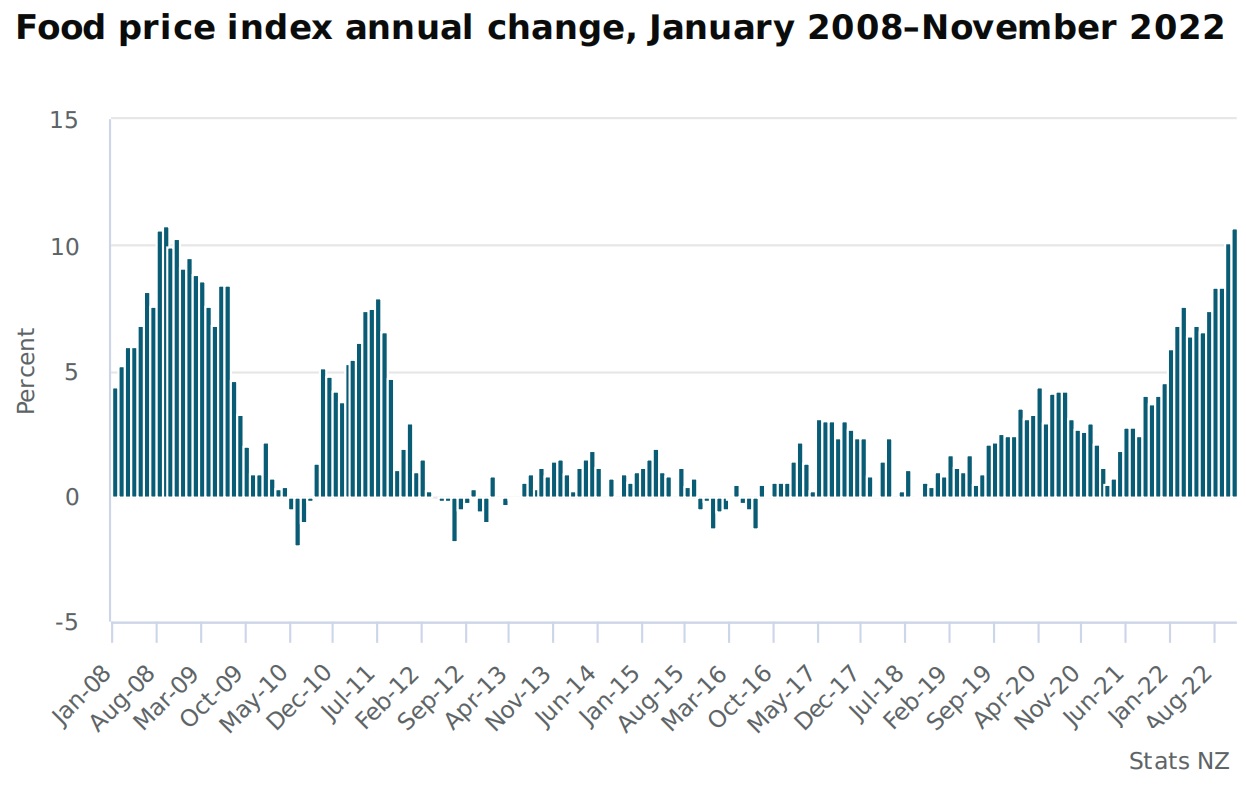
According to the latest Stats NZ Food Price Index release for November, our annual rate of food price inflation hit 10.7% last month.
That's up from 10.1% as of October and is the highest level in this country since September 2008, when annual food price inflation hit 10.8%.
National Party Finance Spokesperson Nicola Willis says all the Government has offered are excuses. "They have blamed the supermarkets, the war in Ukraine, and the banks." More comments from Willis further down.
But back on the latest 10.7% annual food price inflation - while Stats NZ's media release last month for the October figures had explicitly referenced a 14-year high, oddly this month's release made no direct reference in the text at all to the November figure being a new 14-year high water mark - although it is displayed in a graph.
It is noteworthy to mention that beyond that 10.8% figure in September 2008 you have to go back to 1990 to find a time when food price inflation was running at these kinds of levels.
Stats NZ said the 10.7% annual increase in food prices for the year to November 2022 "was due to rises across all the broad food categories we measure".
Compared with November 2021:
- grocery food prices increased by 10%
- fruit and vegetable prices increased by 20%
- restaurant meals and ready-to-eat food prices increased by 8.0%
- meat, poultry, and fish prices increased by 12%
- non-alcoholic beverage prices increased by 7.8%.
Grocery food was the largest contributor to this movement.
Stats NZ's consumer prices manager James Mitchell said increasing prices for cheddar cheese, yoghurt, and standard two-litre milk were the largest drivers within the grocery food sector.
The second-largest contributor to the annual movement was fruit and vegetables. The items within this group that influenced this movement the most were potatoes, onions, and bananas.
In terms of monthly figures, the November month prices were "flat" compared with October.
However - after adjustment for seasonal patterns, prices actually showed a 1.0% increase.
“It’s typical to see food prices fall in November due to falling fruit and vegetable prices. However, fruit and vegetable prices did not fall as much as in a typical November,” Mitchell said.
Fruit and vegetable prices fell 4.7%. But after adjusting for seasonal effects, these same prices actually rose 0.9%.
All other broad food groups rose in price. A 1.1% rise in grocery food was the biggest upwards contributor, led by yoghurt, potato chips, and cheddar cheese.
Some notable fruit and vegetable price falls during the month were:
- tomatoes (down 42%)
- broccoli (down 44%)
- strawberries (down 35%).
However, against this, there were these notable increases:
- onions (up 28%)
- potatoes (up 10%)
- kiwifruit (up 26%).
ASB senior economist Mark Smith noted the fact that food prices were flat in November, but said "this was about where the good news ended as this month typically sees lower food prices".
"The 1.0% seasonally adjusted climb in November continued the strong monthly run of late, with 0.9% being the lowest seasonally adjusted monthly climb over the past 6 months."
In terms of the annual picture, Smith said price rises "remain entrenched" with more increases (73% of all food items) than falls (27%).
"Plus-10% annual inflation for fruit & vegetables, grocery foods, and meat provides little cover for consumers, who will likely be relooking to trim any fat from the food bill this Christmas," he said.
"By all accounts and purposes, food price rises (and those wider tradable goods) should be cooling: Global food commodity prices have cooled of late and in time this should translate into cooling food price inflation at the retail level.
"Global oil prices are sharply lower, and this should provide motorists with some shelter from pronounced price increases elsewhere. Shipping costs have continued to go off the boil and this should act to cool broader tradable consumer prices. The higher NZD should support this, with the kiwi gaining 8 US cents (0.638 USD) since mid-October.
"It is our expectation that annual NZ food price inflation could nudge higher (11%+ is possible for calendar 2022), but then cool over 2023. However, the risk is that the current upward momentum in food prices takes longer to slow," Smith said.
“Today’s data reveals just how tough it is for many Kiwi families. Everywhere they turn, they are facing rising costs – whether it be with their mortgages, or at the supermarket checkout.
National's Willis said the cost-of-living crisis is hurting a lot of New Zealand families "and Labour‘s wasteful spending has made inflation worse".
She said the Government was blaming others, but "Labour fails to mention how their own economic mismanagement, failed immigration settings and added costs have contributed to rising costs".
"Christmas is already a stressful time for many families and my heart goes out to those who are wondering just how they are going to pay the bills. They deserve a real economic plan from Labour.
"National has a plan to fight inflation. We will address worker shortages, reduce costs on businesses, bring discipline to government spending, give Kiwis more money in their back pockets through prudent tax reductions, and focus the Reserve Bank solely on managing inflation."
We welcome your comments below. If you are not already registered, please register to comment
Remember we welcome robust, respectful and insightful debate. We don't welcome abusive or defamatory comments and will de-register those repeatedly making such comments. Our current comment policy is here.