

It's bad news and good news from ASB economists regarding household living costs.
Yes, they say, costs are going to keep going up - but it will be at a slower rate. And they say, unlike in recent years, the next year's cost increases will be beaten by rises in income.
In a household cost of living outlook for next year, ASB senior economist Mark Smith is estimating that for 2023 average household living costs for Kiwis will have risen by $115 a week.
Weekly cost increases for the average household peaked at just under $140 in 2022, he says "and again look set to top the $100 per week mark in 2023".
"In both of those years, rising living costs were higher than gains in household incomes, reducing household saving buffers. Households have been acutely feeling the cost of living ‘squeeze’.
"The outlook is uncertain, but signs for 2024 are brighter, with our estimates suggesting the average weekly cost increase for households will ease to $70 per week. This is expected to be below the weekly rise in household disposable incomes."
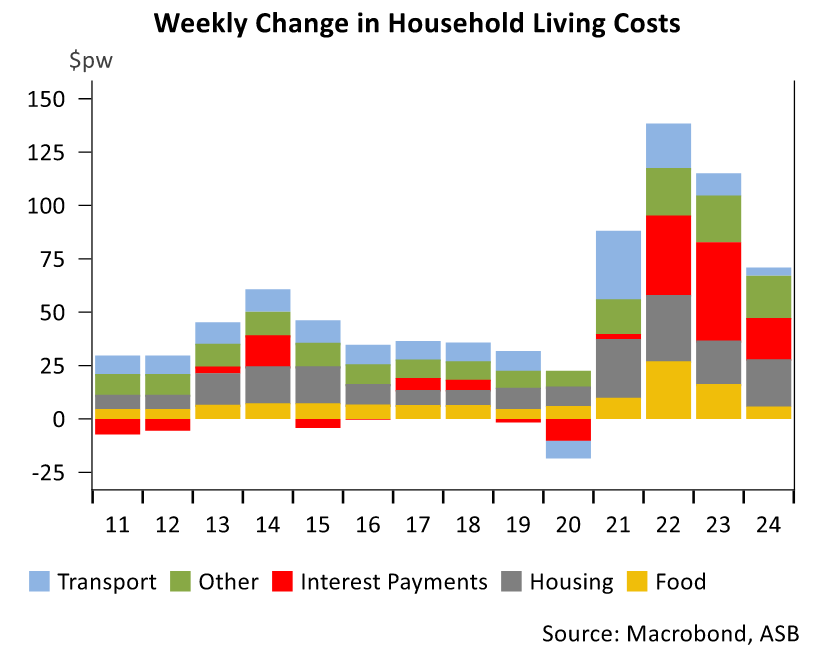
Smith says cost increases for 2024 are likely to be the lowest annual increase since 2020, but they are still elevated relative to pre-covid times where the low inflation environment kept overall cost increases in check.
"We caution that these are average figures, with fortunes differing by household. Rising living costs will be a struggle for many households."
Smith says higher living costs are a significant headwind, but to date the household sector has coped reasonably well overall. In part he says this is a consequence of the covid-19 period when overall household incomes benefited from government support.
"Record low household borrowing costs and the resilient economic backdrop have also played a role, with household disposable income growth at solid rates. Kiwi households are not dissaving in aggregate. Kiwi households have built up a circa $30 billion nest egg of savings since the COVID-19 pandemic. The amount of saving is being eroded as growth in household expenditures has outpaced income growth. Still, households in aggregate are still saving."
But Smith says the concern is that the households who have built up the savings will not be the ones who need to find additional funds to cover higher living costs.
"It will mean considerably reduced funds available for households after paying down the mortgage, with discretionary spending likely to be pressured lower. The Christmas mood is expected to remain sombre for many this year and we envisage 2024 will still be difficult for many households."
Smith says the battle to lower inflation back to 2% is far from over.
"We don’t expect further OCR hikes but acknowledge that the [Reserve Bank's] patience is wearing thin. Tangible progress will need to be made in lowering domestic inflation. While households do not set prices, their actions will have a tangible influence. The battle on inflation is not yet won and the RBNZ will be looking for restraint on the part of firms, consumers and government to reduce inflationary pressure. If not, higher OCR settings may result."
Lowering inflation needs to be a team effort, he says.
"Firms, policymakers and households will need to play their part. Ongoing consumer restraint and increased consumer resistance to paying higher prices are key pre-requisites to cooling domestically generated inflation. If households decide to pop the champagne corks too soon, they might discover a nasty interest rate induced hangover will result."
We welcome your comments below. If you are not already registered, please register to comment
Remember we welcome robust, respectful and insightful debate. We don't welcome abusive or defamatory comments and will de-register those repeatedly making such comments. Our current comment policy is here.