
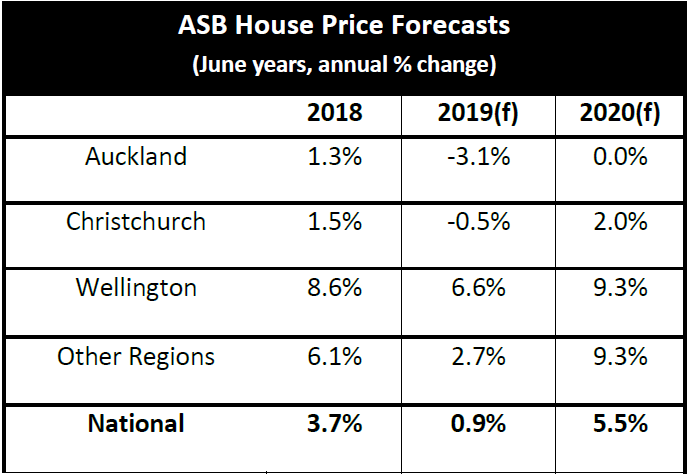
ASB economists expect nationwide house price inflation to pick up from the current annual pace of around 1.5%, to 5-6% by mid next year.
In ASB's new Home Economics publication, senior economist Mike Jones says while there are plenty of "cross-currents" at play in NZ’s housing market, it's ASB economists' view, that sharp falls in mortgage interest rates will combine with still-strong population and labour income growth to "jump-start the Auckland housing market and add a little more heat to simmering regional markets".
Even with the "jump start" though, the ASB's only forecasting flat, IE 0% growth for Auckland prices next year - after a more than 3% drop expected this year.
Talking nationwide, Jones says from late 2020, they expect the price cycle "to top out as new housing supply coming on-stream gradually reduces the housing shortage".
Westpac economists have been offering similar views of a pick-up in the housing market.
ASB's Jones, in comment on the Reserve Bank's 50 basis points cut to the Official Cash Rate on August 7, said the RBNZ’s determination to "slash rates until kiwis start borrowing and spending again" could well see a more enduring than expected house price inflation cycle take hold.
"Certainly, the closer term deposit rates get toward zero, the bigger the risk of a widespread asset-allocation into housing.
"However, the turning NZ economic cycle, policy-related handbrakes, and a ramp up in housing supply will all act to limit the extent of the upturn in our view."
Jones says that spring is shaping up as a key test of their view of the market.
"We find that declines in mortgage rates tend to take six months or so to impact house prices.
"So if we’re right that recent mortgage rate cuts (which began in earnest in March/April) will provide a boost to prices, we should start to see this show up in September/October housing data."
He notes that the picture remains very patchy around the country.
"Conditions in Auckland remain chilly. House price growth remains negative on an annual basis, albeit there’s been small gains posted for the past three months. Days to sell and inventory both remain above average levels suggesting we’ll have to see further thawing in activity before we can expect prices to lift.
"Canterbury is another notable underperformer... a ramp up in supply appears to be part of the story. This appears to be reflected in rents, which are running at just 1.4% yoy in Canterbury, the slowest growth rate in the country."
The report features a detailed Regional Heatmap, which shows the areas that are hot. And those that are not.
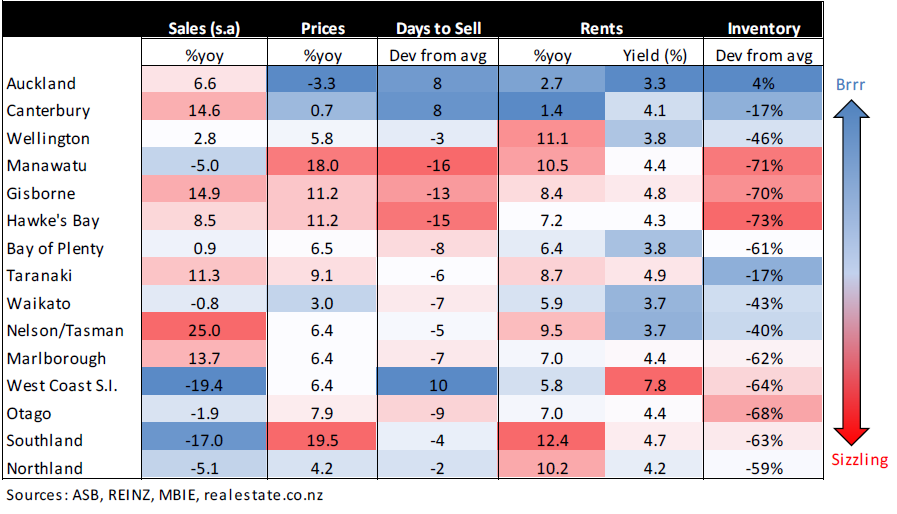
Jones says the Wellington market has cooled from the "giddy heights" of late 2018. Annual house price growth has slowed from double-digit rates to around 5.8%yoy. Days to sell and house sales are also consistent with the market shifting down a few gears.
"Still, inventory remains very tight with just 9 weeks’ worth of sales listed. As such, we could see a second wind for prices should low mortgage rates kick things off again."
Central and Eastern parts of the North Island are "cooking", Jones says.
"These markets are tight. Days to sell a house have fallen appreciably through the first part of the year, inventory is very low, and strong house price and rental growth has swiftly followed. More of the same looks likely, with supply slow to respond and low mortgage rates likely to further boost demand."
Housing market conditions remain fairly strong on the West Coast and South of the South Island.
"Notably, house price inflation in Southland remains the hottest in the country at 20%. Price growth in Otago and the West Coast has also been solid reflecting very low inventory levels. One possible fly in the ointment is the recent cooling in house activity in these regions, with July house sales data well behind year-ago levels. This data can be choppy though so we’ll keep an eye on what happens over coming months."
We welcome your comments below. If you are not already registered, please register to comment
Remember we welcome robust, respectful and insightful debate. We don't welcome abusive or defamatory comments and will de-register those repeatedly making such comments. Our current comment policy is here.