

Recent increases in house prices in New Zealand are "at odds" with the fundamental drivers of the market and in the coming years prices are "likely to come under pressure to realign with fundamental values," according to the Reserve Bank (RBNZ).
In an RBNZ Analytical note: Measures for Assessing the sustainability of house prices in New Zealand, senior economic analyst Matthew Brunton says that until 2020 the growth in NZ house prices had been against a backdrop of falling long-term interest rates, strong population growth and an insufficient supply response to the additional demand.
"In this context, while household incomes were becoming stretched, measures on the relative benefits of owning property (mortgage interest-to-rent, user cost, and rental yield models) were steady. The high house prices observed, while increasingly unaffordable, could have reasonably been considered sustainable," he said.
"However, the recent increases in house prices through 2020 and 2021 are more at odds with fundamental drivers. Estimates of serviceability ratios using long-term interest rates are well above their historic average. As interest rates increase towards their long-term values over the coming years, households’ ability and willingness to service mortgages at current prices may be limited."
This new analytic note from the RBNZ was released in conjunction with a speech from the central bank's Governor Adrian Orr, which, in large part, was a plea to New Zealand households to diversify their investments and not put all their eggs in the housing basket.
And it came a day before the RBNZ was due to release its latest six-monthly Financial Stability Report.
In his analytic note Brunton says that for both households and investors, measures around the benefits of property ownership are suggesting that current prices are becoming less attractive.
"Furthermore, prices are now above user cost estimates based on previous experiences around rent inflation. If the strong supply response limits rent growth over the coming years, estimates around the sustainable price of housing will remain flat or ease back. However, if these supply responses represent a more structural change then this could more persistently reduce rent inflation and cause the more significant declines in sustainable house price levels."
He also says the removal of tax-deductibility and the extension of the bright line test will reduce the potential return, and therefore sustainable value, on existing properties for leveraged investors. As a result, investors may reduce their demand for investment properties until prices realign with their required rates of return.
"Together, these measures suggest that current house prices are becoming increasingly unsustainable.
"As interest rates normalise and supply continues to enter the market over the coming years, prices are likely come under pressure to realign with fundamental values."
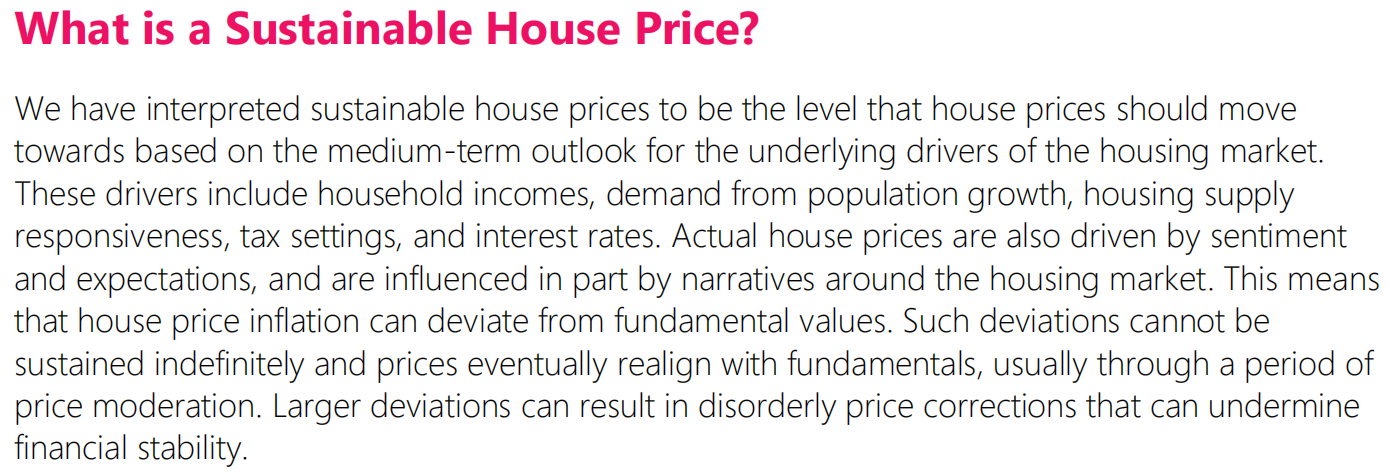
Below is the RBNZ's description of what a 'sustainable' house price is:
We welcome your comments below. If you are not already registered, please register to comment
Remember we welcome robust, respectful and insightful debate. We don't welcome abusive or defamatory comments and will de-register those repeatedly making such comments. Our current comment policy is here.