

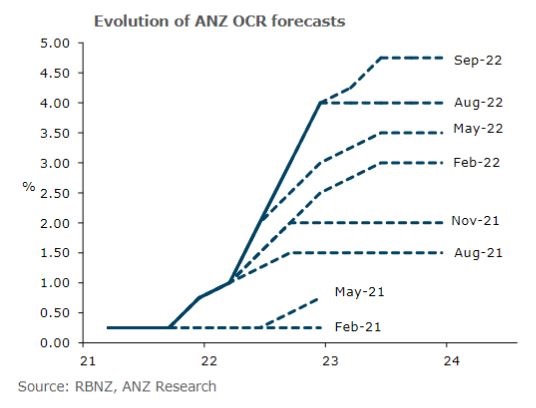
ANZ New Zealand's economists now expect the Official Cash Rate (OCR) to peak at 4.75% next year, up from their previous estimate of 4%, arguing that economic risks are firmly tilted towards inflation and inflation expectations.
The Reserve Bank currently has the OCR at 3%, having started increasing it from its record low of 0.25% last October. However changing her OCR call, ANZ NZ's Chief Economist Sharon Zollner says the economy isn't rolling over, with a tight labour market and strong wage growth partially offsetting the impact of higher interest rates. Additionally she says the low NZ dollar is also a meaningful offset to current monetary conditions.
With Consumers Price Index inflation hitting a 32-year high of 7.3%, and official unemployment at just 3.3%, Zollner says the Reserve Bank needs to see "a fair degree of slack in the economy," including unemployment rising to 5%.
On Thursday Statistics NZ reported Gross Domestic Product (GDP) rose 1.7% in the June quarter, well above the 0.4% increase forecast by ANZ's economists. Following the GDP release, ASB economists also revised their OCR forecast, now seeing a peak of 4.25% early next year, up from 4.0%. According to ANZ's economists, as of Friday financial markets were pricing in a peak OCR of around 4.34% in May/July next year, with cuts priced in after that.
"By hiking the OCR, the Reserve Bank is trying to cool demand to the extent that it drops below (constrained) supply, opening up a 'negative output gap'. That is, they need to see a fair degree of slack in the economy – including a 5% unemployment rate," Zollner says.
The Reserve Bank's Policy Targets Agreement with the Government requires it to target maximum sustainable employment alongside price stability - keeping inflation between 1% and 3% on average over the medium term - when setting monetary policy. However, just what maximum sustainable employment is, is somewhat vague. It's not a specific unemployment percentage.
The Reserve Bank is next due to review the OCR on October 5.
Wanted: Spare capacity
Zollner says recent economic data shows although the economic growth profile isn't strong, it’s not clear that beyond the housing market the rate hikes delivered to date are succeeding in opening up much spare capacity in the economy.
"That requires meaningfully lower household spending. In our consumer confidence survey, those with mortgages were more likely to report that it is not a good time to buy a major household item, but on the other hand, they were more likely to report a better personal financial situation. That likely reflects that those who have houses are typically higher income earners and therefore are being put under less pressure from the lift in the cost of living," says Zollner.
She says wage growth is at least the highest it has been since 2008 and is yet to peak.
"The share of jobs receiving a pay rise of greater than 5% has surged to the highest level since 2008. Median weekly earnings were up 8.8% year-on-year in the second quarter of 2022, the fastest increase since the data began in 1998. Firms’ wage expectations remain very high. The unemployment rate, at 3.3%, is highly inflationary and likely to remain so for at least another year."
Additionally Zollner says core inflation measures are all at least 4.8%, and it’s unclear they’ve peaked.
"While retail volumes are lower, ANZ card spending shows spending on discretionary items like restaurant spending holding up. Both business and consumer confidence are lifting from their lows. Firms’ four biggest problems are all inflationary: finding labour, costs, wages and regulation. Anecdote is consistent with demand holding up."
And while house prices continue to fall, with falls almost reaching double-digits, Zollner says they appear to have found a floor.
"In our updated forecasts, the OCR rises by another 175 basis points, from its current level of 3%, to 4.75% by the middle of next year, and we assume that goes into floating mortgage rates 1:1. But headline inflation does a lot more of the work of lifting real interest rates, dropping from 7.3% in the second quarter to 2% by mid-2024 – that’s 530 basis points of lift in real floating mortgage rates. That highlights that if inflation doesn’t fall as far or as fast as our forecast, for whatever reason, then there is still upside risk to our OCR forecast peak, even at 4.75%," says Zollner.
'Neutral OCR is rising'
She also suggests the neutral OCR, the level where it's deemed to be neither stimulating nor constraining economic activity, is higher than the Reserve Bank's latest estimate of 2%.
"Given how far inflation is above target, expectations that it’s going to remain that way for some time, and strong wage growth, it’s not unreasonable to think that the neutral OCR is rising. That is, on the street, people’s idea of what a 'good' mortgage rate looks like is likely lifting as the shock of the abrupt rise wears off and 7% wage growth takes some of the sting out of the increase in both debt-servicing burdens and borrowing capacity," says Zollner.
"While both uncertain and unobservable, the neutral OCR matters a lot. If it is indeed lifting, then the OCR is chasing a moving target. It needs to rise along with neutral 1:1 just to stand still in terms of the real contractionary impact it is having."
"We suspect the neutral nominal OCR is currently around 3%, or at least will be soon. That might sound high, but it’s worth noting that unemployment is currently lower, and inflation higher, than in the mid-2000s, when the Reserve Bank estimated neutral was around 5%."
"We are not anticipating that the Reserve Bank is going to make a sudden step change in their estimate of neutral. Rather, we are anticipating a slow-burn story of inflation pressures just not cooling as quickly as the Reserve Bank is forecasting. We therefore are predicting a series of 25 basis points [OCR] top-ups, rather than a continuation of aggressive double-sized moves," Zollner says.
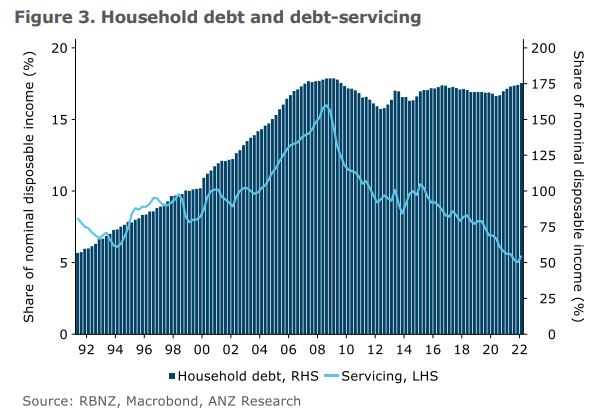
"The mythical median household is actually well-positioned to cope with the consequences for mortgage rates of an OCR rising to 4.75%. As figure 3 [below] shows, the debt-servicing burden is a fraction of what it was in 2008, when the OCR was 8.25%, and still will be at 4.75%. Household debt relative to incomes is actually about the same as it was then, though this statistic masks a large wealth transfer from a younger cohort to an older one."
ANZ is New Zealand's biggest residential mortgage lender with total housing loans of $102 billion at June 30.
We welcome your comments below. If you are not already registered, please register to comment
Remember we welcome robust, respectful and insightful debate. We don't welcome abusive or defamatory comments and will de-register those repeatedly making such comments. Our current comment policy is here.