
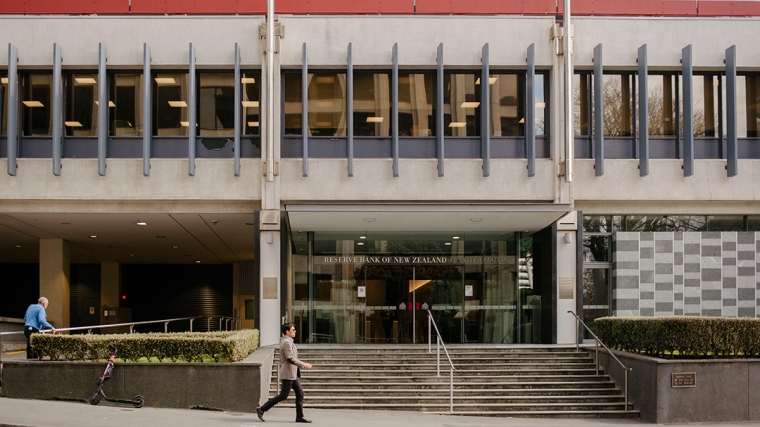
It has been almost 200 days since the last increase to the Official Cash Rate, but the Reserve Bank of New Zealand says it may not be finished hiking.
The Monetary Policy Committee discussed lifting the benchmark interest rate above the current 5.50% at its November meeting, before deciding to wait for further data.
RBNZ Governor Adrian Orr said there was a new word to add to his alliterative summary of the central bank’s next move: watch, worry, wait, but be willing to hike rates if needed.
“We had robust discussions around now versus later, and whether it was going to be necessary or not,” he said at a press conference on Wednesday.
To signal this willingness, the RBNZ lifted its projection of the OCR—for the seventh time in the past two years—adding another 10 basis points to have it peak at 5.69%.
Bond traders would describe this as a 75% chance of a rate hike, if it were priced into market swap rates. Orr rejected that characterisation, however.
He said the committee and RBNZ analysts were demonstrating they had an “upward bias” towards interest rates, but it shouldn’t be considered a yes-or-no probability.
Rather, it was because the risk that inflation could be sticky was greater and more harmful, than the risk that it might fall faster than expected.
“Let me be clear, inflation is declining. Where we are nervous is whether it is declining fast enough for us to succeed in the lowest cost to the rest of the economy”.
There was “very little headroom” to absorb additional inflation surprises and “a lot more” room to absorb disinflation surprises, he said.
While they opted not to raise rates any further, the Monetary Policy Committee signalled it was becoming impatient to get annual inflation back below 3%.
“Some members noted that inflation has now been above target for some time, and that there should be a low tolerance for any increase in the time to return inflation to target,” the meeting notes said.
Meeting the midpoint
For more than a year, the RBNZ has been forecasting inflation will fall back into the target band during the third quarter of 2024. That date is now just nine months away.
Once in the target band, the central bank expects to spend another year pruning price expectations until annual inflation is once again anchored at the midpoint of 2%.
Training the public to expect a steady, slow rate of inflation again will take some time. Five and 10 year inflation expectations have been rising, with the latter now at 2.28%.
“We take that as a personal assault on our credibility and mandate here at the central bank,” Orr said.
Monetary policy has a long lag, and so the rate hike considered by the Committee this week would have been aimed at dampening inflation in June 2025 and beyond.
Or, the spectre of future hikes may have been intended to spook bond traders who were pricing in three rate cuts during 2024, prior to the November meeting.
Stephen Toplis, head of research at BNZ, said the “hawkish stance” adopted by the Reserve Bank may have been to prevent retail interest rates from falling any further.
“It would have feared that if it displayed any overt sign of satisfaction it was winning the battle against inflation that it would result in even more aggressive rate cut pricing by markets”.
“Householders and businesses need to be aware that current lending rates are predicated on the market expectation that the cash rate falls. If this is priced out, as the RBNZ desires, then lending rates will again rise”.
Orr said market participants were hastily predicting the start of the easing cycle, despite consistent signals from the central bank that policy would stay tight through into 2025.
Sharon Zollner, the chief economist at ANZ, said the tough talk may be partly a strategy to stop market traders from inadvertently easing monetary conditions.
“But there does appear to be genuine concern that the bulk of the transmission of monetary policy is now in the rear-view mirror and core inflation and inflation expectations have not responded as hoped”.
Migration matters
Kelly Eckhold, chief economist at Westpac NZ, was one of the few forecasters still betting that another rate hike was more likely than not, prior to the policy decision on Wednesday.
He said the key drivers of the more hawkish outlook stems from a reassessment of what impact very strong, migration-driven population growth will have on demand.
“Our overall first impression is that the RBNZ is concerned that further increases in interest rates may be required towards the middle of 2024. Key will be migration and housing market indicators over the next few months and the next couple of CPI outturns.”
Paul Conway, the RBNZ’s own chief economist, said his view of how migration was interacting with inflation had evolved since the August Monetary Policy Statement.
“Initially, we saw migration clearly easing the labour market, which was very helpful taking some of the heat out,” he said.
“But we said that the demand-side effects were likely to turn up at some stage and what's happened over the last three months”.
The central bank was now seeing more evidence that strong population growth was adding to demand, particularly in house prices and rents.
Eckhold said RBNZ seemed more focused on ensuring that inflation hits the middle of the target range in the next 18 months to 2 years, than it had been.
“Hence, given still persistent core inflation, strong population growth and an upwardly revised long-run neutral OCR (increased a further 25 basis points to 2.5%) the clear message is the balance of risks has shifted towards a need for further tightening”.
*This article was first published in our email for paying subscribers. See here for more details and how to subscribe.
We welcome your comments below. If you are not already registered, please register to comment
Remember we welcome robust, respectful and insightful debate. We don't welcome abusive or defamatory comments and will de-register those repeatedly making such comments. Our current comment policy is here.