
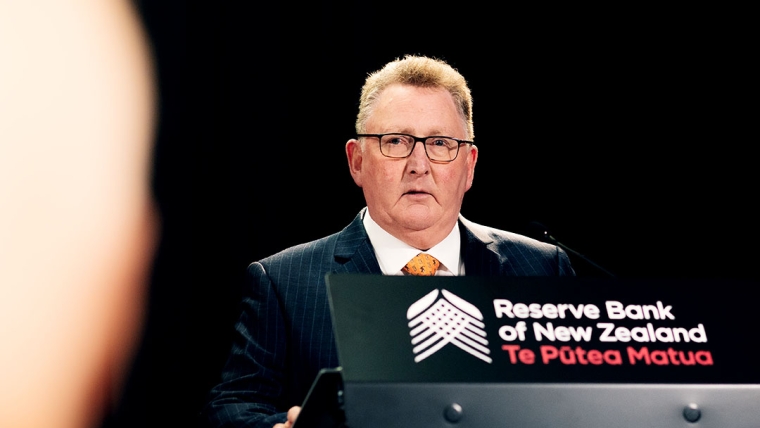
If the Reserve Bank of New Zealand (RBNZ) hoped its hawkish November monetary policy review would convince financial markets interest rates won't be cut until some time in 2025, it has failed.
Market pricing of the Official Cash Rate (OCR), which was already well below the RBNZ’s projections, has fallen further since the release of the Monetary Policy Statement (MPS) on Wednesday.
Analysis by ANZ Research, released Friday morning, showed traders were positioned for 72 basis points of rate cuts in 2024, up from 62 points prior to the release of the MPS.
There was a roughly 100 basis point gap between the OCR level the market's expecting in mid-2025, and what the central bank itself estimated just two days earlier.
The RBNZ lifted its OCR forecast to peak at 5.69% in the September quarter of 2024 and not be cut until half way through the following year.
Migration-led population growth is increasing demand for housing and adding to inflation pressures, the RBNZ said, meaning another rate hike could be needed to get inflation expectations back on target.
While there was an immediate reaction to the hawkish statement, with swap rates rising 12 basis points and the NZ dollar climbing half a cent, it didn’t last.
Texas hold’em
Jason Wong, a market strategist at BNZ, said the market was highly skeptical that monetary policy would need to stay restrictive for so long.
“The two-year swap rate ended the day up only six basis points to 5.23%, or up 10 basis points from the pre-MPS level, after global forces supported lower rates earlier in the session,” he wrote on Thursday.
David Croy, a senior strategist at ANZ, said bond traders were not convinced the RBNZ would make good on its threat and hike interest rates while the rest of the world was cutting.
Market participants would need a catalyst to reprice rates in line with the central bank’s projection. The OCR track itself is not enough to win them over.
“Markets think the RBNZ is bluffing and remain captivated by lower global rates, but even if the RBNZ makes good on its threat, that won’t happen till 2024, and in the meantime, markets are likely to continue dancing to a global beat,” he wrote.
Bond traders will watch economic data with the RBNZ’s upward bias in mind, but won’t reprice rates unless those updates demonstrate the need for tighter monetary policy.
Croy said local rates being roughly unchanged was a partial success for the central bank, since global rates are falling and NZ’s longer term rates tend to track with US bond yields.
Deadly serious
Jarrod Kerr, the chief economist at Kiwibank, said there was “a bit of disbelief” among traders right now, but market pricing might creep higher as they digest the new OCR track.
The RBNZ was running out of patience with inflation and its suggestion it might raise rates should be taken seriously. But repricing interest rates across the market to align with the RBNZ’s track would be a “huge” movement that wasn’t likely to happen overnight, Kerr said.
“It's only been 48 hours, we might see that hike get priced in over the next month or so”.
Christina Leung, the principal economist at NZIER, said she thought the RBNZ would hold the OCR at 5.50% until the middle of 2025. Its decision to raise the forecast track was a way for the bank to signal it was worried about near term inflation pressure and to stop retail rates from falling too soon.
“We don’t think they will have to act on it, and it is more about managing market expectations of when rate cuts will begin,” Leung said.
Leung said one and two-year inflation expectations were easing, although the gradual increase in 10-year expectations could be of some concern.
“It is definitely one to watch, as the Reserve Bank will not want inflation expectations to become unanchored”.
We welcome your comments below. If you are not already registered, please register to comment
Remember we welcome robust, respectful and insightful debate. We don't welcome abusive or defamatory comments and will de-register those repeatedly making such comments. Our current comment policy is here.