
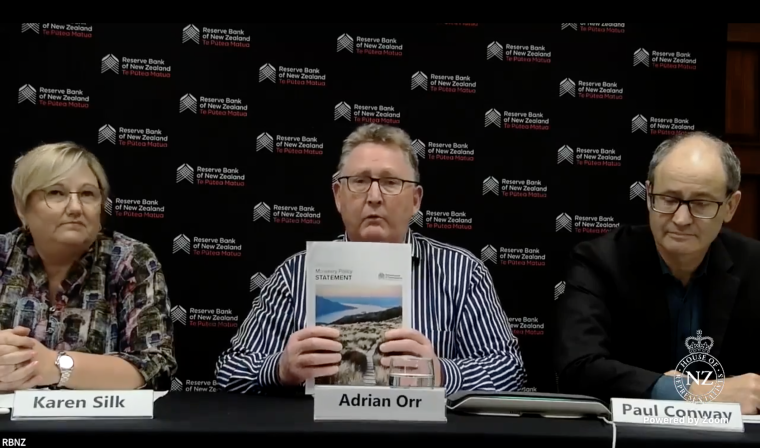
Falling headline inflation won’t be the main focus for Reserve Bank (RBNZ) policymakers heading into their first committee meeting of 2024 on Monday (February 19).
Rather, the central bank will zoom in on core inflation measures and other data points that signal where headline inflation might track in the next 18 months.
The RBNZ has forecast annual inflation, as measured by the Consumers Price Index, will be back in the target range by the end of September this year.
But that is not the job done. Governor Adrian Orr said, in a speech to Waikato University’s economics forum, the goal remains getting annual inflation to the midpoint of 2%.
Paul Conway, the central bank’s Chief Economist, reinforced this message in an interview.
“We’ve always had a focus on the midpoint in legislation. If you keep inflation at 2%, then shocks are less likely to put you outside of the band,” Conway said.
There has been some talk, notably from BNZ Head of Research Stephen Toplis, about whether the RBNZ should be shifting to a higher target to account for structural inflation pressure.
Orr’s speech on Friday morning could be seen as a rebuttal of this argument, as well as a possibility the coalition Government could seek to put a time limit on the inflation target.
It was impossible to ensure inflation hit 2% on any particular day and attempting to do so would result in volatile policy settings and economic outcomes.
Allowing the central bank to hit the target in “the medium-term” gives the RBNZ's Monetary Policy Committee space to respond carefully to noisy data, he said.
Static in statistics
But this shouldn’t be interpreted as a signal the committee would be willing to tolerate much noise in the current data they are looking at over the next nine days.
“Of course, if you are sitting in a period of high inflation and rising inflation expectations [then] our ability, or our appetite, to look through temporary price shocks is significantly reduced — and that has been the case over recent quarters,” Orr said.
The Governor explicitly said the central bank was targeting core inflation, which has been falling more slowly than headline inflation. Core inflation, the RBNZ says, is the estimated measures of inflation that's persistent and broad-based.
Monthly price indexes released by Statistics NZ this week showed inflation was still in decline but largely due to imported prices.
ANZ economists, who have predicted the Official Cash Rate will rise to 6% from 5.50%, said there was nothing in the data that would “materially change” the inflation outlook.
“The RBNZ needs to see more progress on non-tradables inflation to be confident overall inflation is returning to target in a sustainable timeframe,” they wrote in a note on Friday.
Paul Conway said there was very little difference between core and total inflation when you look a few years ahead. In essence, core inflation becomes the headline number over time.
“So, effectively given that we're forward looking, the difference between core inflation and headline inflation is pretty semantic. They all collapse into the same thing,” he said.
Headline inflation was 4.7% in the December quarter, down from a peak of 7.3% last year.
Different measures put core inflation between 3.9% and 5.9%, which were down from peaks between 5.7% and 6.8%.
Orr said these figures were moving in the right direction but there was still work to be done “tackling the tail end of these persistent inflation pressures”.
Fool me once
The RBNZ’s key core inflation measures, called factor models, are estimates that are calculated based on the quarterly consumer price index data.
This makes them subject to regular revisions and means they are not always an entirely accurate picture of inflation pressures in the real economy.
In his speech, Orr said real-time estimates of core inflation were “relatively subdued” in mid-2021 at around 2.2% or 2.3%.
“However, with the benefit of more data, these estimates now measure core inflation at 3% in the second quarter of 2021, the upper limit of our target”.
Sharon Zollner, chief economist at ANZ NZ, said this had contributed to the RBNZ underestimating emerging persistent inflation pressures.
“It serves as a reminder to markets, and other observers, that any one measure of core inflation will have its strengths and weaknesses rather than being the ultimate ‘truth’”.
She also noted the Governor’s speech was not intended to provide any guidance about future policy settings and there had been no market reaction.
Mark Smith, a senior economist at ASB, said the speech didn’t suggest any “imminent hurry to either raise or lower” interest rates.
There was a strong emphasis on hitting the midpoint of the target, as well as there being no perfect time frame to get there — which could be seen as providing wriggle room.
“It suggests that OCR hikes are not imminent but that the RBNZ will need to see concerted progress is being made in lowering core inflation before cutting the OCR”.
The seven-person Monetary Policy Committee begins its February meeting on Monday and will announce its new policy settings on Wednesday, February 28, the following week.
We welcome your comments below. If you are not already registered, please register to comment
Remember we welcome robust, respectful and insightful debate. We don't welcome abusive or defamatory comments and will de-register those repeatedly making such comments. Our current comment policy is here.