

Economists at the country's largest bank have changed their call and are now no longer forecasting official interest rate rises in the foreseeable future.
And in their Weekly Focus publication, the ANZ economists say the next interest rate move by the Reserve Bank is more likely to be a cut than a hike.
Recent extremely 'dovish' statements from the RBNZ - along with it moving out its forecasts for rate hikes - have prompted the country's economists to all sharpen their pencils regarding their own forecasts.
Westpac economists said last week they now saw a one in three chance of an official rate cut within 12 months.
Previously the ANZ economists had forecast a rise in the Official Cash Rate from November next year.
"The Reserve Bank is reluctant to hike; they made that abundantly clear in the recent Monetary Policy Statement," the ANZ economists said.
"And we see growth averaging 2½% over the next couple of years; hardly a stall, but considerably softer than the Reserve Bank’s expectation. That combination is not consistent with forecasting rate hikes.
"We are now forecasting that the OCR will be flat for the foreseeable future.
"Of course it is not that we literally believe the OCR will never be moved ever again; rather, we no longer believe on balance that the next move will necessarily be upwards.
"Indeed, given how long it is until a hike could plausibly be on the cards, the balance of risks is, if anything, tilted towards the next move being a cut.
"But the economy is muddling through for now. We still expect core inflation to rise further in the near term, reflecting previous strength in the economy. But beyond that, the resilience of underlying inflation does not look assured."
The economists said their previous growth forecasts "were already less optimistic than the RBNZ and we’ve tweaked them lower". Additionally, the RBNZ made it crystal clear that the hurdle to hikes is extremely high.
"To our minds, that combination is sufficient to warrant removing hikes from our forecast entirely."
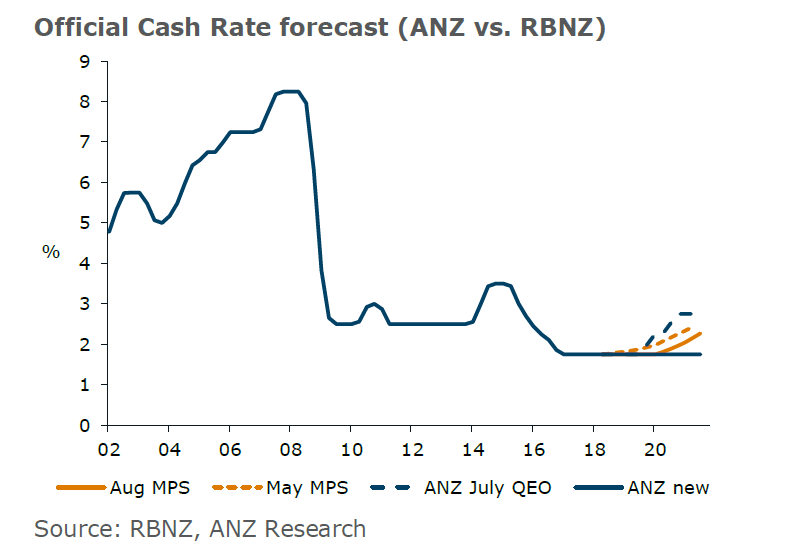
The economists said while they saw, if anything, the risks as skewed towards the OCR heading lower from here, they "will await further evidence before making that call".
"The key differences in our view versus the RBNZ’s expectations relate to the medium term. But of course there is much that can change the picture between now and then, and the near-term picture for both growth and inflation is decent. In light of that, we are comfortable biding our time."
The ANZ economists see the following developments as likely resulting in a hike:
A renewed lift in net migration or a marked fall in mortgage rates give the housing market another leg up.
Low surveyed activity indicators turn out to have very little impact.
Wage pressures broaden and impact on inflation in a cost-push fashion.
Inflation expectations lift on the back of higher CPI inflation.
"On the other hand, there are a number of risks that, should they come to fruition, could see an OCR cut eventuate, potentially in short order," they say:
Global/China growth slows more sharply than expected; the terms of trade take a tumble.
Bank funding costs increase due to a global risk aversion spike.
The housing market is weaker than expected, perhaps due to a faster fall in net migration.
Near-term consumption disappoints: the Families Package is trumped by higher petrol prices and a cooler housing market.
Businesses cut back on investment to the extent indicated in surveys.
Construction sector woes have negative flow-on impacts into the broader economy.
Drought.
The economists say the new committee OCR decision-making structure the RBNZ is moving to adds another level of uncertainty for RBNZ watchers.
"Perhaps a Committee will prove more likely to backstop growth. Or maybe it will have a degree of inertia that isn’t associated with a single decision maker. It is impossible to know, but it makes any forecast less certain. And making long-term forecasts of the OCR is a tricky business at the best of times."
We welcome your comments below. If you are not already registered, please register to comment
Remember we welcome robust, respectful and insightful debate. We don't welcome abusive or defamatory comments and will de-register those repeatedly making such comments. Our current comment policy is here.