

So, two big questions face us with the forthcoming release of Consumers Price Index (AKA inflation) figures for the June quarter.
Question one is, will we crack the '7' this time? (Spoiler alert - very probably and it will be, as Westpac senior economist Satish Ranchhod aptly describes: "The not-so-magnificent seven.")
Question two - and this is the real biggie - will this be the peak?
Statistics New Zealand unveils the data on Monday (July 18).
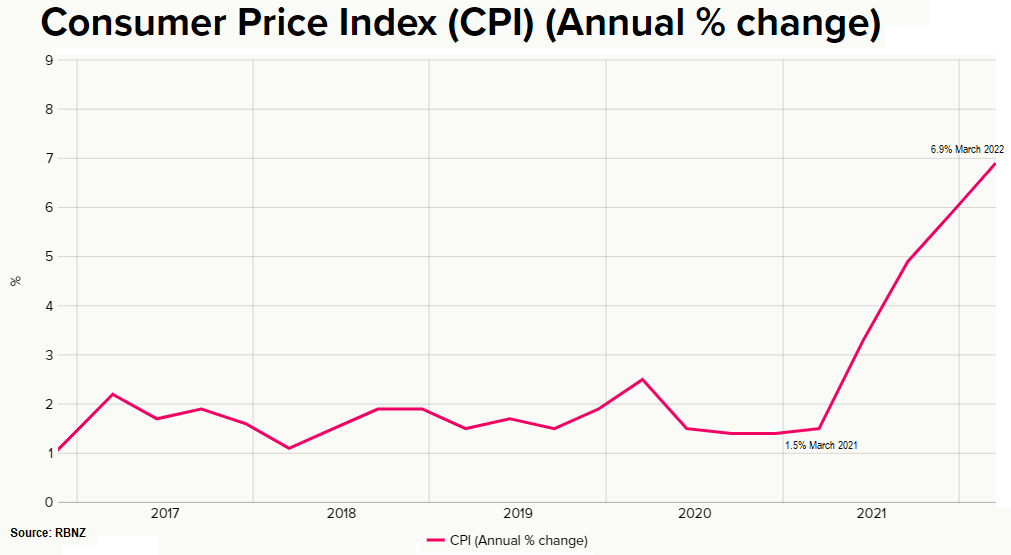
Economists expect that annual inflation, having just come up shy of 7% for the March quarter, with 6.9%, will make the '7' mark this time - for the first time in over three decades.
Wow, how did this happen?
A year ago the Reserve Bank (RBNZ) forecast that the annual rate of inflation as of June 2022 would be just 1.5%. Slight undershoot in expectations there - but the central bank was by no means alone in that. By no means.
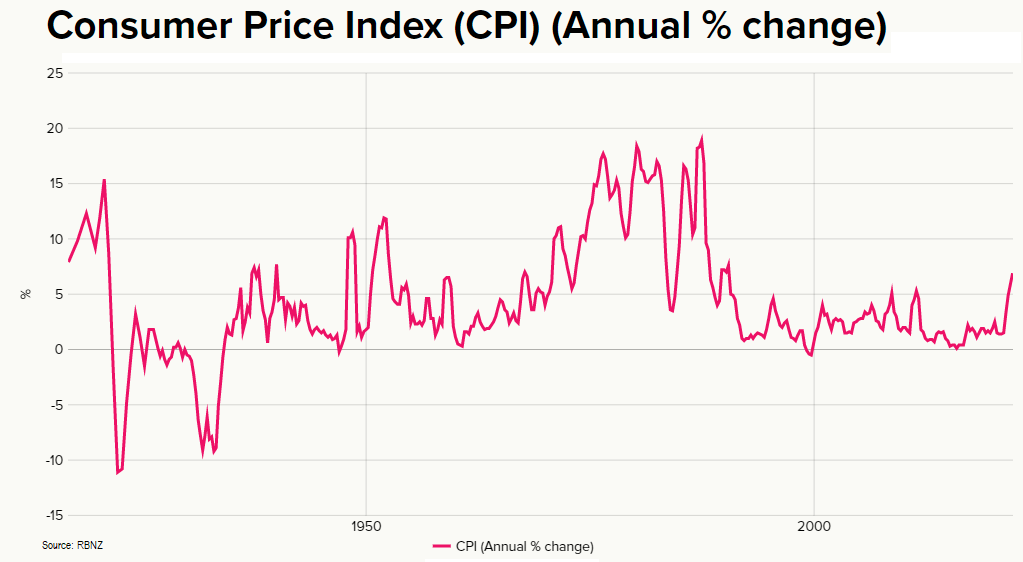
Anyway an inflation figure of 7% or possibly even slightly higher means the inflation rate will be the highest in 32 years.
Here's a graph going all the way back to 1916, courtesy of the RBNZ, that gives historical perspective.
And here's another one featuring the more recent past and highlighting how dramatic the move upward has been.
Will the June quarter figure prove to be the peak though?
Economists think so. The Reserve Bank, which is pretty interested in the subject, thinks so too. The RBNZ, which is charged with keeping inflation between 1% and 3%, has forecast (as of its May Monetary Policy Statement) that the annual rate will be exactly 7.0% for the June quarter, before falling to 6.2% in the September quarter.
However, the RBNZ is not forecasting for the CPI to get back to under the 3% ceiling of its targeted range till December of next year. So, inflation is going to be elevated for a while yet.
What's more though, economists are growing pretty doubtful that the RBNZ will get the inflation beast back into its box even within the kind of timeframe it is talking about. So even though we could be about to see the peak, it doesn't mean that inflation will necessarily fall quickly from here.
The RBNZ has been talking tough and indicating that slaying inflation is everything at the moment. It has increased the Official Cash Rate by 225 points (to 2.5%) in the past nine months, with a 50 point rise on Wednesday (July 13). The RBNZ is fearful that people's expectations of future inflation will rise.
Killing inflation expectations can almost be seen as the biggest immediate priority for the central bank. That's because if people expect prices to be higher in future, well, they will put prices up and that will feed into inflationary behaviour. It could become self-fulfilling. High inflation could be around for some time.
It's worth noting that the next edition of the RBNZ's own Survey of Expectations - which canvasses the views of experts on expected future levels of inflation - comes out on August 8, a little over a week before the RBNZ next reviews interest rates. The results of this survey will likely be very influential on what the RBNZ decides.
As for what we can expect for the CPI inflation release, the main suspects in terms of helping to cause the '7' are expected to be fuel (as you will have noticed), housing related costs (as you will have noticed) and food (as you most certainly will have noticed). In reality though, and worryingly, the inflationary pressures have become remarkably widespread.
As ever there will be keen interest in the division between the so-called tradeables inflation from imported goods (such as the ever-volatile petrol) and non-tradeables, which are domestically-generated sources of inflation.
It's the latter, the 'non-tradeables', the price rises generated right here in NZ that are the most problematic for the RBNZ.
Economists are expecting that 'non-tradeable' inflation will again be around or over 6% when the latest data is released (and it was exactly 6.0% in March). The RBNZ's still got work to do. Plenty.
And so, regardless of whether our not-so-magnificent seven inflation figure does prove to be the peak, questions will remain about whether inflation is likely to recede that quickly again either, and what might therefore happen to inflation expectations.
This is all crucial when it comes to interest rates.
There are those out there hopeful that mortgage rates, having rocketed this year, might have peaked.
It's simply too early to say that, not when the US is still producing red-hot inflation figures, and not when any higher-than expected inflation figure here might start forcing our wholesale interest rates up again. Plenty of water to go under the bridge.
So, what are the economists making of all this? Here we go:
Westpac's Ranchhod says there’s been "no relief from the intense price pressures that have been buffeting New Zealand households".
"We’re forecasting a 1.4% rise in consumer prices in the three months to June. Coming on the back of the strong price rises in previous months, that would take the annual inflation rate to 7.0% - up from 6.9% last quarter and the highest annual rate in more than three decades."
He notes that much of the rise in consumer prices over the past three months (and over the past year) relates to three key areas – fuel, food and housing costs.
"However, the strength in inflation isn’t limited to a few areas. Rather, price pressures are bubbling over in every corner of the economy, boosted by a cocktail of supply-side cost increases and strong consumer demand.
"On the cost side of the ledger, businesses continue to grapple with disruptions to global supply chains and the related difficulties sourcing both consumer goods and raw materials.
"Operating costs have also been boosted by elevated global prices for commodities such as oil. And on top of those factors, wage costs have been pushing higher as businesses have struggled to attract and retain staff.
"But while shortages of staff and materials have boosted inflation, what’s really lit a fire under consumer prices has been the strength of demand. Indeed, if we look at the areas where businesses are reporting significant shortages of supplies, they’re predominantly in areas where demand has been strong, like the retail and construction sectors. In other words, the economy’s productive capacity hasn’t been able to keep up with the lift in demand since health restrictions were eased, and that’s resulted in prices ratchetting higher.
"That strength in demand is important for two reasons. First, it’s given many businesses greater scope to pass on cost increases into output prices, rather than just taking a hit on margins. Second, if demand is strong, inflation is likely to remain elevated even when the current pressure on operating costs (eventually) eases off. And that’s a big concern for the RBNZ, as a key factor underpinning the strength of household demand has been stimulus from low interest rates. In fact, that’s a key reason why the RBNZ has been raising the Official Cash Rate at such a rapid pace in recent months," Ranchhod says.”
ASB senior economist Mark Smith says the speed at which inflation has climbed has surprised "just about everyone (us included)". He's picking a figure of 7.1% for annual inflation.
"Once again, higher tradable goods prices should feature as a reminder that high inflation rates are not unique to NZ. Non-tradable and core inflation rates, however, are expected to remain sticky, with annual readings at (or close to) multi-decade highs," Smith says
"The inflation outlook is still highly uncertain, but annual CPI inflation looks to have peaked this cycle. Despite this, inflation is considerably above the [RBNZ's] 1-3% CPI inflation target with the risk of annual CPI inflation staying outside the inflation target for considerably longer than expected by the RBNZ. Another 150bps of OCR hikes by the end of the year looks to be needed, and while we have pencilled in OCR cuts for 2024, high inflation will need to be conquered first."
Smith expects annual inflation to have peaked, but for the deceleration in headline inflation to be slower than RBNZ expectations. He says ASB research points to the risk of high inflation rates persisting for longer, particularly if the labour market remains tight.
"It would up the ante on the RBNZ delivering a more front-loaded pace of OCR hikes to lean against inflationary pressure. It is our expectation that the OCR would end 2022 at 3.50%, around 100-150bps above neutral levels, with the 275bps of hikes for calendar 2022, the largest increase for a calendar year on record. Hopefully, this will be sufficient to break the back of inflationary pressure and allow the OCR to eventually head to less restrictive settings. We have pencilled in OCR cuts from 2024 but this will depend on there being sufficient slack in the labour market, something that is sometimes outside of the RBNZ’s control.
"There is still a lot priced into wholesale interest rates despite the recent pullback and there appears to be limited scope for NZ yields and the NZD [NZ dollar] to gap higher from an upward inflation surprise. With the growth outlook looking wobbly we are likely to see more pronounced currency and rate moves from a more benign set of numbers for headline and non-tradable inflation close to (or below) RBNZ expectations," Smith says.
ANZ economist Finn Robinson and chief economist Sharon Zollner are also picking 7.1% annual inflation.
"Uncertainty remains high, with global commodity prices being buffeted by geopolitical developments, and trading partner inflation continuing to surge. Domestic inflation risks are firmly to the upside, given still-high inflation expectations and an extremely tight labour market. We expect annual non-tradables inflation remained high at 6.0%, while tradables is expected to have nudged up to 8.7% y/y (8.5% previously)," they say.
"The RBNZ is unlikely to find any comfort in next week’s data – and that should see another 50bp hike delivered at the August MPS, despite downside growth risks piling up. If we were to see a non-negligible upside surprise to the CPI print, another 50bp in October would be game on. The RBNZ has no leeway to take any chances on the inflation front."
Robinson and Zollner say the inflation data will be a reminder that "even though downside growth risks are accumulating, public enemy number 1 remains inflation".
"Underlying inflation pressures have continued to build – and with non-tradables inflation likely to remain far too high over the next year, the pressure is on for the RBNZ to rein inflation in.
"That said, it is currently our expectation that the RBNZ will pause hiking at the end of this year, as demand falls away a little faster than they currently anticipate. A soggy outlook for consumer spending and a housing market in decline should take significant heat out of the economy. Now that we’re a full 12 months past the record-low mortgage rates seen during 2021, many mortgage-holding households will be feeling the effect of higher interest rates. We’re forecasting another 50bp hike in August, followed by 25bps in both October and November.
"From there, we are forecasting the RBNZ to pause, with the OCR at 3.5%, as signs of slowing demand become evident.
"However, everything comes down to inflation. The RBNZ will need to see firm evidence that they’ve hit demand hard enough to contain inflation. If that evidence fails to emerge, then don’t expect the RBNZ to ease off the interest rate brakes any time soon – even if growth starts to fall away. And any meaningful upside surprise to the CPI starting point in Monday’s data would make another 50bp hike in October considerably more likely. In the May MPS, the RBNZ expected non-tradables to ease to 5.7% in Q2, versus our expectation it stayed flat at 6.0%. If we’re right, that would suggest a more persistent domestic inflation pulse than the RBNZ has forecast," Robinson and Zollner say.
Consumer prices index
Select chart tabs
*This article was first published in our email for paying subscribers. See here for more details and how to subscribe.
We welcome your comments below. If you are not already registered, please register to comment
Remember we welcome robust, respectful and insightful debate. We don't welcome abusive or defamatory comments and will de-register those repeatedly making such comments. Our current comment policy is here.