
Assessing and projecting how exchange rate values may change as a result of market and economic trends/swings is nigh impossible in the current environment as we experience an unprecedented stop in economic activity around the world.
It is not possible to have any accuracy in estimating how long and how deep the economic downturn will run.
No-one can forecast with any confidence about anything.
Alternative scenarios are published; however, these are changing daily as events unfold. Economic, investment and business news that normally influences the direction of free-floating exchange rates have been swamped out by reactive/panic decisions by global fund managers to return their money immediately back to home base.
The Kiwi dollar was caught in the crossfire of this frenzy last week as US investors, in particular, sold out of foreign equity and bond holdings in a mad scramble to return their funds to US dollars - the fund managers requiring the US dollars to meet their own margin calls and client fund redemptions. Foreign participation in our bond and equity markets has generally been a positive thing in the past, however it does leave the currency vulnerable to wholesale disinvestment in global shocks that are nothing to do with New Zealand.
Whip-sawing price action in wild and dysfunctional FX markets
Large scale sell orders on the Kiwi dollar to buy US dollars were unable to be met in the forex market over this last week, resulting in a second “flash-crash” in the NZD/USD rate from 0.5950 to 0.5480 on 19 March; illiquid market conditions and a total absence of NZD buyers created the free-fall situation. Since that plummet in the rate on 19 March, the Kiwi dollar has whip-sawed up and down between 0.5500 and 0.5900, finally displaying signs of settling around 0.5700. The USD has continued to strengthen against the major EUR, GBP and JPY currencies as share markets collapse and US fund managers disinvest their offshore assets to shore-up their home positions.
The global shortage of US dollars last week due to the aforementioned demand, prompted the US Federal Reserve to provide currency swap facilities with other central banks around the world, including the RBNZ.
The speed of the NZ dollar depreciation raised the spectre of whether the RBNZ would be considering direct FX market intervention to stabilise the NZ dollar in disorderly and dysfunctional market conditions. It is a high threshold or hurdle to intervene, the criteria or prerequisites being:-
- The NZ dollar currency value must be exceptionally high or low.
- The exchange rate level must be unjustified by economic fundamentals.
- Intervention must be consistent with the RBNZ’s Policy Target Agreement.
- Conditions in the FX market must be opportune and allow intervention a reasonable chance of success.
While the RBNZ would have been monitoring the markets last week, it is doubtful that all four pre-conditions for intervention would have been fulfilled.
In my view, the NZD/USD rate would need to be trading below 0.5000 to meet the first and second prerequisites. However, the pressure is on the RBNZ to intervene in the local interest rate/bank funding markets ASAP as long-term interest rates increase (due to more Government bond issuance and absence of foreign buyers), a perverse outcome when the OCR was slashed 0.75% to reduce interest rates across the yield curve.
The world is changing fast and we now need your support more than ever. Quality journalism is expensive and in these very troubled times our ad revenues are becoming very uncertain. We provide our coverage free to readers, and if you value that, we ask that you Become a Supporter. To do that, either click on the Red button below, or on the Black button at the top of this page. The level of your support is up to you. Thank you. (If you are already a Supporter, you're a hero.)
When and how will Government fiscal rescue packages work?
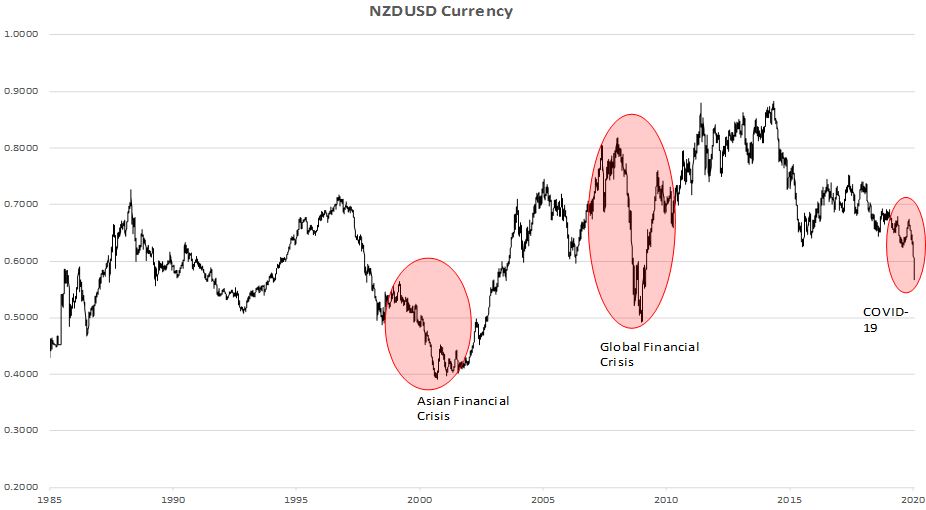
Australia is about the announce their second and much larger Government fiscal package, the US is set to announce a US$2 trillion aid deal/relief package and Germany is considering a US$380 billion in new debt to fight the coronavirus crisis. However, in terms of potential impact on the NZ dollar value, we await the size and scale of the inevitable Chinese Government fiscal package. The Chinese saved the global economy in 2010 with massive infrastructure spending and they will do the same again as a global recession decimates their manufactured exports. After plunging to 0.5000 during the GFC in 2009 (refer chart below), the NZD/USD exchange rate reversed sharply higher in 2010 to 0.7500 as commodity prices soared (higher AUD) from the Chinese demand for raw materials/commodities.
The chance or probability of China implementing the same policy in 2020? – much greater than 50% in the viewpoint of the author.
Short-term demand for USD’s will run out, and then what?
Whilst the mad scramble for the US dollar has strengthened the rate to $1.0700 against the Euro over the short-term, the medium-term outlook for the US unit is set for a serious depreciation for the following reasons:-
- The US economy will potentially be hit harder than others, requiring large-scale Fed Quantitative Easing – a major US currency negative.
- The increased size of the US internal budget deficit and Government debt levels.
- An over-valued USD is extremely damaging to the global economy as emerging market economies struggle to keep afloat.
- Coordinated central bank FX market intervention to weaken the US dollar is very much on the cards as another mechanism to return confidence and growth in the aftermath of the virus shock.
The NZD/USD exchange rate will not remain at these lower levels if and when the US dollar depreciates for the above reasons.
NZ exporter profitability key for economic recovery
The rapid NZD depreciation to 0.5700, without the typically related large decreases in our key export commodity prices, provides a rare opportunity for our primary industry exporters to hedge forward USD receipts and lock-in significant profit margins. Increased business Investment and jobs in our economy come from increased and secure future profits. Many USD exporters have already hedged forward in the low 0.6000’s, however they now need the support of their bankers to provide the FX dealing limits to hedge even larger amounts further forward. When the Kiwi dollar was at 0.5000 in 2009 many exporters at that time wanted to hedge large volumes, however they were restricted from doing so due to their bankers being overly worried about the unrealised marked-to-market losses on existing FX contracts. The Government and Adrian Orr at the RBNZ are asking the banks to be supportive of business in these challenging times. Providing the facilities for companies to secure their future profits through prudent FX hedging is one way the banks can help the economy recover.
Sign up for our daily Currency email.
Daily exchange rates
Select chart tabs
*Roger J Kerr is Executive Chairman of Barrington Treasury Services NZ Limited. He has written commentaries on the NZ dollar since 1981.
We welcome your comments below. If you are not already registered, please register to comment
Remember we welcome robust, respectful and insightful debate. We don't welcome abusive or defamatory comments and will de-register those repeatedly making such comments. Our current comment policy is here.