

Summary of key points:
- Threat of negative interest rates pushes the Kiwi lower
- Jawboning of the Kiwi down never lasts too long
- RBNZ contention that a lower NZD benefits the economy does not stand up to scrutiny
Threat of negative interest rates pushes the Kiwi lower
Another week, another Reserve Bank of New Zealand (“RBNZ”) monetary policy statement and another dip in the Kiwi dollar as a result.
The NZD/USD exchange rate reacted adversely to the RBNZ monetary policy messaging, the Kiwi unit depreciating almost two cents from above 0.6100 last week to 0.5935 on Friday 15 May.
Over the last two years the RBNZ have consistently delivered a message to the financial markets, the business community and the public that an appreciation of the Kiwi dollar is bad for the economy and that further depreciation will assist them to achieve their dual objectives of stable inflation between 1% and 3% and stronger employment.
Up until recently the cutting of the OCR has been the method to reduce the attractiveness of the Kiwi dollar and cause it to fall. Now we have quantitative easing (“QE”) as an additional tool and the announcement that the amount of QE is to increase from $33 billion to $60 billion simply adds to the supply of NZ dollars and reduces its value.
The increase in QE was widely anticipated beforehand, so that was not the major factor in forcing the Kiwi lower last week.
The fact that the RBNZ have not ruled out negative interest rates in March 2021 if they need to go there, was designed to push the NZ dollar lower.
The jury is still very much out on whether negative interest rates are an effective monetary policy instrument to stimulate economic activity and lift inflation. The evidence from both Japan and Europe who have implemented negative rates over recent years would suggest very limited success.
The Reserve Bank of Australia have appeared to have dismissed negative interest rates as an effective method, citing that they do not necessarily change investor and borrower behaviour in the economy. Last week the US Federal Reserve also dismissed negative interest rates as a policy, Governor Jerome Powell stating that they “do not see negative interest rates as likely to be an appropriate positive response here in the United Sates”.
It is highly unlikely that the RBNZ would do the opposite of the Fed and RBA, therefore Governor Orr is merely using the threat of negative interest rates as part of his “jawboning” tactic to depreciate the Kiwi dollar. If we have to resort to negative interest rates in March 2021, it will be that the economy is still in one enormous hole due to the pandemic.
That scenario has a very small probability given all the current monetary/fiscal stimulus, close to Covid-19 eradication in New Zealand and likely preventative vaccines by year-end.
Jawboning of the Kiwi down never lasts too long
Any analysis of daily NZD/USD exchange rate movements over the last two years confirms that the RBNZ’s predisposition and preoccupation that a lower currency value is desirable and beneficial for the economy has not really worked.
The consistent pattern of NZD/USD movements is that the rate declines immediately on the RBNZ statement/OCR change, however within a few days or a week or two it is back to the pre-announcement level.
The impact is only ever short-term and temporary as the more fundamental forces on the NZD/USD exchange rate such as the USD itself, the Aussie dollar, commodity prices and economic data take over as the dominant determinants. The global equities market sell-off in mid-March due to the pandemic/economic shock causing the recent Kiwi dollar depreciation.
In 2018, the RBNZ’s 10 May, 9 August and 8 November monetary policy statements all caused very temporary dips in the Kiwi dollar.
In 2019, the statements on 8 May and 7 August (0.50% OCR cut) also resulted in the short-lived NZD depreciation.
The 13 November 2019 and 12 February 2020 statements were more positive affairs as the RBNZ belatedly realised the economy was travelling a lot better than they had earlier forecast. Due to the stronger economy, inflation increased to 2.8% by 31 March 2020, making a mockery of the 0.50% OCR cut in August 2019 which was designed to prevent deflation! Of course the Covid-19 pandemic and economic shock over recent months has saved the RBNZ from an embarrassing monetary policy boo-boo.
On the historical evidence, the current Kiwi dollar dip to 0.5935 should not last too long, particularly as the US dollar weakens on their rapidly deteriorating economic numbers and massive QE from the Fed.
One downside risk for the Kiwi dollar is the potential for another US equities market sell-off if it becomes clear that there is a second-wave of Covid-19 infections in the US as too many states re-open from lockdown too early (encouraged to do so by President Trump!). Let us all hope that that the second-wave does not occur.
RBNZ contention that a lower NZD benefits the economy does not stand up to scrutiny
As I commented in my mid-week FX market update to clients last week, if a constantly depreciating exchange rate value was the correct policy prescription to economic nirvana then Zimbabwe and Venezuela would be economic powerhouses and Switzerland would be a banana republic!
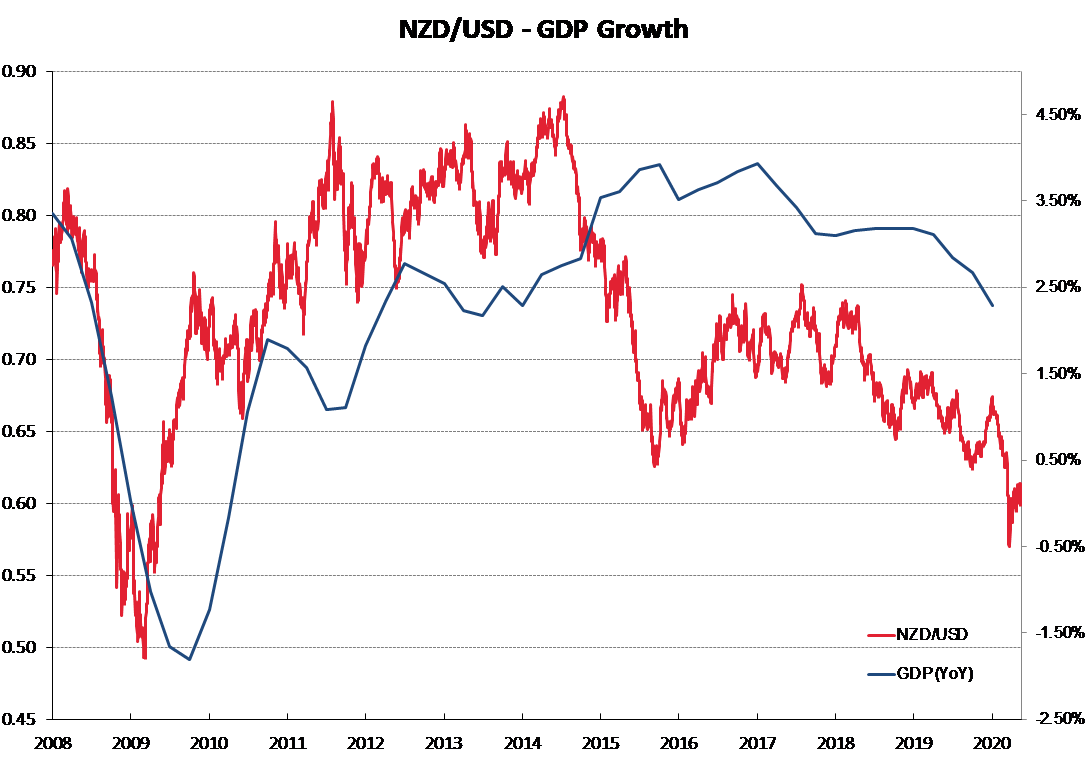
An examination of New Zealand’s GDP growth performance over the last 10 years also confirms that we produced increased growth to 4% pa when the Kiwi dollar was appreciating and strong from 2010 to 2015. GDP growth has reduced back to 2.5% over the last five years in a period when the NZ dollar has generally depreciated. Agricultural exports and tourism are dominant parts of our economy and the NZ economy performed to a higher level in the 2010 to 2015 period of currency appreciation, not depreciation.
The RBNZ’s rationale that we always need a lower NZ dollar to help the export sector and thus the economy, does not stand up to scrutiny.
The argument for a lower dollar value is that it helps profitable production growth and investment in the export sector and thus benefits the overall economy. As covered in last week’s column, the export benefits are often temporary and it forces exporters to sell on price alone, not quality and added-value.
Offshore buyers of our commodity exports simply drop their USD prices offered when they see NZD depreciation benefiting the NZ exporter. Most exporters want a stable exchange rate environment, not a volatile one caused by the RBNZ. Manufacturing exporters also like a higher NZD value from time to time as it allows them to buy new imported machinery at an entry cost that is viable and produces the required financial returns from the investment/asset.
Daily exchange rates
Select chart tabs
*Roger J Kerr is Executive Chairman of Barrington Treasury Services NZ Limited. He has written commentaries on the NZ dollar since 1981.
We welcome your comments below. If you are not already registered, please register to comment
Remember we welcome robust, respectful and insightful debate. We don't welcome abusive or defamatory comments and will de-register those repeatedly making such comments. Our current comment policy is here.