
By Gareth Vaughan
Here's the return of our monthly currencies outlook and review with HiFX's senior dealer Dan Bell. This month we look at whether the US Federal Reserve will unveil plans to start tapering off its US$85 billion a month bond buying, or quantitative easing (QE) or money printing, programme later in December.
Key US jobs data out Friday night New Zealand time showed back-to-back monthly payroll gains of 200,000 and the unemployment rate down to 7% from 7.3%. This is heightening expectations the Fed will announce it's reducing bond buying at the December 17-18 Federal Open Market Committee (FOMC) meeting. Some 34% of economists surveyed by Bloomberg now expect the Fed will begin tapering this month, up from just 17% on November 8.
But Bell reckons a cautious Fed isn't quite ready to fire the start gun yet.
"They probably should (start tapering) but they probably won't," says Bell.
He notes the November jobs growth of 203,000 was ahead of the 185,000 expected and the drop in the unemployment rate was also better than expected. The figures suggest unemployment is trending down towards the Fed's 6.5% target.
"A much stronger employment situation in the US probably should be enough to see the Fed start tapering some of this bond purchasing that they've been doing for the last few years, (but) they're a pretty cautious bunch. They're a pretty dovish bunch of central bankers up there in the US. And this is (chairman) Ben Bernanke's last FOMC so maybe he's just going to let it ride and hand the reins over to Janet Yellen and she can kick off the tapering maybe early next year," says Bell.
Entering its sixth year of QE, the Fed is currently buying US$45 billion in long-term Treasury bonds and US$40 billion of mortgage-backed securities monthly, as it strives to boost the economy by pushing down long-term interest rates to encourage borrowing, spending and hiring. The Fed's overnight bank lending rate has also been at between zero and a quarter percentage point since December 2008.
'They (the Fed) are a little bit behind the curve'
But Bell says key US economic indicators on the US economy, the world's biggest, show it's strengthening, meaning the Fed will start tapering next year with the New Zealand dollar likely to weaken against the greenback.
"I think ultimately the Fed will start tapering next year. I think they (the Fed) are a little bit behind the curve. They have been cautious this year. They wanted to see this really sustainable recovery in the US economy which we are seeing if you look at employment, housing, manufacturing," says Bell.
"A lot of the key, hard indicators in the US are doing very well. Their GDP growth last week coming in at an annualised rate of 3.6%, so they're essentially one of the strongest economies in the world at the moment but they've still got this ultra loose momentary policy."
"There has been more doves in the Fed over the last few years, but I think there could be a little bit more of a hawkish change early next year," says Bell. "And I think the long-term rates in the US will go up so US 10-year Treasury yields will be up over 3.5% at some stage next year."
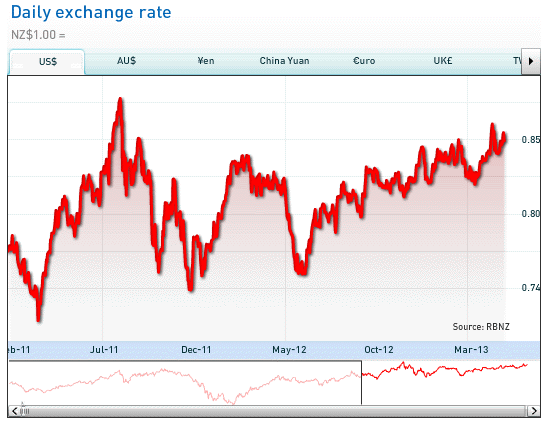
"The New Zealand dollar is still sitting around the US82c mark which is quite strong based on historical averages. I think it would be feasible to see it back down into the mid 70s if we did see the US central bank really start to remove some of the stimulus and their economic data and bond yields start to go up," Bell adds.
What will the RBNZ say about the NZ dollar?
Meanwhile, the Reserve Bank of New Zealand will review the Official Cash Rate on Thursday. It has been at 2.50% since a 50 basis point cut on March 10, 2011 following the devastating and tragic February 22 Christchurch earthquake. Like most observers Bell is again expecting no change. However, what the Reserve Bank says, including about the strong Kiwi dollar, will be watched closely.
"I think the cash rate will stay at 2.5%. The RBNZ has already given us a heads up that we are going to see some tightening next year. I see the market's pricing in about a 40% chance of a rate hike in January next year, but this week will be steady as she goes," says Bell.
"There might be some comment about the stronger Kiwi. We have been a little bit weaker against the euro and the pound. I can see why we're weaker against the pound, the UK economy's looking a little bit better."
But a five-year high against the Australian dollar above A91c is a concern, Bell says, especially given Australia is a key market for New Zealand manufacturers.
"That's going to erode the upside of exporting to Australia and maybe take some momentum out of the more productive side of the economy."
----------------------------------------------------------------------------
Dan Bell is the Senior Dealer at HiFX, a UK-headquartered foreign exchange dealer with significant operations in Australia and New Zealand. It has a dealing room in Auckland. See more detail here.
We welcome your comments below. If you are not already registered, please register to comment
Remember we welcome robust, respectful and insightful debate. We don't welcome abusive or defamatory comments and will de-register those repeatedly making such comments. Our current comment policy is here.