
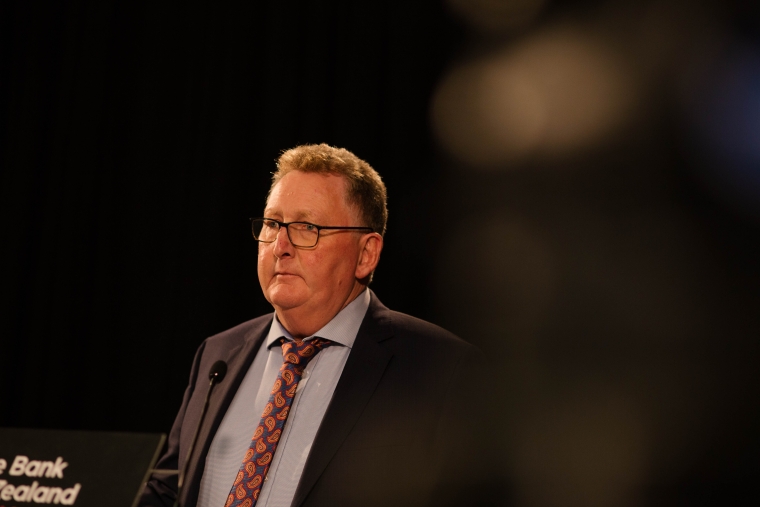
Some economists say the chance of an Official Cash Rate (OCR) hike has increased after Wednesday’s labour market data came in stronger than expected.
Employment in New Zealand held fairly firm throughout 2023 despite rising interest rates, a slowing economy, and record net migration.
The unemployment rate rose just 0.1% percentage points in the last three months of the year from 3.9% to 4%. This was below consensus expectations of around 4.3%.
Other employment metrics also weakened but not to the extent some were expecting.
Henry Russell, an economist at ANZ, warned this could prompt the Reserve Bank of New Zealand (RBNZ) to lift the OCR from 5.50% to 5.75% at its next review on February 28.
“A 25 basis points hike later this month has become a very real possibility, and RBNZ Governor Orr’s speech on 16 February could raise the market-perceived probability of a hike further,” Russell said.
One-in-five chance
Market traders were pricing in a 20% chance of an increase by midday Wednesday, up from just 5% prior to the data release.
At the last RBNZ meeting in November, the Monetary Policy Committee signalled it would not be willing to tolerate any upward surprises in economic data.
Inflation had been above target for too long and the committee was impatient to get it back to the 2% midpoint without any further delays.
While economic data was moving in the right direction overall, there had been small surprises on consumption, non-tradable inflation, and now labour data as well.
Russell said the RBNZ could interpret this as being enough to trigger the rate hike it warned was possible late last year.
“That said, today’s data have not materially changed our labour market outlook and we continue to expect a rapid loosening in the labour market across 2024, taking the unemployment rate to over 5%”.
Right direction, too slow
Michael Gordon, an economist at Westpac NZ, said the unemployment rate was a valuable real-time indicator of how hot the economy has been running.
The RBNZ has been watching to see if an OCR of 5.50% had slowed the economy enough to bring down inflation. Statistics NZ's Consumers Price Index put annual inflation at 4.7% in the December quarter.
“And while activity is clearly cooling, the unemployment rate suggests that they haven’t made as much progress as they would have hoped at this point,” Gordon wrote in note.
Westpac said stronger data was more likely to delay rate cuts than prompt an increase to 5.75%.
Stephen Toplis, head of research at BNZ, said it was worth asking whether the RBNZ might actually hike the OCR after all.
“We have been warning that the chance of a February rate hike was non-zero. That non-zero chance has now got a little bigger,” Toplis said in a note.
Leaders at the central bank had downplayed the significance of downside data surprises in gross domestic product and the consumer price index.
“It’s difficult to imagine that [labour data] will be downplayed given they support the RBNZ’s general sense of nervousness about the economy’s inflationary outlook," Toplis added.
Like Westpac, BNZ stuck with its prediction that the central bank would leave the OCR unchanged in February but retain its hawkish bias.
Gareth Kiernan, chief forecaster at Infometrics, said he expected unemployment to rise to 5% in the second half of 2024, which would allow for OCR cuts to begin in August.
“With the unemployment rate back to a neutral level of 4%, the key for the Reserve Bank now is to see a more definite easing in labour cost pressures, to give the Bank confidence that lingering wage growth will not lead to more persistent inflation during 2024/25”.
We welcome your comments below. If you are not already registered, please register to comment
Remember we welcome robust, respectful and insightful debate. We don't welcome abusive or defamatory comments and will de-register those repeatedly making such comments. Our current comment policy is here.