

So are we ready for the latest episode of the Reserve Bank's great juggling act?
That's right. It's that time again. The RBNZ is having its latest review of the Official Cash Rate on Wednesday, July 10. And again this will be the cue for our central bank to juggle with, on the one hand reassuring us it is on track to quell inflation, but on the other hand steadfastly refusing to give us any clues at to when the OCR may be cut. And this of course at a time when there is a growing clamour for lower interest rates.
The very easiest of things to forecast about the July 10 event is that the RBNZ will NOT be changing the OCR at the moment. That's a slam dunk.
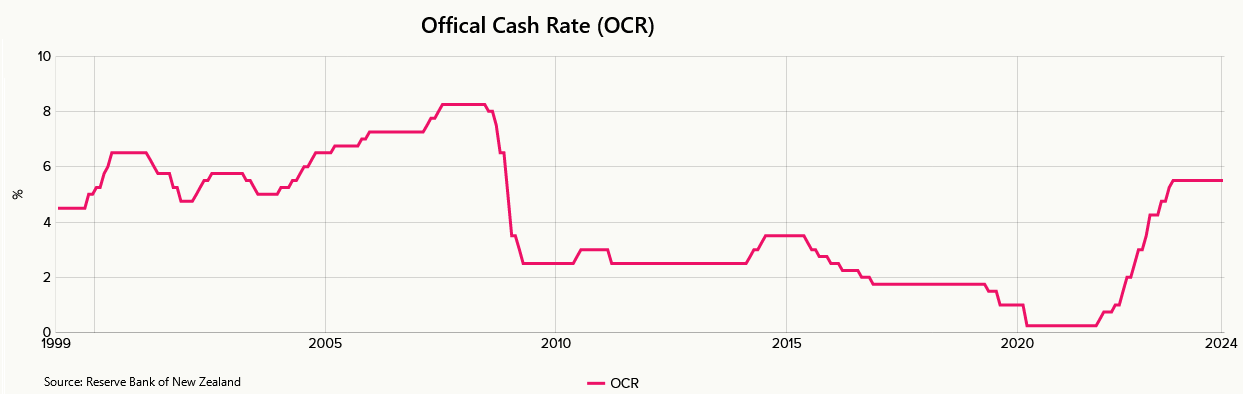
The OCR will remain at 5.50%, where it has been since May 2023 - on hold following a super-aggressive round of hikes that brought it all the way up from just 0.25% as of the start of October 2021 to the aforementioned 5.5%.
The series of OCR hikes that we saw was the RBNZ's response to galloping inflation that charged all the way up to a peak of 7.3% in the middle of 2022. Remember, it's the RBNZ's job to keep inflation between 1% and 3%, with a specific target of 2%. That's the theory.
Well, inflation has now been outside of the 1% to 3% range for over three years. Which is a while. The most recent annual inflation figure as measured by the Consumers Price Index (CPI) was 4.0% as of the March quarter.
Somewhat frustratingly, the June quarter CPI figures - which will be so vitally important - are being released on July 17, exactly a week after the forthcoming OCR review. (I'll write a full preview of the CPI figures closer to the time.) However, as some indication of what we might expect inflation-wise, the fairly recently introduced monthly Selected Price Indexes, which account for around 45% of what's in the CPI, have been moving very much in the right direction, and food prices had their smallest increase in five years in the 12 months to May.
The RBNZ is forecasting that annual inflation as of June will have fallen to 3.6% and that it will further fall to 3.0% by the September 2024 quarter before ducking its head back under 3.0% (to 2.9%) in the December quarter. Based on those forecasts it will have taken three-and-a-half years to get inflation back into the 1%-3% zone.
However, the RBNZ won't be second-guessing inflation outcomes when its Monetary Policy Committee (MPC) makes its latest OCR decision on Wednesday. It will base the decision on known things. And based on what it knows right now, it won't be contemplating shifting the OCR. Not yet.
In fact, according to its most recent forecasts made in May, the RBNZ is not forecasting any reduction to the OCR till the second half of 2025, while it still sees about a 60% chance of actually raising the OCR again before the end of the year.
Do we really think the OCR might be raised again? No chance. But the RBNZ's keen to keep the ever-eager financial markets from driving down wholesale interest rates and prompting falls in mortgage interest rates. So, having the suggestion of a potential rate hike in the forecasts helps to keep the financial markets on their toes. There's a growing mood though that the RBNZ IS going to have to cut the OCR much sooner than it has indicated.
Since the RBNZ had its last OCR review on May 22 there has not been much key economic data released. But various more timely, second-tier, indicators have all moved pretty strongly in a direction that suggests two things:
•The economy's not exactly on its knees, but it's definitely getting into an uncomfortable crouching position.
•Inflation is on the run. (But is it running fast enough for the RBNZ?)
The biggest piece of economic data that has been released since the May 22 OCR decision was the March quarter GDP figure.
In the run-up to the March quarter figures, the economy went backwards for four quarters out of five (including back-to-back negative figures in September and December 2023 - a 'technical recession').
For the March 2024 quarter the economy managed growth of 0.2%, but nobody was getting particularly excited about this 'move out of recession'.
Economy slumps into reverse gear again
Economists are already forecasting that the economy will have gone back into reverse again in the just-finished June quarter. And in any case we need to very much bear in mind thatt GDP per capita shrank for the sixth consecutive time in the March quarter. The cumulative 4.3% contraction in per capita GDP during that time is more than we had in the aftermath of the Global Financial Crisis.
Other recent economic news has all been consistently downbeat. Retail spending is completely down in the dumps. The BNZ – BusinessNZ Performance of Services Index (PSI), recorded the lowest level of activity for a non-Covid lockdown month since the survey began. Kiwis' confidence in being able to get another job has plummeted. Company liquidations hit their highest level for a May month in 10 years. Both the ANZ Business Outlook Survey and the very long-running NZIER Quarterly Survey of Business Opinion painted a picture of dire economic activity and falling inflationary pressures.
I could go on, but I think you get the picture. It's dark for the economy - but inflation looks like it is in retreat. Which is what we need. But what we also need, or more to the point, what the RBNZ needs, is definitive proof.
Well, we might start to see that definitive proof as soon as July 17, but in the meantime the RBNZ will want to keep us 'on ice', telling us the pressure has to be kept on - and by implication interest rates have to stay up.
Back in April the RBNZ may have set a record for the most brief ever OCR statement, when it virtually said 'ditto' in what was clearly a deliberate (and successful) effort to leave well alone in terms of anything that might fire up market expectations. Move on. Nothing to see here. The RBNZ might just aspire to do similar (very brief) things with the forthcoming statement on July 10.
Ah, but those markets always have expectations. And the expectations have once again been centering on the RBNZ lowering that OCR much earlier than it has indicated it will. The wholesale interest rate markets are now actually pricing a better than 50% chance of the first cut coming in October. It won't. But you increasingly have to think it might come in November. A cut is more than fully priced by the markets for then.

Including the July 10 decision, the RBNZ has four more OCR reviews this year before the three month break till February 2025. These reviews are: July 10 as mentioned, August 14, October 9 and November 27. Two of the reviews - the August and November ones - are also accompanied by Monetary Policy Statements (MPS). That's an important thing to remember, because the RBNZ has a general preference for making the big decisions in tandem with the release of a new MPS. An MPS is generally about 60 pages, chock full of information, with all kinds of charts, graphs and special articles that can fully explain the RBNZ's current thinking; hence the reason it likes to make any significant change at a time when it has a new MPS coming out to explain the change in.
What that all means is that in terms of any significant shift in stance the RBNZ might contemplate before the end of this year, it's more likely to do that during either the August or November review. Or indeed maybe a bit in both.
The RBNZ should, but it won't
So, even though logic suggests the RBNZ should right now be dispelling any thoughts of another OCR hike and maybe suggesting that OCR cuts are in the pipeline, it won't. Not now. If there's to be a perceptible shift in stance then that is not likely to come till the August review at least - although it has to be said that the RBNZ has made something of a habit of trying to surprise the markets in the recent past.
All of which means that those among us who might be looking for clues from the July 10 OCR could well be disappointed. A change in tack is coming but the RBNZ doesn't want us to know about it till it's ready to do it. I leave you with two pithy summations. First from Westpac chief economist Kelly Eckhold:
"We don’t see any net dovish tilt [from the RBNZ] that might bring an easing in 2024 into play – if that’s coming it would be at the August Monetary Policy Statement."
And second, from Abhijit Surya, Australia and New Zealand Economist for global independent economic researchers Capital Economics:
"We expect the RBNZ to leave rates on hold for a seventh consecutive time at its meeting next Wednesday. To be sure, the Bank will probably strike a hawkish tone out of an abundance of caution. However, with the economy in tatters and inflation on its way back to the RBNZ’s 1-3% target, we still expect a pivot to policy easing by year-end."
*This article was first published in our email for paying subscribers early on Friday morning. See here for more details and how to subscribe.
We welcome your comments below. If you are not already registered, please register to comment
Remember we welcome robust, respectful and insightful debate. We don't welcome abusive or defamatory comments and will de-register those repeatedly making such comments. Our current comment policy is here.