

The coming months are expected to see further falls in interest rates, but is it possible our actions might yet sabotage this?
The last quarter of this year is already looking like one you won't want to take your eyes off. And neither, dare I say, will the Reserve Bank (RBNZ).
It was only as recently as May that the RBNZ, still concerned about stubbornly high domestic inflation, was indicating we would see no cuts to the Official Cash Rate until the second half of 2025.
And yet, now the RBNZ has already cut the OCR by 25 basis points (to 5.25%) and it is indicating there will likely be two more cuts before the end of this year and probably four more next year, which would take the OCR down to 3.75%.
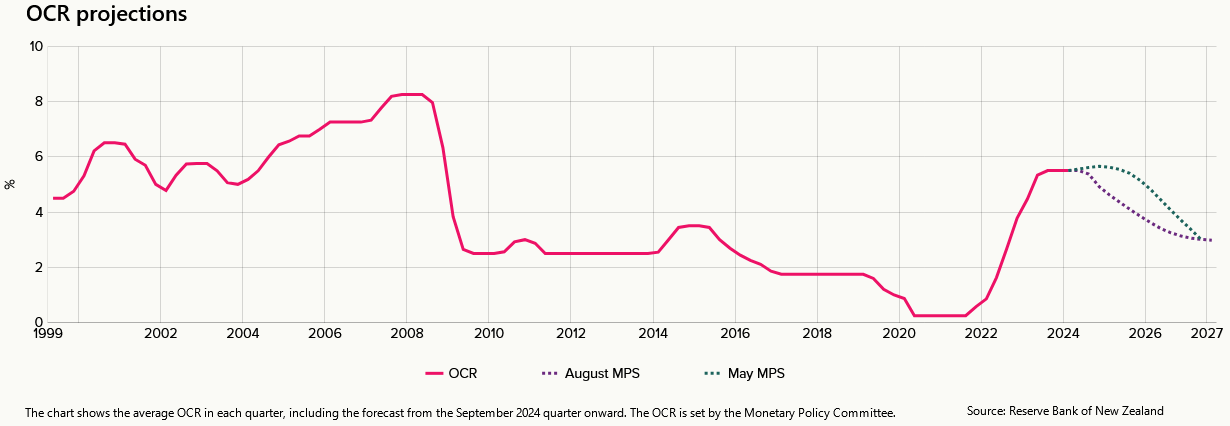
But of course, the RBNZ can change its mind, particularly if we give it reasons to do so. And just maybe, we might.
I don't think the RBNZ would have been thrilled at all by the extraordinarily strong result in the latest ANZ Business Outlook Survey.
Perhaps this was just letting off steam, a business community giving a collective 'hurrah!' to the fact that interest relief was coming a year earlier than the RBNZ had indicated. And perhaps this will give way to more 'reality' as people realise things are still tough out there.
Maybe not though. Remember, it is estimated that only around a third of the population have mortgages. And they have been the ones bearing the brunt of the high interest rates. What we've seen in the past few months, I think, is that quite a lot of people not necessarily directly affected by high interest rates have stopped spending because, well, they've heard things are tough, so, best to save at the moment.
This mood could quickly switch.
There's a lot of things up in the air. And the fact is the RBNZ can't have been pleased at the part in the business survey in which more firms said they will be looking to increase prices over the next three months. The RBNZ's hell bent on achieving inflation between 1% and 3% so, won't have room for unpleasant surprises.
Inflation figures will be important
The next reading on inflation, as measured by the Consumers Price Index, will be for the September quarter and it's due to be released on October 16. That will be big. The RBNZ has its next OCR review on October 9 and it would be reasonable to assume there will be another 25 bps cut (to 5.0%) then. However, if there's any 'nasties' in those inflation figures the RBNZ might be tempted to pause the interest rate easing.
And will the central bank appreciate, already, that headlines are appearing in the mainstream media questioning when house prices will start to rise and by how much?
I've already said previously that the kind of default setting for the housing market in this housing-centric country is 'frothy' and we never seem to need much encouragement to get the market bubbling again - sometimes from the most improbable circumstances.
I thought it was notable that the July mortgage figures showed the highest level of investor involvement for three years. The investor grouping took only 20.5% of the total mortgage money in the month, but that was up solidly from just 18.6% the month before.
Since hitting heady highs of 35% of the mortgage monies in 2016 the investors have generally been reined in by particularly high loan-to-value ratio (LVR) limits imposed on them. But it is worth noting that the limits have been relaxed recently, although also now augmented with new debt-to-income rules.
The last time the investors had a big surge in activity was amid the pandemic in 2020. In February of that month the investors took just 20% of the mortgage money, but after the RBNZ inexplicably dropped the LVR rules altogether, this share rose to 25% by December of that year.
What will the investors do?
And significantly, this gorging by the investors helped kick the FOMO (fear of missing out) levels up to 11 for the first home buyers. The resultant free-for-all saw us experience a 40% rise in house prices, during a global pandemic.
For me, the investors will unquestionably be the key to the housing market in the next 12 months. If they get heavily involved again then - even though it looks unlikely now - there could be fireworks.
So, there's no doubt the RBNZ will be watching the (currently dormant) housing market like a hawk for any signs of trouble.
Much really depends on the extent to which the recession we are in has been fuelled directly by hardship (and that's got to be the case for at least some mortgage holders). But it's really hard to get a reading on that.
How much of the downturn, particularly in the June quarter, has as much as anything been mood-driven? Things are tough, rein it in - even if you CAN actually afford to buy things.
Well, moods change and the mood of the country has seemingly already lifted. How much difference will that make? And how quickly?
I was intrigued by a comment ANZ chief economist Sharon Zollner made in her weekly podcast, noting that this recession had been caused by interest rates and not some other negative shock. "...Rates are normally cut because something really bad has happened and that’s not the case this time."
And it's a very fair point. The RBNZ even conceded it was engineering a recession. I can't recall anything quite like this before.
Consider for a moment, the path of interest rates in the past 25 years...
The OCR was introduced in 1999. Between then and 2005 it bounced around in a 4.5% to 6.5% range, before then being ramped up all the way to 8.25% in 2007 and through to June 2008. When it came down it was because of the Global Financial Crisis and in fact it dropped like a brick to 2.5% in April 2009.
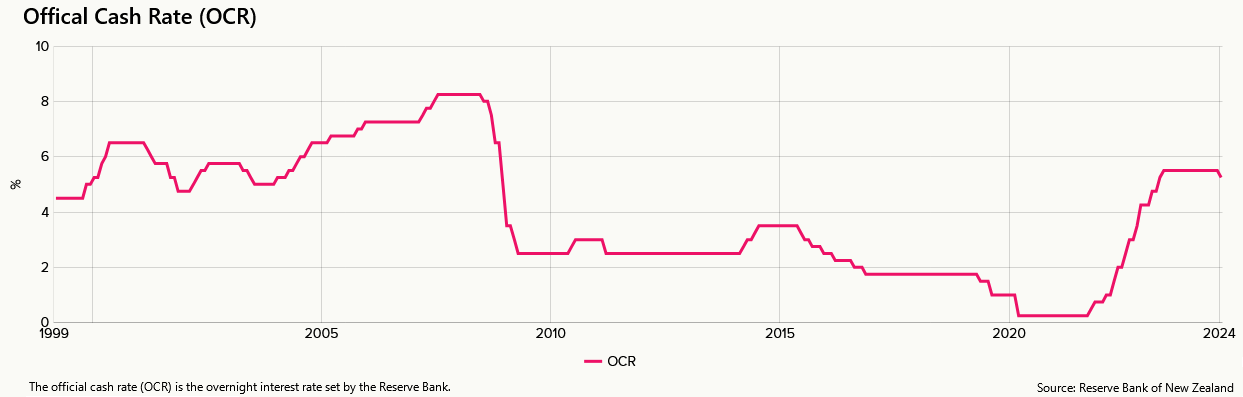
Such a massive drop in such a short space of time might be expected to have a huge stimulatory effect - but of course the economy had been well wrecked, and took ages to recover.
And that was the last time we saw a high OCR followed by a drop. So, this time it will be quite different. In many respects it's going to be unchartered waters. And we don't really know yet whether the economy might start to heat quite quickly again. And what does the RBNZ do if there are signs of this? - with the housing market, as ever, the first place to look.
Remember how quickly the economy bounced back from the lockdowns? Nobody expected that. But at the time everybody, including the economists, had tried to apply the usual logic of how quickly an economy recovers from a 'recession' - and therefore expected recovery would take a while. It didn't. The lockdowns didn't create true recessions as we can now fully acknowledge. Once the tap was turned on again, the water flowed. Might we now be looking at a situation not directly comparable, but at least with some similarities?
Spend, spend, spend?
It all depends on how quickly people might feel they can start to spend again. And in that regard, I don't think the RBNZ would be all that pleased with how well organised the mortgage holders have been this year in 'going short' with their fixed rate mortgage terms en masse in anticipation of falling interest rates.
As of July three-quarters of the country's $360 billion mortgage pile was either on floating rates or fixed for a year or less. Around half of the pile was on either floating or fixed for six months or less.
People are therefore going to get some interest rate relief quite quickly. It could be this will be more quickly than the RBNZ is truly comfortable with. And the more the RBNZ cuts rates, the more relief will flow.
Will we see spending start to ramp up again quite soon then?
One thing that will likely mitigate against that is the rate of unemployment, which is expected to continue rising strongly into next year. But how much of a dampening impact will that have? Again it's not really that clear, but my suspicion is less impact than might be expected.
There's a lot of questions surrounding the current economic situation. I'm not making any bold predictions, but, I just think we can't take for granted that there will now be a steady continuing fall in interest rates and all will be sweetness and light. The RBNZ may yet have a few surprises for us. Much will depend on what we do.
*This article was first published in our email for paying subscribers early on Friday morning. See here for more details and how to subscribe.
We welcome your comments below. If you are not already registered, please register to comment
Remember we welcome robust, respectful and insightful debate. We don't welcome abusive or defamatory comments and will de-register those repeatedly making such comments. Our current comment policy is here.