
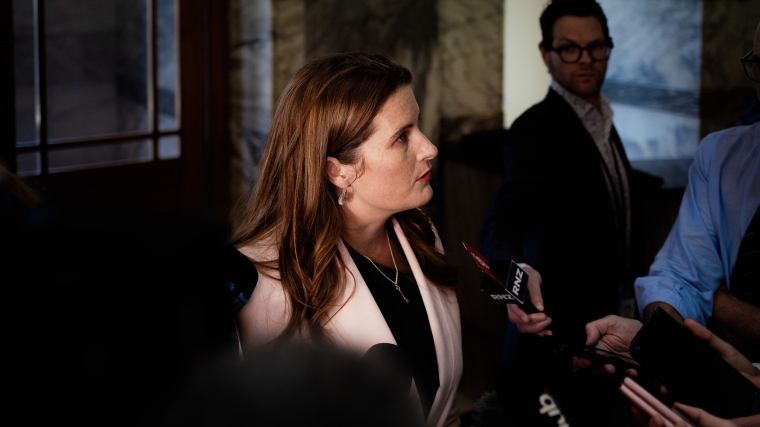
Finance Minister Nicola Willis is encouraging borrowers to show they have power, shop around, and haggle with banks.
Her comments come with people who hoped the Reserve Bank's November 26 Official Cash Rate cut would lead to banks reducing fixed-term mortgage rates being disappointed.
In fact on Tuesday, Westpac NZ increased some fixed rates by 30 basis points. It did cut its six-month rate by 20 basis points, while its one year and 18 month rates were unchanged.
Asked about Westpac’s decision to increase some of its fixed rates, Willis said: “Westpac have made that choice, other banks have not.”
Willis said New Zealanders should shop around and she wanted them to see that they have power when it comes to where they take their mortgage.
“Don’t just look at the headline rates, go and hold your bank’s feet to the fire, see if another bank can give you a better rate.”
“Make them compete with each other, don’t just accept that you’re getting the best deal right now," Willis said.
"Let’s make them compete."
Westpac’s increases come a few weeks after Willis called on the banks to "pass on as much as possible" following an Official Cash Rate (OCR) cut.
Fixed mortgage rates
Select chart tabs
Breman points to rising rates in wholesale markets
Earlier on Wednesday new Reserve Bank Governor Anna Breman was asked about Westpac's hikes and noted wholesale market interest rates had risen.
“My understanding is that the shortest variable rates have followed downwards after the [Reserve Bank] rate cuts but the longer dated mortgage rates have gone up,” Breman said.
“We have to look at the overall picture, but one way as an economist to describe that is to say that some part of financial conditions have tightened a bit and we have to evaluate how that affects the economy if that’s in line with the transmission that we want in monetary policy.”
Willis was asked by a reporter about the wholesale rates and whether the Reserve Bank had mucked up.
In response, she said “the Reserve Bank is responsible for responding to financial conditions as they see them unfold."
Willis said Breman had made comments earlier about how markets interpret the OCR and what that means for financial conditions is one of the things the central bank analyses ahead of its interest rate decision.
“I’m sure that they’ll do that analysis," Willis said.
Each bank makes its own decision
Prime Minister Christopher Luxon, who has also previously called on banks to pass on OCR cuts quickly to customers and encouraged consumers to shop around, said each bank would make its own decision about its long-term assessment.
He said the Reserve Bank would be continuing to monitor this and that he wanted New Zealanders to get the best deal they could.
He said there had been nine OCR cuts and interest rates were now relatively low, and inflation was under control.
“And you’re seeing signs of growth in the economy and that’s a good thing.”
Labour leader Chris Hipkins said the Government was waiting for the Reserve Bank to save them.
“Nicola Willis has made this problem for herself,” Hipkins said.
“She actually said the Reserve Bank’s one job is to keep inflation within the target band. They don’t have a remit around employment anymore, they don’t have a remit to grow the economy. That’s the Government’s job and they haven’t got a plan to do that.”
Where the RBNZ’s focus will be
On Wednesday morning, when asked by a reporter if she would be comfortable if a future government broadened the mandate (for example, putting employment back into it), Breman said it was important to respect the democratic process.
The Reserve Bank would always do what is mandated in legislation and she did not have a preference for a single mandate, Breman said.
With her continual emphasis on the mandate, Breman said it was important that everyone understood the role of the Reserve Bank in the New Zealand economy.
“I think I’m simply doing it to stress where our focus will be and I’m also doing it because we’ve seen over the past few years how hurtful high inflation is, how much it harms households and businesses."
“It erodes purchasing power. Volatile inflation is very complicated for small businesses to handle as well. So I’m focusing on that because this is what we are expected to achieve - inflation within the target range, focusing on the midpoint.”
"You want an economy that has lower, stable inflation because it helps to foster prosperity for all New Zealanders,” Breman said.
Daily swap rates
Select chart tabs
Economic growth was important but the central bank’s tools are set up to focus on low and stable inflation, she said, which will promote growth and a strong labour market.
Snaphot
One useful way to make sense of the changed home loan rates is to use our full-function mortgage calculator which is here.
And if you already have a fixed term mortgage that is not up for renewal at this time, our break fee calculator may help you assess your options. Break fees will be minimal in a rising market. But they become important in a falling market, like now.
Here is the snapshot of the lowest advertised fixed-term mortgage rates on offer from the key retail banks at the moment.
| Fixed, below 80% LVR | 6 mths | 1 yr | 18 mth | 2 yrs | 3 yrs | 4 yrs | 5 yrs |
| as at December 9, 2025 | % | % | % | % | % | % | % |
| ANZ | 4.79 | 4.49 | 4.49 | 4.49 | 4.79 | 5.39 | 5.39 |
 |
4.85 | 4.49 | 4.45 | 4.49 | 4.79 | 5.09 | 5.15 |
 |
4.79 | 4.49 | 4.45 | 4.49 | 4.79 | 4.99 | 4.99 |
 |
4.75 | 4.49 | 4.49 | 4.85 | 5.19 | 5.39 | |
 |
4.69 -0.20 |
4.49 | 4.45 | 4.75 +0.30 |
5.05 +0.30 |
5.29 +0.30 |
5.29 +0.30 |
| Bank of China | 4.68 | 4.28 | 4.38 | 4.58 | 4.78 | 4.95 | 4.95 |
| China Construction Bank | 4.79 | 4.49 | 4.49 | 4.49 | 4.79 | 4.99 | 4.99 |
| Co-operative Bank | 4.79 | 4.45 | 4.49 | 4.49 | 4.79 | 4.99 | 5.19 |
| ICBC | 4.69 | 4.25 | 4.29 | 4.59 | 4.79 | 4.99 | 4.99 |
 |
4.99 | 4.49 | 4.49 | 4.65 | 4.85 | 4.99 | 4.99 |
 |
4.99 | 4.39 | 4.75 | 4.49 | 4.89 | 5.19 | 5.39 |
We welcome your comments below. If you are not already registered, please register to comment
Remember we welcome robust, respectful and insightful debate. We don't welcome abusive or defamatory comments and will de-register those repeatedly making such comments. Our current comment policy is here.