

The latest quarterly Consensus Forecasts from the New Zealand Institute of Economic Research (NZIER) have downgraded New Zealand’s economic growth outlook in 2026 and 2027.
NZIER’s quarterly forecasts are compiled from a survey by NZIER of financial and economic agencies. Respondents included the five biggest banks, Treasury, the Reserve Bank and NZIER itself.
NZIER senior economist Ting Huang said GDP growth of 0.6%, on average, is now forecast for the year to March 2026 and is expected to pick up to only 1.6% in the March 2027 year.
Previously, the NZIER March Consensus Forecast had predicted GDP growth to rise 0.8% in the March 2026 year and jump 3% in the year to March 2027.
Huang said the US-Israel war with Iran since the end of February, along with the related fuel crisis and heightened uncertainty, presents key headwinds that will likely delay New Zealand’s economic recovery over the coming year.
Huang said activity indicators had suggested that the impact of lower interest rates was gaining traction in supporting a gradual recovery since the September 2025 quarter.
However, this recovery is expected to face “headwinds” over the coming year from the global fuel crisis and heightened global uncertainty sparked by the Middle East war.
Forecasts of household spending have been revised lower for the coming year, with the NZIER changing its March 2026 year forecast to down to 1.4% (previously 1.8%) and slashing its March 2027 year forecast to 0.8% (previously 2.6%).
Huang said although retail activity continued to recover over the March 2026 year, consumer confidence has recently declined on the back of rising petrol, electricity and food costs.
“Soft wage growth against these increases in living costs presented additional challenges for the household sector. This increased caution amongst households is expected to weigh on household discretionary spending over the coming year,” she said.
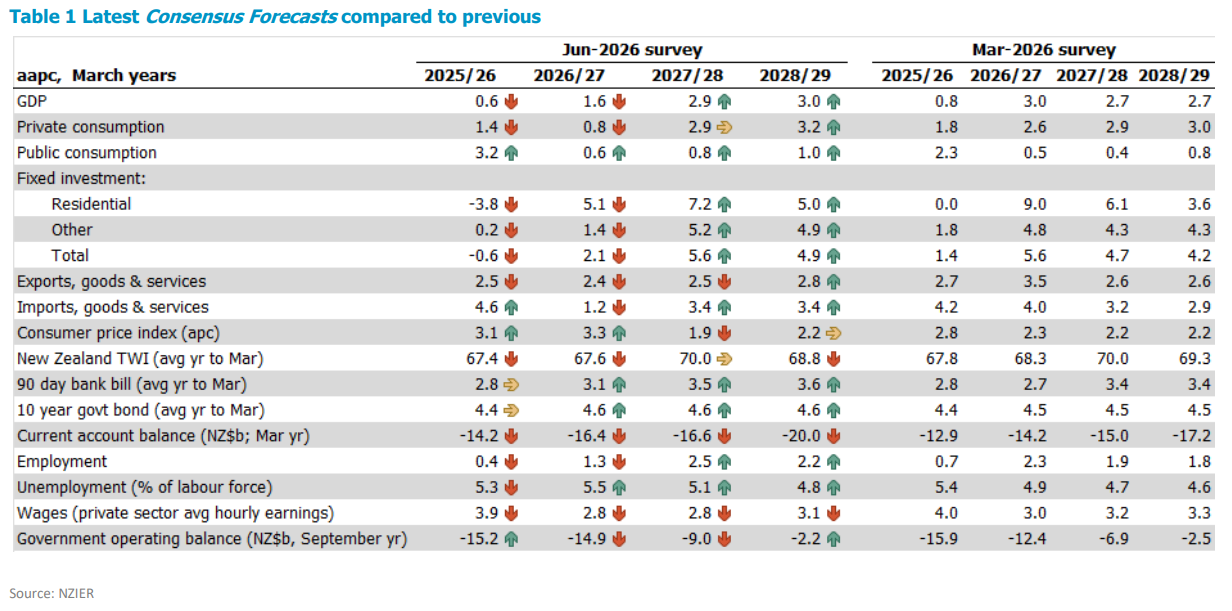
The NZIER has also trimmed investment growth forecasts for 2026 and 2027.
According to the NZIER’s June survey, it is now anticipating investment growth to be up just 0.6% in the year to March 2026 and up 2.1% in the year to March 2027. In the economic consultancy’s March survey, NZIER was forecasting total fixed investment to be up 1.4% in the March 2026 year, and up 5.6% in the March 2027 year.
“Before the fuel crisis, lower interest rates had been supporting a gradual recovery in investment demand,” Huang said.
“However, higher fuel costs and heightened uncertainty over geopolitical conflicts and the upcoming New Zealand general election are expected to weigh on a recovery in investment activity over the coming year.”
Statistics New Zealand's latest Selected Price Indexes (SPI) figures show that from April to May, petrol prices decreased 3.8% while diesel prices fell 11.4%.
This follows petrol prices rising 33.6% and diesel a massive 94.9% over the two months from February. In the year to May, prices for petrol rose 28.7% and diesel prices soared 76.8%.
Huang said the NZIER Quarterly Survey of Business Opinion (QSBO) undertaken between early March and early April showed evidence of a deterioration in business confidence and investment intentions after the fuel crisis unfolded.
The GDP figures for the March 2026 quarter are being released on Thursday. The Reserve Bank is expecting a 1% increase in economic activity during the March quarter.
ANZ and Westpac are also forecasting an increase of 1% in GDP growth in the first three months of the year, while BNZ anticipates 0.9%, ASB expects 0.8% and Kiwibank is predicting 0.7%.
New Zealand’s GDP edged up 0.2% in the December 2025 quarter and rose 1.1% in the September 2025 quarter.
We welcome your comments below. If you are not already registered, please register to comment
Remember we welcome robust, respectful and insightful debate. We don't welcome abusive or defamatory comments and will de-register those repeatedly making such comments. Our current comment policy is here.