
It is probably fair to say Reserve Bank Governor Adrian Orr surprised a lot of people on Thursday morning.
The Kiwi dollar fell to a near two year low and after the release of the Monetary Policy Statement (MPS) and bank economists detailed their shock in economic notes. The dollar dropped 100 basis points, and at the time of writing was at US66.84 cents. Wholesale swap rates also tumbled, down about 10 basis points across the rate curve.
The main theme coming through in the hours after the MPS was released was that it was a “dovish statement.”
“We expect to keep the OCR [Official Cash Rate] at this level [1.75%] through 2019 and into 2020, longer than we projected in our May Statement,” Orr said.
The reason for the surprise and the sizeable drop in the currency was because this is a significant shift in timing.
In May, the Reserve Bank was forecasting the OCR would rise in September 2019. Orr had pushed back the timing of the hike by one quarter, compared to November’s MPS.
On Thursday, Orr had pushed out his expectations for an OCR change by an entire year.
This goes much further than all the major bank economists’ forecast.
“We had expected the RBNZ to sound a little more ‘dovish’ in the statement – but in the end, the RBNZ was considerably softer in its outlook for inflation and interest rates,” ASB said in a research note.
“We are surprised by the degree of reaction from the RBNZ today,” Westpac Senior Economist Michael Gordon said after the MPS was released.
So what’s behind the Governor’s much more dovish stance?
“The difference is we see [the OCR] being lower for longer,” Orr told the MPS media conference.
“The recent slower economic growth gives us more confidence that there is no immediate capacity pressure leading to the rising inflation.”
Economic growth has slowed recently, the MPS says. Annual GDP growth was 2.7% in the March 2018 quarter, down from over 4% in mid-2016.
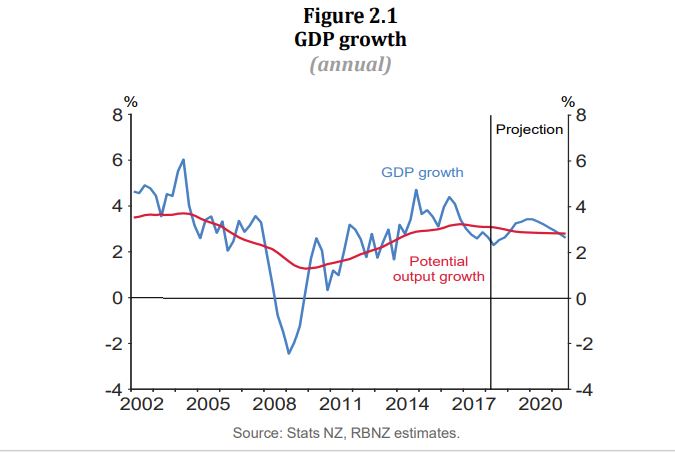
August's MPS forecasts the economy to grow at 2.8% over the coming year - that's 0.5% lower than its estimates in May's MPS.
Growth estimates vary between forecasters, but there is a general consensus the New Zealand economy has shifted down a gear.
Orr says economic growth is expected to pick up to above trend levels in 2019, but there are two major reasons for this.
“Fiscal and monetary stimulus underpin this growth outlook,” Orr says.
Simply put, keeping the OCR “lower for longer” while the Government is putting money back into people’s back pockets through the Families Package is expected to keep growth humming along.
“The OCR setting is based on how we see the economy evolving and part of that is the Government’s investment intentions,” Orr says.
A sugar hit
This does not sit well with National’s Finance Spokeswoman Amy Adams, who says this is simply masking the underlying picture of the economy.
“The Minister of Finance has talked repeatedly about building a productive and sustainable economy; if your growth is only held up by Government spending, that is nether productive nor sustainable.”
She says having both monetary and fiscal policy being so stimulatory does nothing to support an actual increase in productivity of the real economy.
“It’s a sugar hit, it isn’t truly sustainable growth in the economy.”
Meanwhile, Orr has yet again made it clear he thinks the next OCR move “could be up or down.”
“We believe the risks [to the economy] are balanced, hence the ‘up or down’ next move on the OCR,” Orr says.
He says the upside risks to the OCR is inflation, and inflation expectations, which “could get away quicker than we project.”
The challenge in this area, he says, is margin pressures in business that could be passed on into higher prices which could, in turn, lead to higher inflation.
On the downside risks – “we’re well aware of business confidence levels being low.”
But he says the Central Bank spends more time focusing on the firms’ own activity, which in the most recent ANZ data was at the lowest levels since the Global Financial Crisis.
Because of this, the Reserve Bank has a “more muted investment cycle projected, but our growth could take longer to pick up than what we project through that side.”
A 'stridently dovish' RBNZ 'shocks & Orrs'
In his note on the MPS, entitled RBNZ Stridently Dovish, BNZ Head of Research Stephen Toplis said the new Orr-led regime has revealed its spots.
"The question going into it [the MPS] was would the Governor be more concerned about the weakening growth indicators or would he be more bothered by the upward trend in both core and headline inflation? The answer is now there for all to see - weak growth won the day. Inflation forecasts were, on balance, little changed but this was not enough to prevent the RBNZ lowering its interest rate track," said Toplis.
"The scenario analysis in the MPS also reveals the [Reserve] Bank’s dovish biases. Under the Bank’s higher inflation scenario it raises the cash rate by 50 basis points more than its central scenario. However, was growth to surprise on the downside, the door is open to a 100 basis point cut."
"Ultimately, we think the Bank is going to get both of these outcomes – namely lower growth and higher inflation. However, the Bank has low-balled its near-term growth forecasts so any downside surprise is unlikely to show up until calendar 2019. Indeed, near term we see upside risks to both the Bank’s growth and inflation forecasts. Consequently, we think there is little chance that the data will give markets the chance, near term, to price in a full 25 basis point cut," Toplis added.
"We have been warning for some time that we might need to delay our first rate hike prediction so we are, today, taking the opportunity to formally push back our forecast first rate hike to August 2019 from May 2019. We have also lowered the peak in our interest rate track to 2.75% from 3.00%."
And in his note entitled Shock and Orr, Kiwibank chief economist Jarrod Kerr said the main message from the Reserve Bank was one of heightened uncertainty, with downside risks prevailing. Kiwibank's economists have pushed out their expectations for an OCR increase to May 2020, from Aug 2019.
"The Governor continued to deliver a positive feel during the media conference, but the numbers in the MPS are blatantly dovish. It’s time to watch, worry and wait," said Kerr.
"The big news here is the reaction is financial markets to the dovish signals. The Kiwi dropped over 1% to $0.6680 against the Greenback. The two-year swap rate dropped 6 basis points immediately, to ~2.055%, at time of writing. Orr noted he was 'very pleased with the performance of the currency. It’s as close to fair value as it gets.' Along with our change in OCR forecast, pushing it out a few months, we have lowered or swap rate forecasts and Kiwi dollar forecasts."
"The Kiwi looks like an endangered species, and we see the bird hitting 0.65c by year end, down from 69c previous forecast, and 63c in mid-2019, down from 67c. So we forecast the Kiwi moving in the same direction, down, but now much lower. Our rate forecasts are also lower, and curve outlook steeper, despite today’s awkward move," Kerr added.
We welcome your comments below. If you are not already registered, please register to comment
Remember we welcome robust, respectful and insightful debate. We don't welcome abusive or defamatory comments and will de-register those repeatedly making such comments. Our current comment policy is here.