

Last month was another searing one in the housing market as far as mortgage lending went.
Figures released by the Reserve Bank show $7.601 billion was advanced for new mortgages, which is easily the most for a February month, though well below the recently set monthly record of $9.652 billion in December 2020.
The February figure was some 36.2% higher than the amount borrowed in the same month a year ago ($5.579 billion).
The figures confirm the recent trend that first home buyers are getting squeezed out of the market.
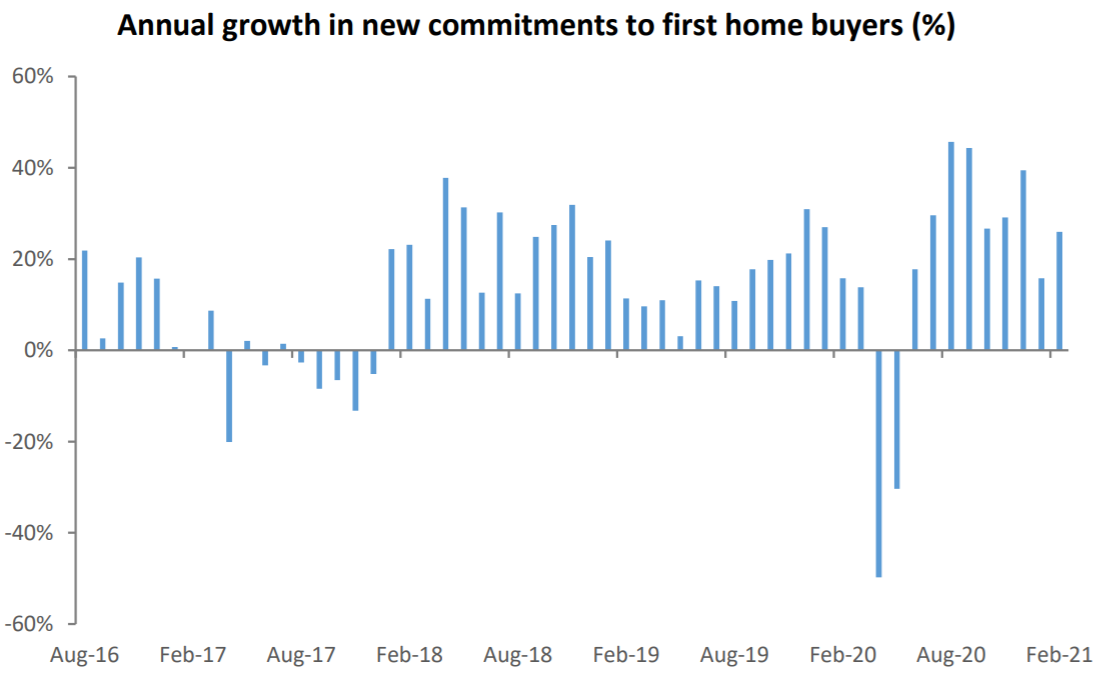
The FHB grouping did borrow some $1.182 billion in February, but this made up just 15.6% of the total - which is the lowest proportion captured by this grouping since August 2018. If you go back to July 2020 the FHBs were claiming 20.4% of the mortgage money.
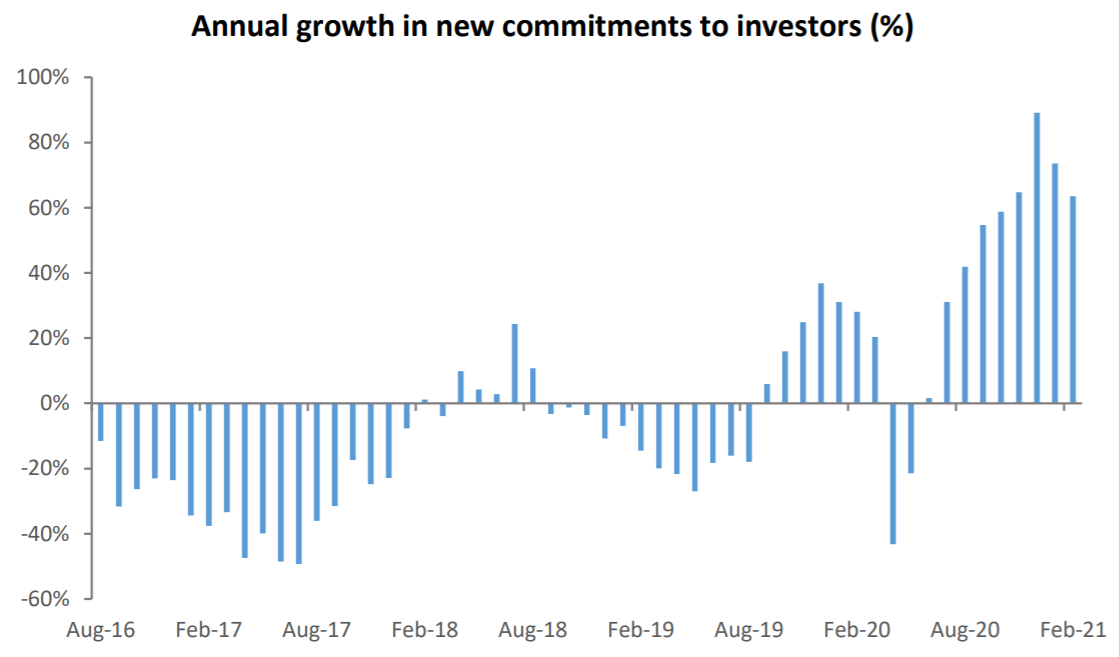
Investors again thoroughly outstripped the FHBs, by borrowing $1.856 billion in the month of February, representing 24.4% of the total.
These figures cover the last month of mortgage lending prior to official reintroduction of the RBNZ's loan to value ratio (LVR) restrictions on March 1.
The restrictions were removed as of May 1, 2020 in response to the Covid crisis with the intention that they be off for at least 12 months.
However, in November in response to an incendiary housing market the RBNZ announced the measures were going to be coming back. Many banks began applying restrictions from the time of the announcement.
Remember also that as of May 1 this year the restrictions for investors will be further tightened and they will need 40% deposits, up from the 30% they need at the moment.
And there are certainly early signs that the investor surge is beginning to tail off.
In January the investors took 26% share of the mortgage market and 25.4% in December.
But much of the lending has been fuelled by high LVR borrowing (currently being defined for investors by the RBNZ as as loans for more than 70% of the value of the property).
In dollar terms the peak of this surge was November, when the investors borrowed $844 million worth of high LVR mortgages.
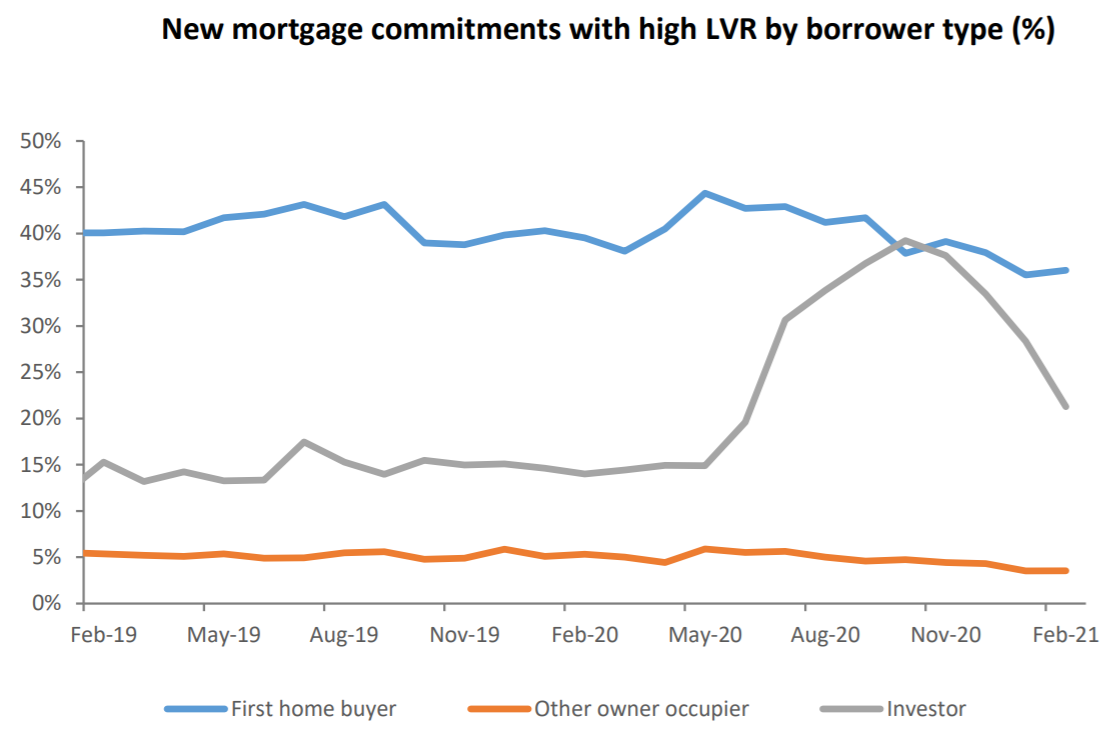
However, as the banks have started to adopt the tougher lending standards ahead of the official reintroduction of the LVR limits, these numbers have been coming down.
In February $395 million of new investor borrowing was at high LVRs, which represented 21.3% of all investor borrowing.
In January, of the $1.651 billion borrowed by investors $469 million of it was for high LVR mortgages. So, that $469 million represented 28.4% of the total borrowed by investors in January.
This compares with a percentage of 33.5% of high LVR borrowing by investors in December and 37.6% in November. In October, before the reintroduction of LVRs was announced, as much as 39.2% of the investor borrowing was on high LVRs.
So, the high LVR lending to investors has been dropping quickly from very high levels.
Separately, the RBNZ's figures highlighting interest-only and revolving credit borrowing show that of the $1.856 billion borrowed by investors in February, $756 million of it (40.7%) is either interest-only or revolving credit.
A proportion of about 40% of new lending to investors on interest-only or revolving credit is entirely typical and in fact the figure's often been higher than that; in October it was 45%.
The Government has of course made some noise about potentially stopping interest only lending for investors, but there were no decisions made on this in the housing policy announcement this week.
The RBNZ has been playing catch-up with the mortgage figures and various of its other statistics because of the data breach problems. It has now caught up with the mortgage figures.
We welcome your comments below. If you are not already registered, please register to comment
Remember we welcome robust, respectful and insightful debate. We don't welcome abusive or defamatory comments and will de-register those repeatedly making such comments. Our current comment policy is here.