

Kiwibank economists think the Reserve Bank's limits on high loan-to-value ratio (LVR) lending - introduced as a temporary measure - in 2013 are set to become permanent.
But in their Kiwi Economics Weekly Update Kiwibank chief economist Jarrod Kerr and senior economist Jeremy Couchman reiterate that RBNZ is set to loosen the LVR restrictions again in its Financial Stability Report being released on Wednesday.
And they say their preference is for a loosening in the speed limit on high-LVR owner-occupier loans "because the availability of credit should be extended to first home buyers in particular".
The economists have already indicated they think the RBNZ may loosen the 'speed limit' on the amount of bank new lending that can be advanced on loans to owner-occupiers above 80% of the value of the property to 20% of that new lending from 15% now. And they think the deposit limit for investors may be lowered from the current 35% to 30%.
But in their latest update, the economists speak in favour of the central bank actually going a bit further and loosening the 'speed limit' for owner-occupiers to 25%.
"A lifting in the speed limit to 25% would ease access to a difficult market, in our view. An easy argument to make politically," they say.
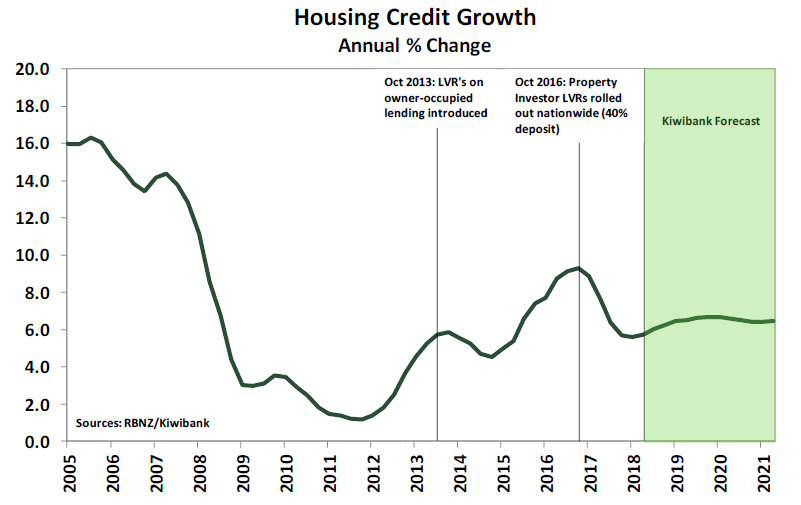
"The deposit on investor lending could also be eased (again) to 30%, and the speed limit to be lifted a little without adding much fuel to the fire. Credit growth is subdued, and credit to investors has been reined in since 2016. A loosening in LVR restrictions would loosen the availability of credit, and add a little to credit growth next year."
The economists say though that the “temporary” measures that are the LVRs, "are unlikely to remain temporary, but become permanent".
"The levels at which these measures become permanent will most likely be looser than the current settings. So, as an interim step between temporary and permanent, we expect the LVR restrictions to be loosened again. It was this time last year when the RBNZ loosened the LVRs just a little. And we expect a little more loosening this year. Risk in the system is being managed."
The RBNZ has maintained that the measures are meant to be temporary, but they have now been with us for five years.
Kerr and Couchman say a loosening is in line with the RBNZ’s three criteria:
- Evidence that house price and credit growth have fallen to around the rate of household income growth.
- A low risk of housing market resurgence once LVR restrictions are eased.
- Confidence that an easing in policy will not undermine the resilience of the financial system.
"We argue all three criteria have now been met. The need to guard against excessive leverage building in parts of the system remains. But credit quality has improved materially since 2016. We believe the 2nd and 3rd requirements are easy to argue, now that the housing market has cooled, with Auckland’s lead."
They say that the LVR restrictions have clearly worked, "if not initially".
"They were difficult to implement, but clearly worth the effort. Our chart shows the LVRs reducing risk in the system. But now the market has cooled, and temporary measures need to be looked at. We prefer a loosening in the speed limit of 15% on owner-occupier loans with <20% deposit. Because the availability of credit should be extended to first home buyers in particular."
We welcome your comments below. If you are not already registered, please register to comment
Remember we welcome robust, respectful and insightful debate. We don't welcome abusive or defamatory comments and will de-register those repeatedly making such comments. Our current comment policy is here.