
The writing was on the wall for the Sixth Labour Government when Prime Minister Jacinda Ardern stepped down in late January 2023.
It's probably not why she resigned, but the political pendulum was already set to swing back and bowl over big chunks of progressive policy in the process.
Chris Hipkins, one of the few people forewarned of Ardern’s resignation, recently said he felt a “strange sense of foreboding” when he became Prime Minister a few days later.
Labour lost this year’s election back in 2021, when Aucklanders lost patience with long lockdowns and inflation left its target band to seek a life among the stars.
Any Government that presides over a 20% increase in living costs during a single term will not be reelected; regardless of whether it was their fault or not.
But, Hipkins did breathe a bit of life into Labour’s chances. The left leaning bloc was leading the polls for the early part of the year and it looked like a third term could be possible.
Voters wanted a change in Government but seemed unconvinced by the alternative.
Christopher Luxon, the first-term MP and leader of the opposition, was struggling under the pressure as some began to blame him for the National Party’s poor performance.
Hipkins sensed an opportunity, ordered the party to focus on ‘bread and butter issues’ and struck a match for his policy bonfire. He had just nine months to get ready for Election Day.
It was about this time that I joined Interest.co.nz and had the opportunity to meet the Prime Minister. In a short chat, Hipkins commented on some of the difficulties of his new job.
“Oh well,” I said mindlessly, “you’ll only have to do it for nine…”
I paused just long enough to watch his eyes narrow slightly.
“...years,” I finished quickly. Graciously, he laughed.
New Zealand gets poorer
While Hipkins was working to save his party, New Zealanders were getting to grips with reality: the pandemic had made them poorer. Or at least, not much richer.
This was a nasty shock for those who thought their bank balances and asset prices were climbing because of an increase in intrinsic value, not fiscal and monetary policy.
Paul Conway, the chief economist at the Reserve Bank of New Zealand, gave a speech in which he accepted the central bank and government had some culpability for inflation.
Prices were rising because fiscal and monetary responses to the pandemic supported demand while health measures reduced the supply of labour and products, he said.
“While lockdowns were tough going … economic life for many New Zealanders was surprisingly ‘normal’ for many months during the global pandemic”.
Despite ‘normal life’, the Government was spending big to support the economy and the RBNZ had dropped the official cash rate to its “‘effective lower bound”.
Supply shock + stimulus = inflation. Policy pushed the economic pendulum too high and it has begun to swing back with a vengeance.
“We are worse off because of the pandemic, the war and floods. Monetary policy cannot do anything about the loss of real income stemming from these events,” Conway said.
Average gross domestic product growth in New Zealand over the past decade has been about 2.8%. We can think of that as being roughly the country’s potential growth rate.
However, real GDP increased a whopping 6% in 2021 and 3.2% in 2023. NZ now has to pay that surplus growth back with lower rates in 2024 and 2025.
Treasury forecasts growth to resume as normal—2.9% average between 2026 and 2028—once inflation and interest rates normalise. We have to let the pendulum swing back.
Labour falls apart
It was still March when Labour MP Stuart Nash was fired for leaking confidential Cabinet information to donors. It would turn out to be only the first of four ministerial scandals.
Just two months later, Meka Whaitiri defected to join Te Pāti Māori. The party went on to win a clean sweep of all seven Māori electorates bar one, Whaitiri’s Ikaroa-Rāwhiti seat.
On election night, a National Party supporter was overheard saying: “Māori were so fed up with Labour that they wouldn't even vote for a former party member”.
That wasn’t quite correct. Voters in Māori electorates were strategically splitting their votes to get more Māori members into Parliament — and it worked.
Michael Wood was the next to go, brought down by a handful of shares he bought as a teenager and failed to sell as a minister despite 16 reminders from the Cabinet Office.
“Political scandals often start as comedies before morphing into tragedies,” I wrote at the time. Wood lost Mount Roskill and didn’t make it back into Parliament.
If he’d sold the shares in a timely fashion, he may have been in a position to become the leader of the Labour Party and run for Prime Minister in the 2026 or 2029 election.
One final tragedy: Justice Minister Kiri Allan’s mental health crisis, car crash, and arrest. That’s four ministers in six months.
Hipkins later commented that this “succession of ministerial scandals” helped to harden the public mood against the Labour government.
“By the time we launched our campaign slogan ‘in it for you’, which was decided some time earlier, many in the public were already feeling that they were anything but our priority,” he said.
National’s turnaround
Here’s where Luxon deserves credit. The National Party was in bad shape when he became leader. It had suffered from its own run of scandals and was decimated in the 2020 election.
Hamish Walker, Michael Woodhouse, Michelle Boag, Andrew Falloon, and Jake Bezzant all had scandals, and the party churned through leaders like it was a butter factory.
Sometimes Luxon gets criticised for being too corporate or managerial, but the party was in dire need of a good manager and there he was.
“That’s it, that’s why I came, that’s why I love doing turnaround jobs, because that’s the challenge,” he told Newsroom in 2022.
His first job was turning the MPs who survived the 2020 election into a functional team that could win the next election and actually govern afterwards.
This seems to have been a success. There have been few scandals or visible infighting since and (spoiler alert) they did win the election.
While Luxon’s managerial skills helped to sort out the party, his political inexperience and corporate communication style did hampered its progress in opinion polls at first.
He was personally socially conservative, politically pretty liberal, and happy to go into coalition with libertarians and nationalists alike. A hard message to sell.
The public didn’t really trust or understand him. He’s socially conservative personally, but liberal politically. He doesn’t want to be in coalition with NZ First but is happy to do so.
What does he stand for? Getting things done. Which things? That has been announced yet.
Behind the scenes Luxon is energetic, warm, and obsessed with people. Literally all people.
It’s not uncommon to find him deep in conversation with the (nominally) least important person in the room, or someone who disagrees with him deeply. He loves it.
But that doesn’t come across much on TV and it isn’t particularly apparent in his policies, which could be fairly characterised as a heavy dose of ‘tough love’.
He has also been landed with the unenviable job of defending unpopular policies put forward by coalition partners to please their minority voter base.
The two most obvious examples are Treaty of Waitangi reform and the rollback of the upgraded SmokeFree laws. National wouldn’t have done either of these things itself.
Tail wagging the dog
The Act Party fell short of expectations in the election but it has been incredibly successful as a political movement and has supercharged reform on the right.
National made several policy decisions during the campaign that were designed to stem the flow of voters shifting over to the Act Party.
These policy changes included housing reform, agriculture emissions, and performatively ruling out a coalition with Te Pāti Māori.
Meanwhile, Winston Peters was working town halls around the country winning support for a revival of New Zealand First. It looked like a longshot at first but that quickly changed.
The party first polled above 5% in August and a month later Interest.co.nz predicted National would need its support to form a Government.
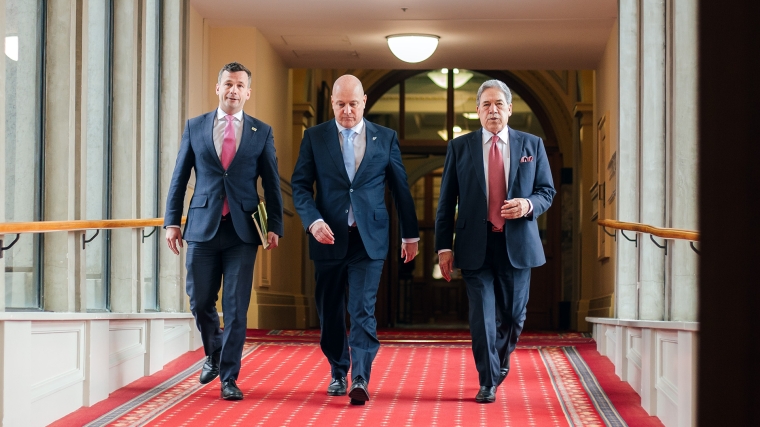
Now, Peters is Deputy Prime Minister — the pendulum has swung in his favour once again.
This was a year of correction, both for an overheated economy and a political party that left too much of the public behind. It remains to be seen how far we’ll swing in the other direction.
We welcome your comments below. If you are not already registered, please register to comment
Remember we welcome robust, respectful and insightful debate. We don't welcome abusive or defamatory comments and will de-register those repeatedly making such comments. Our current comment policy is here.