

Inflation has rocketed to its highest level in over 10 years, with the annual figure reaching 4.9% at the end of the September quarter.
That's far higher than economists were picking - even though they expected the figure to be a big one.
And it's more than the Reserve Bank (RBNZ) was expecting. It forecast 4.1%.
Wholesale interest rates rose sharply, with the two-year swap rate rising by 10 basis points, while the Kiwi dollar climbed to nearly US71c.
While the latest annual inflation figure is officially the highest in 10 years the figures back in 2011 were affected by the last GST increase.
Before that you have to go back to 2008 for the last time inflation was 'naturally' at this sort of level - exactly 13 years. (Inflation spiked to 5.1% in September 2008 before dropping rapidly as the worst of the Global Financial Crisis hit.)
The annual inflation figure in the quarter ended June 2021 was 3.3%, which was itself a fast rise from the previous quarter figure.
The RBNZ targets inflation between 1% and 3% with a specific focus on achieving 2%.
Having delayed raising the Official Cash Rate in August due to the oubreak of Covid Delta, the RBNZ earlier this month made its move and increased the OCR to 0.5% from 0.25%.
Even though the country - and particularly Auckland - remains hamstrung by the Delta outbreak, the latest inflation figures would appear to make it certain that the RBNZ will be forced to hike rates again - probably to 0.75% when it next reviews them on November 24.
Ben Udy, Australia & New Zealand economist with Capital Economics said the strength in inflation over the last six months means it is unlikely to fall back into the RBNZ’s 1-3% target until the end of next year.
"We had already expected the RBNZ to continue hiking rates despite the Auckland lockdown. But the strength in consumer prices in Q3 will surely nudge the Bank towards an even more aggressive hiking cycle," he said.
ASB senior economist Mark Smith said the widespread nature of price increases was "not a comforting sign".
"If it were not for the Delta variant outbreak, the pace of OCR hikes being implemented by the RBNZ would potentially be quicker than 25bp increments," Smith said.
"As it is we still expect ‘considered steps’ from the RBNZ, with 25bp hikes in November and February 2022, with the OCR hitting 1.50% by the end of next year.
"The speed and magnitude of subsequent OCR moves remains conditional on a range of factors, including the degree of economic scarring caused by restrictions to contain the Delta outbreak and whether inflation expectations and other inflation anchors are consistent with the 1-3% medium-term target - or become unstuck."
Statistics New Zealand said the consumers price index rose 2.2% in the September 2021 quarter, the biggest quarterly movement since a 2.3% rise in the December 2010 quarter.
Excluding quarters impacted by increases to GST rates, the September quarter movement was the highest since the June 1987 quarter, which saw a 3.3% rise.
Annual inflation was 4.9% in the September 2021 quarter when compared with the September 2020 quarter. This was the biggest annual movement since inflation reached 5.3% between the June 2010 and June 2011 quarters.
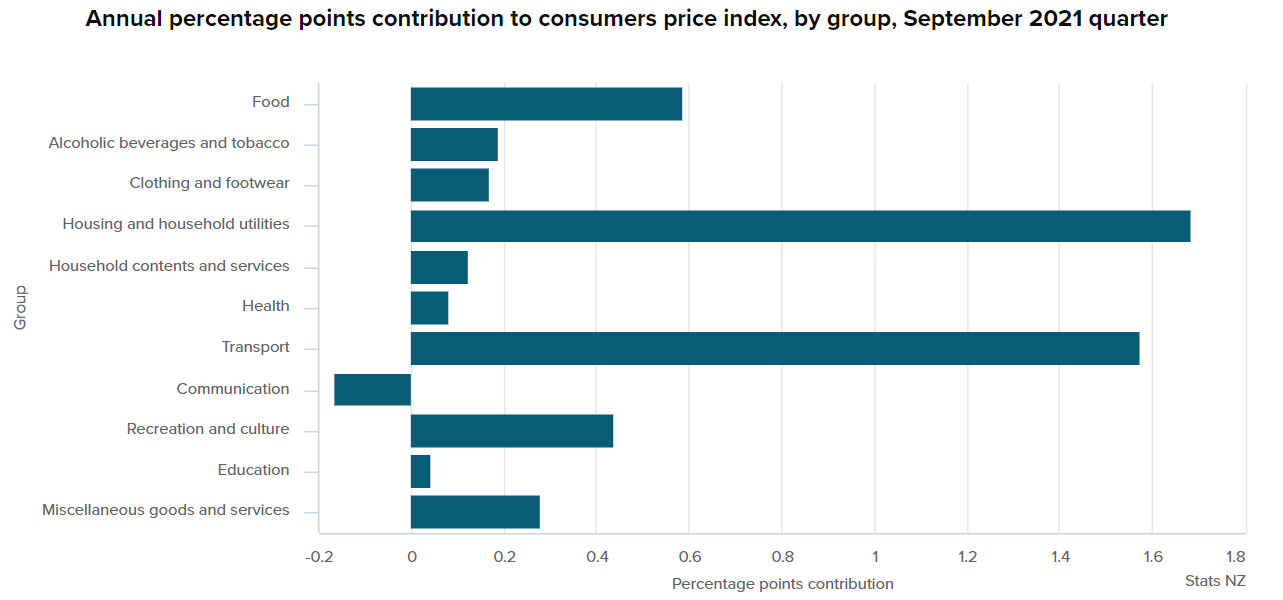
The quarterly price rises were widespread, with 10 of the 11 main groups in the CPI basket (such as food and transport) increasing in the September 2021 quarter compared with the June 2021 quarter.
The main drivers were housing-related costs, such as construction of new houses and local authority rates.
Prices for construction of new houses were up 4.5% for the quarter, and 12% for the year.
“Both supply-chain challenges and high demand are pushing up the cost of building houses,” Stats NZ's consumer prices manager Aaron Beck said.
“Construction firms reported that it is hard to get many materials needed to build a house, and that there are higher labour and administration costs.”
Local authority rates and payments rose 7.1% in the September 2021 quarter. This was higher than the 3.1% rise in the September 2020 quarter.
“Many councils set smaller than usual rate increases in 2020 to alleviate cost pressures on rate payers due to COVID-19,” Beck said.
“In 2021, councils faced increasing revenue and cost pressures.”
Rates are captured once a year in the September quarter, as this is when ratepayers see price changes set by councils.
Vegetable prices rose 19%, making it the second largest upwards contributor to inflation. This was influenced by higher prices for tomatoes, lettuce, and broccoli.
Transport prices rose 4.2% in the September 2021 quarter, due to higher prices for petrol, as well as international and domestic airfares.
Petrol prices rose 6.5% in the quarter and 22% for the year. The annual increase is the highest since the September 2007 quarter to 2008 quarter.
Global fuel prices fell over early 2020 as the COVID-19 pandemic took hold. Overall, global fuel prices have risen steadily since then.
The weighted average price of a litre of 91 octane petrol was $2.27 over the quarter, up from $2.13 in the June 2021 quarter, and $1.86 in the September 2020 quarter.
We welcome your comments below. If you are not already registered, please register to comment
Remember we welcome robust, respectful and insightful debate. We don't welcome abusive or defamatory comments and will de-register those repeatedly making such comments. Our current comment policy is here.