

The squeeze is on big time for New Zealand businesses, with firms reporting soaring costs, soaring prices charged - and yet falling profitability.
That's the upshot from the latest NZIER Quarterly Survey of Business Opinion released just a day before our Reserve Bank (RBNZ) has to make key decisions about whether to hike - and by how much - interest rates.
ANZ economists have been calling for a 50 basis point rise in the Official Cash Rate, which would take it to 1.5% (from 1.0% currently).
And they doubled-down on that call again following the result of the NZIER survey, which showed similar results to those in the most recent ANZ Business Outlook Survey.
ANZ economist Finn Robinson and senior economist Miles Workman said the NZIER survey confirmed what was seen in the most recent ANZ Business Outlook.
The NZIER survey showed that a net 77% of firms surveyed expect higher prices over the next three months, up from 65% previously.
"Our current forecast is that annual CPI inflation hit 7.1% in Q1 [quarter ending March 2022] – but the ANZBO and QSBO reports for Q1 indicate upside risk to that," Robinson and Workman said.
Annual inflation hit 5.9% as of the December 2021 quarter. Statistics New Zealand is set to release the March quarter CPI figures on Thursday, April 21.
"Real economic activity is struggling to make headway as cost pressures and shortages of labour and supplies continue to worsen. These constraints are reflected in multi-decade highs for pricing intentions."
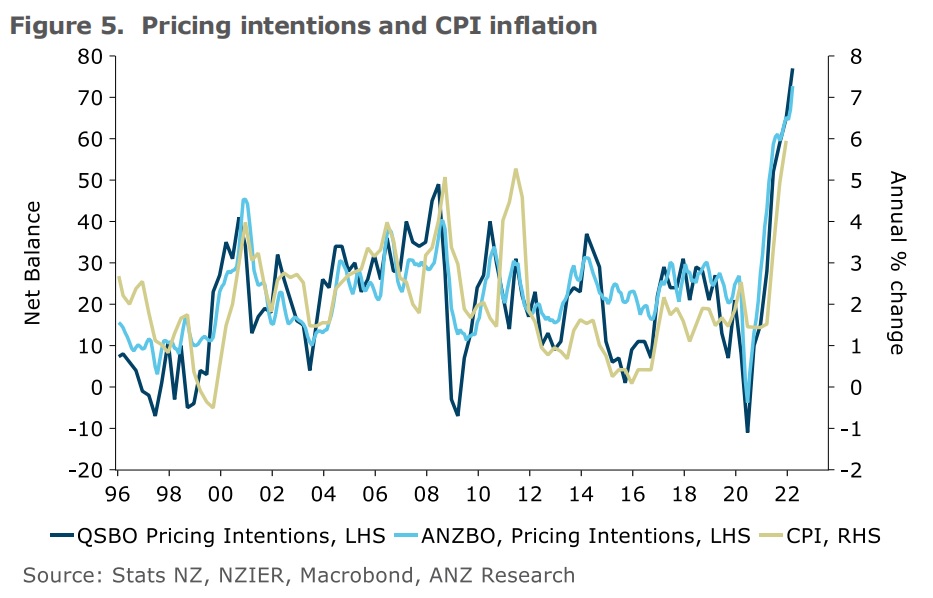
The NZIER survey was "another piece of data pointing to the need for aggressive interest rate hikes, despite downside growth risks – consistent with our expectation that the RBNZ Monetary Policy Committee (MPC) will conclude the best approach is to hike 50bps at tomorrow’s Review", Robinson and Workman said.
"Economic activity is struggling against surging costs, shortages, and other Covid disruptions. Simultaneously, inflation pressures (and expectations) continue to accelerate. For the RBNZ, it’s clear that aggressive action is needed to stop inflation spiralling – and we think today’s report reinforces the need to hike the OCR by 50bps tomorrow to really start to gain traction on inflation pressure."
Westpac senior economist Satish Ranchhod said the survey "highlighted the rocky start to the year for many New Zealand businesses, as well as ongoing price pressures".
"This doesn't change the arithmetic for the RBNZ ahead of Wednesday's OCR decision. We continue to expect a 25bp rise, but it is a close call."
ASB senior economist Mark Smith in reviewing the survey said the inflation outlook "is looking increasingly problematic".
"...And it looks to be a coin toss between a 25 and 50bp OCR hike tomorrow. Tomorrow’s RBNZ hike looks to be towards the start of what looks to be a concerted degree of monetary tightening."
BNZ head of research Stephen Toplis noted the falling profit expectations of firms.
"Expectations are plummeting and portending recession," he said.
"Sure, currently growth remains positive and employment intentions are robust. And, sure, the profit reduction is cost-based and will flow into heightened inflation. But if profit expectations remain this low for much longer, businesses will start to fail. Failed businesses will not have the option to raise prices, hire staff, nor invest."
The NZIER survey showed that a net 33% of businesses surveyed expect a weakening in general economic conditions over the coming months on a seasonally adjusted basis, while a net 9% of businesses reported weaker activity in their own business in the March quarter.
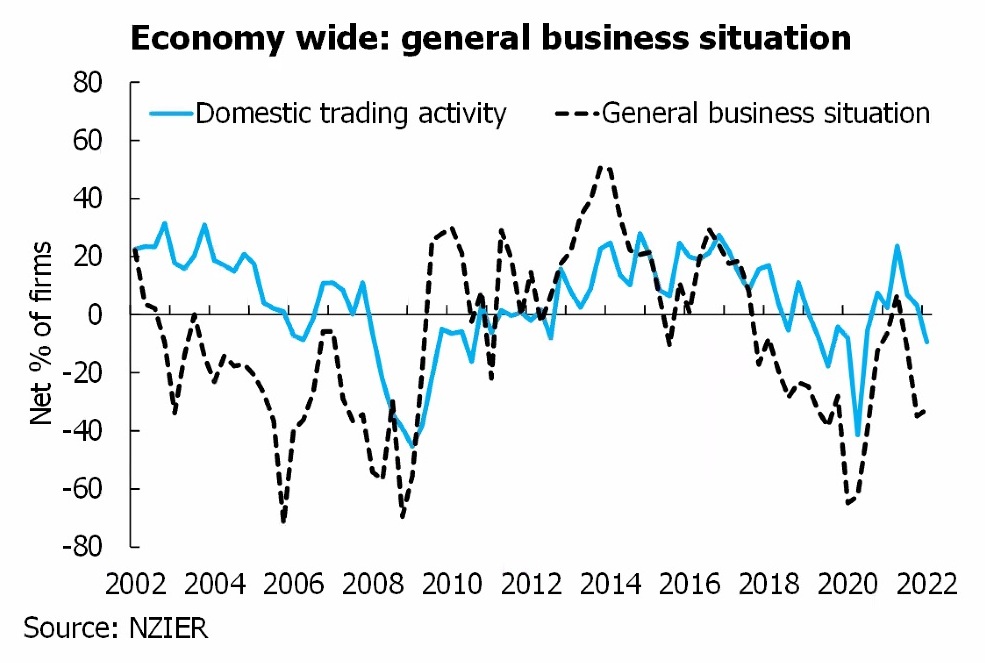
NZIER principal economist Christina Leung said the retail sector is now the most downbeat. Cost pressures in the sector are at a record high.
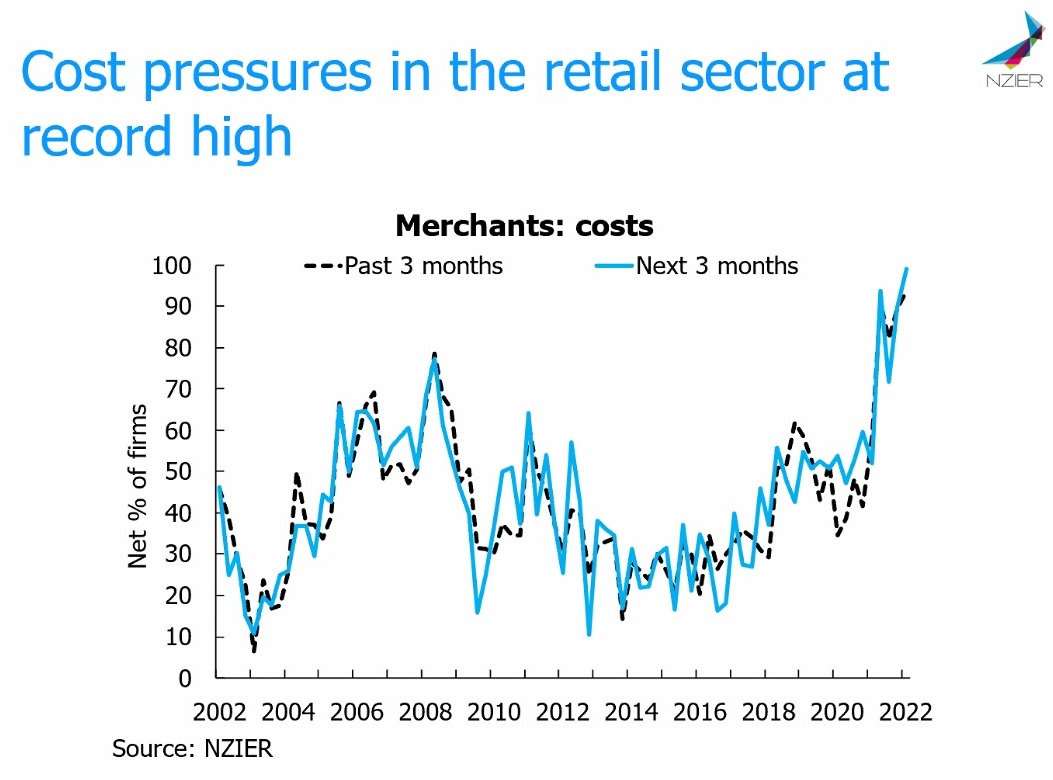
"A net 60% of retailers surveyed are expecting a deterioration in general economic conditions over the coming months.
"This pessimism likely reflects the relatively greater negative impact the spread of Omicron has had on the retail sector, as people stay home out of fear of (or actual) infection. The retail sector also bore the brunt of worker shortages that arose from the Omicron spread, given the limited ability of its workforce to work from home.
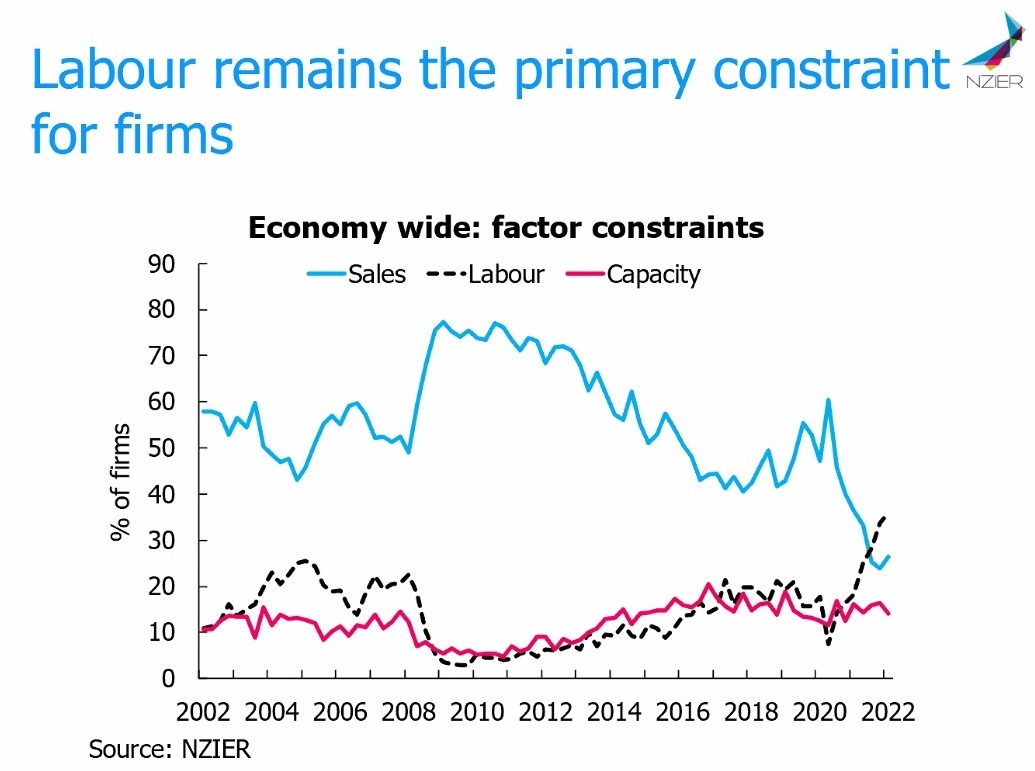
"Overall, businesses are feeling more cautious in an environment of acute labour shortages and intense cost pressures. Although firms have generally found it easier to increase prices, profitability is weakening. A net 34% of firms report reduced profitability in the March quarter, while a third expect weaker profitability in the next quarter."
Leung said with the negative impact of the Omicron spread becoming more apparent and continued uncertainty over how the Covid-19 outbreak will evolve, firms have reduced investment plans for the coming year.
"A net 7% of firms plan to pare back on investment in buildings, while 6% of firms plan to reduce investment in plant and machinery over the coming year. This weakening in investment intentions points to a slowing in business investment over the coming year."
We welcome your comments below. If you are not already registered, please register to comment
Remember we welcome robust, respectful and insightful debate. We don't welcome abusive or defamatory comments and will de-register those repeatedly making such comments. Our current comment policy is here.