

The National Party's kicking off election year with an attack on the Government's economic credentials, saying it needs to "come back from holiday with a real economic plan".
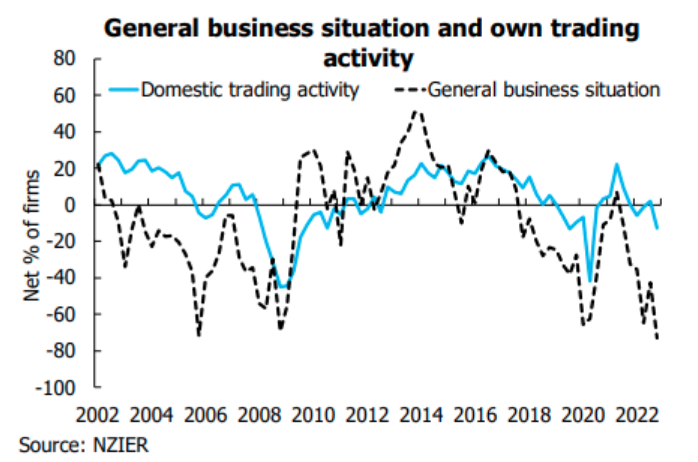
The comments from National's Finance spokesperson Nicola Willis follow release on Tuesday of the latest NZIER Quarterly Survey of Business Opinion, which shows that a net 73% of businesses expect worsening economic conditions in coming months. That's the weakest result ever in a survey that was first conducted in 1961.
ASB economists say the results of the survey show the economy has "run into a brick wall". BNZ economists say "it's all starting to look like stagflation on steroids".
Willis said a record number of businesses were "bracing for pain in coming months".
“The Government’s failure to rein in spending and address labour shortages mean Kiwis are being slammed by rapidly rising interest rates. It’s no surprise that the cost of that failure has left businesses feeling gloomy.
“Alarmingly, the number of businesses expecting higher costs and higher prices have increased since the last survey – suggesting more cost of living pain is on the way in 2023."
Willis said Kiwis deserved a Government with an economic plan. "National would rein in wasteful spending that's adding fuel to the inflation fire, stop adding new costs and taxes, refocus the Reserve Bank on price stability, address worker shortages and let Kiwis keep more of what they earn."
In terms of the actual NZIER QSBO results, these had been expected to be bad, given that this survey was conducted in the aftermath of the Reserve Bank's last Official Cash Rate (OCR) Review and Monetary Policy Statement in late November. The statement then from the RBNZ was much more 'hawkish' than anybody expected and among many surprises had the RBNZ forecasting inflation to rise to 7.5% in the December quarter and suggested that the OCR (currently 4.25%) would go as high as 5.5% by the middle of this year.
NZIER principal economist Christina Leung said the business mood was "downbeat across the sectors".
"The building sector was the most pessimistic of the sectors surveyed, with a net 77% of firms expecting worsening economic conditions over the coming months.
"The decline in the sector’s new orders and output points to a softening in demand over the longer term. While most building sector firms still reported intense cost pressures, the proportion of firms that increased prices continued to fall in the December quarter," she said.
ASB senior economist Mark Smith said the survey's weak readings for the demand side of the economy were "consistent with recessionary conditions".
"Despite this, capacity pressures remain marked, with firms continuing to report extreme difficulties in obtaining skilled and unskilled labour, and with labour shortages still the major constraint on boosting production.
"Rather than falling, experienced and expected price rises ticked up, which along with increasing pressures on profitability and costs and the still-tight labour market highlights the risk of protracted above 3% rates of inflation.
"This, and the possibility of the economy actually proving to be more resilient than signalled by dire sentiment measures, should see the RBNZ to follow through with OCR hikes (a further 125bps expected by mid-2023 and a 5.50% OCR peak)," Smith said.
"Nevertheless, there is no sugar coating the fact that 2023 is turning out to be a difficult year. OCR cuts should follow in 2024, but not until the RBNZ is 110% confident that inflation will settle in the 1-3% target range. This still looks a long way off."
BNZ head of research Stephen Toplis said the results of the QSBO were the "worst of all worlds".
"It’s all starting to look like stagflation on steroids. There is no sign inflation is abating in any meaningful way yet the survey adds more weight to our long-held argument that the economy is headed for recession. Moreover, that recession could come faster, and be much deeper, than many care to believe."
Toplis said while he understood the importance of the "actuals" in terms of hard economic data as opposed to the leading indicators, "we maintain our view that the leading indicators are so weak that the Reserve Bank should now be moderating its approach. Such softness in activity will almost inevitably lead to an easing labour market and lower inflation.
"We have never believed that a 75 point rate hike at the February meeting would be necessary, we are even more convinced of that now."
ANZ senior economist Miles Workman said if the RBNZ was looking to "spook the horses" with the November MPS, then the latest QSBO data suggest "mission accomplished".
"Now the big question is whether or not this sharper downwards momentum is maintained, or if the economy goes back to surprising us on the more robust side after the dust has settled," Workman said.
He said at face value, the latest QSBO data confirmed the RBNZ’s forecast that a softening in the economy is unfolding.
"However, the big worry in the data is the fact that costs and pricing lifted for both the past quarter (Q4) and the next (Q1). That’s going the wrong way, and suggests near-term inflation pressures remain acute (and far too high for the RBNZ to call these data ‘comforting’)."
Kiwibank economists including chief economist Jarrod Kerr, senior economist Jeremy Couchman and economist Mary Jo Vergara said Tuesday's QSBO report "supports our opinion that the RBNZ may deliver too much in the way of rate hikes and monetary tightening".
"The report may not be enough to alter the RBNZ’s view on delivering another 75bp hike in the OCR next month to 5%. Although we would advocate a lesser move (25, not 75). And financial markets are moving in favour of reduced rate hikes. The economic pendulum is clearly swinging towards downside risks, rather than upside risks. We continue to forecast a peak in the RBNZ’s cash rate in coming months, and a likely cut to that cash rate by year-end."
NZIER's Leung said that regarding activity in their own businesses, a net 13% of firms reported a decline in activity over the past quarter.
"This was the weakest since the June 2020 survey when the full impact of the first Covid-19 lockdown was captured."
Leung said the survey showed that firms are preparing for tough times ahead.
"The survey results show firms have become much more cautious and are now looking to reduce staff numbers and pare back on investment plans.
"However, shortages of skilled and unskilled staff remain acute despite the decline in hiring, with finding labour remaining the top primary constraint for businesses.
"That said, a growing proportion of firms are also starting to report sales as the primary constraint for their business, suggesting weakening demand is beginning to impact more businesses."
Leung said despite a greater proportion of businesses passing higher costs on by increasing their prices, profitability has weakened.
"Nonetheless, the pick-up in costs and prices points to high inflation persisting into 2023."
Speaking to some specific sectors, Leung said the architects’ measure of activity in their own office points to a continued softening in the pipeline of construction work over the coming year.
"The pipeline of housing and commercial construction for the coming year continues to decline, while that for Government construction work has moderated. These results suggest construction activity, especially residential construction, will start to ease over the second half of 2023."
The retail sector is also feeling very downbeat, she says.
A net 76% of retailers are expecting a deterioration in economic conditions over the coming months.
"The weaker demand is limiting the ability of retailers to increase prices in the face of intense cost pressures, which has reduced profitability in the retail sector.
"With almost half of mortgages due for repricing over the coming year, many of those mortgages will be rolling off historically low fixed-term mortgage rates of around 2% to 3% on to significantly higher rates of 6% to 7%.
"Consequently, substantially higher mortgage repayments should drive a slowing in retail spending over the coming year."
•The New Zealand Institute of Economic Research has conducted its Quarterly Survey of Business Opinion since 1961. It is New Zealand’s longest-running business opinion survey. Each quarter NZIER asks around 4,300 firms about whether business conditions will deteriorate, stay the same, or improve. The responses yield information about business trends much faster than official statistics and act as valuable leading indicators about the future state of the New Zealand economy.

We welcome your comments below. If you are not already registered, please register to comment
Remember we welcome robust, respectful and insightful debate. We don't welcome abusive or defamatory comments and will de-register those repeatedly making such comments. Our current comment policy is here.