
The largest “cause and effect” variable on the New Zealand economy next year will not be what the Government of Reserve Bank decide on policy changes, it will be the increase in pork, beef, lamb and chicken prices.
Our export commodity prices are forecast to increase further from their already record highs and domestic prices for meat will follow and push up inflation.
The dramatic decline in pork production due to the African swine fever in China is contributing to a global shortfall in meat supplies that can only drive prices higher.
China’s pig herd has been halved and it will take years to rebuild.
A quarter of the world’s pig population has been lost.
As a result, worldwide production of chicken, pork and beef in 2020 will about 6 million tonnes down on this year. Beef, chicken and lamb production cannot be automatically ramped up to replace the pork shortages.
The global food trade has not seen a meat supply shortfall of this magnitude for more than 50 years. It is an extraordinary situation that has not been given the prominence in New Zealand’s media that it deserves. As the swine fever (a viral disease) spreads into Vietnam and Cambodia, the New Zealand and Australian border bio-security authorities will need to be on full alert.
Inside China pork prices have increased 170% over the last year, chicken prices are up 20% and beef up 10%.
What is not known at this time is the socio/political ramifications within China if the urbanised populations cannot buy protein as the price is just far too high. Chinese control of their media means that we may never hear the fully story of public food shortages as substitutes for pork cannot be found quickly enough. It may be over to the Americans to substantially increase beef exports to China as Australia’s herds are down due to drought and the other large global beef producer, Brazil is constrained. Environmentalists have already raised concerns that increased cattle-rearing in Brazil will drive high levels of deforestation in the Brazilian Amazon.
The implications for currency values from this emerging food supply disaster are twofold:-
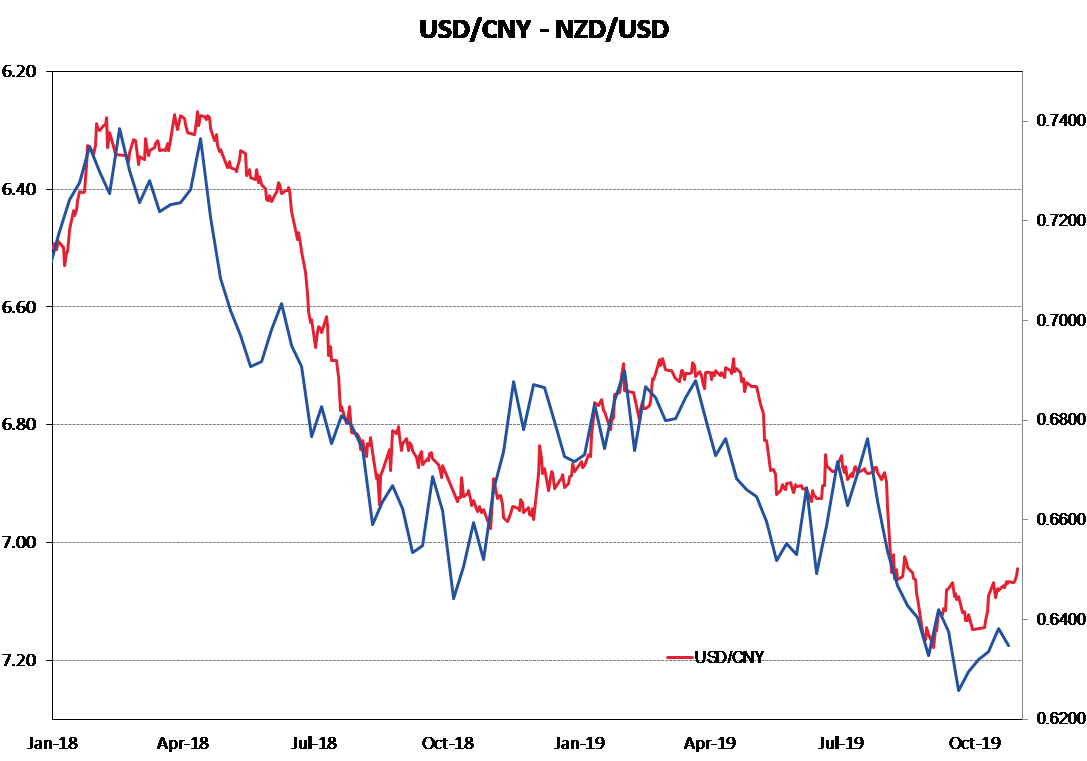
- Already record high export prices for our beef and lamb are set to move higher still in 2020. Whole milk powder prices are also likely to increase further as China demands imported protein. The divergence of the NZD/USD exchange rate value away from our commodity price index over the last 18 months (due to the uncertainties of the China/US trade war) will widen further unless the NZD exchange rate moves upwards.
- The People’s Bank of China (PBOC) are already setting stronger Yuan values against the USD on a daily basis. The Yuan was deliberately weakened against the USD over the last 12 months as a retaliatory measure against US import tariffs on Chinese export goods. As the trade war starts to be resolved the Chinese authorities are changing policy away from a weaker Yuan. A stronger Yuan against the USD will make increased imports of beef and sheepmeat less expensive and help control domestic foods prices within China. The Yuan has already appreciated against the USD from 7.1800 in early September to 7.0350 last Friday. Both the NZD/USD and AUD/USD exchange rate are highly correlated to the Yuan (USD/CNY) exchange rate.
Given the new circumstances of a phased trade agreement with the US now being agreed and the need to dramatically increase food imports into China, it would not be too surprising to see the USD/CNY exchange rate return to the 6.7000 area it was trading at back in January to April this year. A 7% appreciation of the Chinese Yuan from here would see the NZD/USD rate return to well above 0.6800.
First test for monetary policy committee members
We may be about to witness the first real test of the expanded RBNZ monetary policy committee which now includes three external members (Caroline Saunders, Bob Buckle and Peter Harris) as well as the four internal RBNZ members, when the next Monetary Policy Statement is released on 13 November.
There have been considerable changes in both the global and local economies since their last statement in early August.
Global financial/investment markets are now reflecting less risk to the world economic outlook as progress is made on the China/US trade dispute and an end-resolution is in place for Brexit (i.e. a “hard Brexit” is not going to occur).
Here in New Zealand, both GDP growth and inflation are now tracking above official RBNZ forecasts.
Additionally, business confidence is finally recovering, and consumer confidence has moved higher again.
The so-called economic “headwinds” never arrived, and the export commodity price outlook now suggests a considerable “tailwind” for the NZ economy looking ahead. Whether the largely academic external members of the RBNZ Monetary Policy committee are up to speed with these recent economic developments will be interesting to observe.
The local interest rate market now has much less conviction about the RBNZ cutting the OCR by another 0.25% from 1.00% on 13 November.
The Australian interest rate market is now barely pricing in another 0.25% reduction over the next two years following the change from the RBA to a more neutral monetary policy stance.
Whatever the RBNZ decision is on 13 November it may be positive for the Kiwi dollar. A 0.25% cut to 0.75% (same as the Aussies) may be interpreted as the last reduction. A “no change” decision would also send the Kiwi dollar higher. A break above the 0.6450 resistance would see the NZD/USD rate higher towards 0.6600 over coming weeks.
Daily exchange rates
Select chart tabs
*Roger J Kerr is Executive Chairman of Barrington Treasury Services NZ Limited. He has written commentaries on the NZ dollar since 1981.

We welcome your comments below. If you are not already registered, please register to comment
Remember we welcome robust, respectful and insightful debate. We don't welcome abusive or defamatory comments and will de-register those repeatedly making such comments. Our current comment policy is here.