

Summary of key points: -
- NZ government’s calculated gamble still has a way to go
- No market “disconnect” between the NZD and the USD
NZ government’s calculated gamble still has a way to go
The constantly repeated tone in this column over many weeks has been the largest future risk facing NZ exporters in US dollars is the separate and independent depreciation of the US currency unit on the world stage.
Recent evidence is that the expected weakening of the USD has commenced, and the NZD/USD rate is therefore trading in the 0.6400/0.6500 region and not below 0.6000. Further USD depreciation against all currencies seems likely as the US economy struggles to recover from the pandemic, thus massive deficits, debt and money printing continue.
However, what happens with the NZ economy over the next 12 months would stand as the second largest factor for the NZD/USD currency pair. Our economic direction and performance are less clear-cut.
Prime Minister Jacinda Ardern and Finance Minister Grant Robertson took a calculated gamble in March when they locked down hard, bringing the economy to a shuddering halt, on the premise that the earlier we eradicated the Covid-19 virus the earlier the economy could recover.
The plan was that economic damage would be limited by reducing the time period to return to normal economic activity.
The first part of the strategy has worked very well and Jacinda has received the plaudits from abroad and at home (judging by the political opinion polls).
Strong and decisive leadership, clear communication and unrelenting focus have been the successful hallmarks on addressing the health part of the crisis.
The nation is now crying out for the same leadership, decisiveness and focus from the Government to drive the economy to recovery.
However, the economic recovery is not just about returning activity levels to the previous norms.
We have a two-month hole to replace and that requires additional economic growth/activity in the future to the past norm.
To date, the Labour Coalition government shows absolutely no signs of understanding what is required to do this.
Distributing borrowed money around the economy was the relatively easy part, stimulating additional economic growth to generate additional tax revenue to the Government to repay that debt is more difficult. But it needs to be done.
Innovative economic policy prescriptions that allow New Zealand to advantage from our Covid-free status in the world would seem to be a very good place to generate that additional economic activity we require.
Entrepreneurial business folk have been promoting such initiatives as software/technology hubs, free trade zones, pharmaceutical research/drug trialling clusters, specialist education centres, global sporting events and movie industry opportunities.
Successive governments have recognised the benefits of hosting major sporting extravaganzas like the America’s Cup yachting in New Zealand, but only after they were prepared to listen to and be convinced by relentless lobbying from Grant Dalton and others.
Sadly, the current government, from the evidence so far, is not even prepared to listen, engage with and work with business to create the legislative/regulatory environment to bring these initiatives to fruition.
Anecdotes of business identities such as Rob Fyfe, Rod Drury and Fraser Whineray being totally frustrated with the inertia and lack of engagement from Wellington politicians and civil servants tells us that the Government has their ears and eyes shut to business.
The business/government dialogue that needs to occur is just not happening, with the PM being “angry” with a major retailer not helping the situation.
Fast-tracking identified “shovel ready” infrastructure projects has been promised for weeks and weeks now, however nothing happens.
Enormous opportunity exists to expand food production in New Zealand, therefore fast-tracking irrigation and aquaculture projects should be an imperative. But nothing happens.
If the government does not listen and engage with business in the design of the new economic policies, and instead attempt it on their own, you end up with expensive and disastrous failures such as Kiwibuild.
The post-war economic success of Japan and Germany was based on a unique partnership between the state and business. The successful partnerships were centred on mutual recognition and respect.
Unfortunately, political attitude and ideology from the current government prevents this happening in New Zealand today.
If the Government was to embrace the new initiatives and allow business to participate in the policy design with them we could have a chance at achieving the additional economic growth we need.
The “same old/same old” will not cut it for the New Zealand economy, the Government needs to create the policy environment so business risk takers can get on with what they do best.
No market “disconnect” between the NZD and the USD
The debate rages on that there is a total disconnect between Wall Street and Main Street, in that rising share market valuations bare no resemblance to what is happening in the real economy of lower activity, profit annihilation, worker layoffs and business failures.
The free cost of money (near zero interest rates) has a lot to do with the disconnect. Equities and property are the logical investment destinations when Mum and Pop investors receive less than 2% yield return from bank deposits and government bonds. The US Federal Reserve seem prepared to live with investment asset bubbles if that is what it takes to get the US economy on the recovery trail. The market disconnect seems likely to continue with only an escalation of second wave Covid-19 infections in the US causing equity market jitters (thus consequential NZD pullbacks).
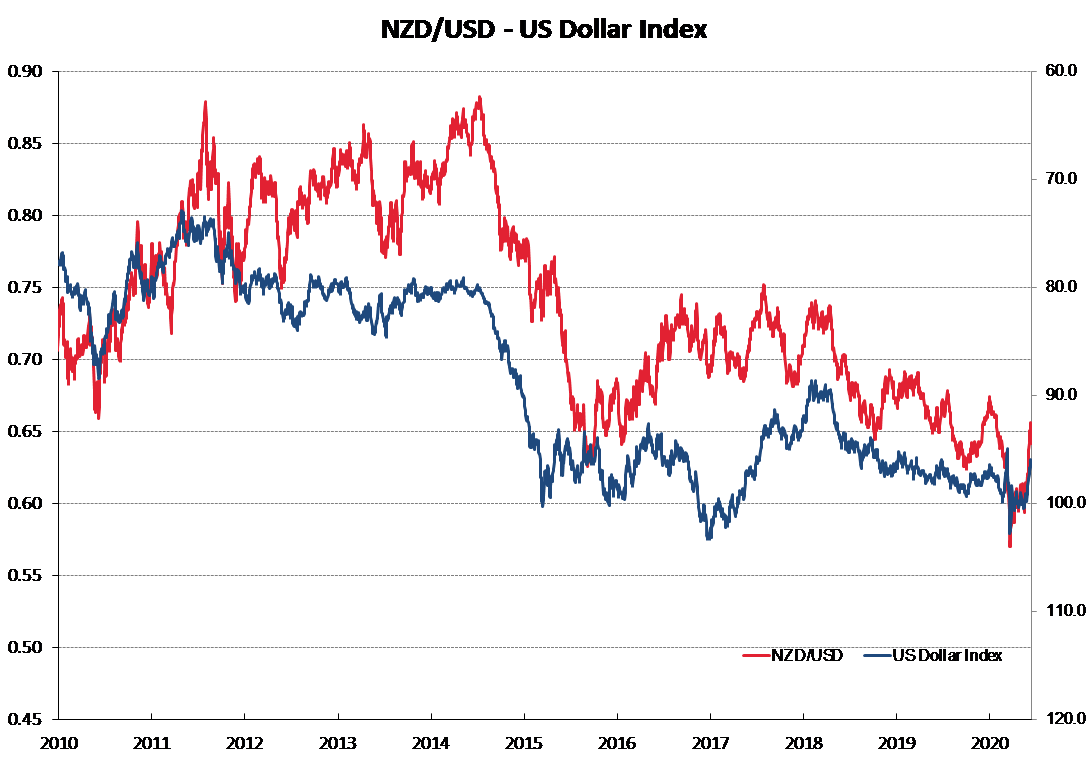
However, there is no such disconnect for the NZ dollar’s future direction with the NZD/USD correlation to the overall US dollar currency index remaining strong. A weaker USD combined with a strongly recovering NZ economy (if the Government is listening to business!) suggests a higher NZD/USD exchange rate going forward. Otherwise, a weaker USD and a wobbly NZ economic recovery points to more time in the mid to low 0.6000’s.
Daily exchange rates
Select chart tabs
*Roger J Kerr is Executive Chairman of Barrington Treasury Services NZ Limited. He has written commentaries on the NZ dollar since 1981.
We welcome your comments below. If you are not already registered, please register to comment
Remember we welcome robust, respectful and insightful debate. We don't welcome abusive or defamatory comments and will de-register those repeatedly making such comments. Our current comment policy is here.