
Summary of key points:
- Covid19 “own goal” an economic setback
- Adrian Orr will be true to form on jawboning the Kiwi lower
- US dollar’s reserve currency status under question
Covid-19 “own goal” an economic setback
The NZD/USD exchange rate has recoiled from the highs of 0.6575 reached on 9 June to trade lower to 0.6410. Given the negative virus quarantine control and GDP economic news coming out of New Zealand over the last week it is a little surprising it is has not weakened further.
The NZ Government’s smug complacency over their success in controlling Covid-19 has turned to bite them on the bum as the Health Ministry displays complete ineptitude in operating strict quarantine controls for travellers arriving into the country. The nation was asked by the Government to sacrifice a lot back in March and April in order that Covid-29 could be eradicated quickly, and the economy could rebound earlier. Both business folk and consumers alike now rightly feel betrayed that the health authorities could not do their job to the required standard and untested/infected individuals could wander around the country.
It is not good enough that Government politicians lay the blame at the people and systems in the quarantine hotels. However, responsibility and accountability for failures and stuff ups has not been a hallmark of the Ardern Coalition government. Unfortunately, the inadequacies of bureaucratic government departments are now directly impacting on the fledgling economic recovery as households will be more cautious about spending and travel. The prospect of the NZ economy recovering ahead of others because we took the tough medicine with the total lockdown and therefore could return to normal activity earlier has been dealt a body blow. A frustrating “own goal” for our economy and one that may well prove to have adverse consequences for the Labour Coalition government come the general election in September. The “be kind” and “we have got this” feel-good image surrounding the Prime Minister, I suspect, is rapidly being replaced by a view that they are not up to the job.
The opportunity to promote New Zealand’s unique status as “Covid-free” and open for international businesses to come here has also been delivered a major setback. Any positives the NZ dollar currency value may have received from foreign capital inflows because of our Covid-free status have also been eradicated by the bureaucratic bungles.
There was no great reaction in the forex markets to the March quarter’s GDP growth result of a 1.6% contraction being considerably more than the prior forecasts. However, it needs to be said that any forecast of economic data is fraught with extreme difficulty in the current environment. Whilst the decrease in economic activity was more than experienced in Australia over the first three months of the year, the outcome was not too different to GDP results in Europe, Canada and the US.
Adrian Orr will be true to form on jawboning the Kiwi lower
In the short-term, the Kiwi dollar is certainly at risk to further depreciation against the USD into the 0.6300’s and maybe to the mid-0.6200’s.
Being true to past form, RBNZ Governor Adrian Orr is likely to comment on the recent NZD gains to 0.6500 when the RBNZ reviews the OCR on Wednesday 24th June. His rationale and justification to be always talking the NZ dollar lower is perplexing to the writer, however he would be inconsistent with all previous monetary policy signalling/messaging over the last two years if he did not mention the value of the currency.
On all prior occasions the Mr Orr has jawboned the Kiwi lower, the selling pressures in the FX market never last too long and the Kiwi soon recovers to the pre-statement levels. The OCR review this week should be no exception to that pattern.
Therefore, exporting companies should take advantage of the short-term dip to add to forward hedging percentages. Orders placed with banks to buy Kiwi, sell foreign currency forward should be staggered down, not just for the NZD/USD but also for the cross-rates against the AUD, GBP and EUR. The RBNZ triggered selling will be specific to the NZ dollar, therefore all cross-rates will briefly drop in unison.
Importers should already be well hedged to protect their trading margins over this expected short-term period of weakness in the Kiwi dollar.
US dollar’s reserve currency status under question
The anticipated short-term pull back in the Kiwi to marginally lower levels does not, however change or disrupt the medium to longer term view that the US dollar itself is at the start of a new and potentially multi-year downtrend against all currencies. It is clear that the major EUR/USD exchange rate is not about to move in an even/straight line higher (stronger Euro, weaker USD). After climbing to $1.1375 on 10 June, the USD has recovered back to just below $1.1200. The risks around a major potential second-wave of coronavirus infections in the US has reduced somewhat, well that is what Wall Street is telling us anyway! President Trump seems impervious to the health and economic risks of a second wave in the US and relies on a “hope” the pandemic will simply go away. Trump also appears to be ignorant of the risks around the more officials he fires, the greater the likelihood they will seek vengeance and payback though disclosing how he really behaves (e.g. John Bolton).
The majority of US-based foreign exchange market analysts and commentators still argue the “TINA” defence (There Is No Alternative) to the value of the US dollar as the world’s reserve currency and therefore it will not weaken. However, as respected Yale economist Stephen Roach (ex-Morgan Stanley) argues, the US dollar is no different to any other foreign exchange rate. It is a “relative” price and as such it incapsulates a broad spectrum of a nation’s value proposition of economic, financial, social and political factors compared to other countries.
Recent events in the US with social unrest, the Covid-19 economic downturn, increased government deficits/debt and a divisive President facing re-election (or not), all add to undermining that USD relative-value proposition.
Roach’s viewpoint is that the level of everyone’s foreign reserves held in USD’s will continue to decline over coming years as the US leads the charge in trade protectionism, de-globalisation and decoupling. Global managed funds, central banks and financial institutions will all be looking to re-weight USD holdings/exposures to lower levels. The US needs to attract foreign capital to fund its dual budget and Current A/c deficits (domestic savings are not enough). Foreign investors will not commit their funds with the USD exchange rate currently so strong, the USD needs to depreciate to a lower value to then attract the capital inflows.
If the US dollar value does re-align and weaken to $1.2000 against the Euro, the NZD/USD exchange rate would return to above 0.7000 (refer chart below).
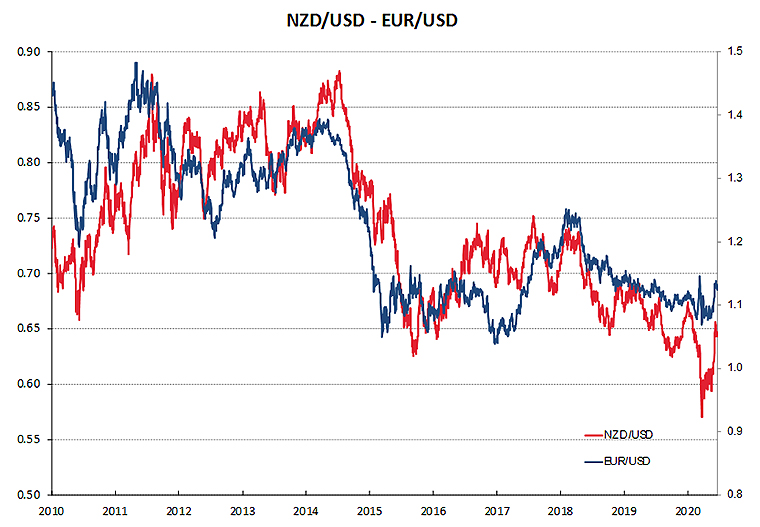
Daily exchange rates
Select chart tabs
*Roger J Kerr is Executive Chairman of Barrington Treasury Services NZ Limited. He has written commentaries on the NZ dollar since 1981.
We welcome your comments below. If you are not already registered, please register to comment
Remember we welcome robust, respectful and insightful debate. We don't welcome abusive or defamatory comments and will de-register those repeatedly making such comments. Our current comment policy is here.