
So, are we beating this inflation thing, or is it beating us?
We'll get some answers this Friday (January 23) when Statistics NZ releases December quarter Consumers Price Index (CPI) figures.
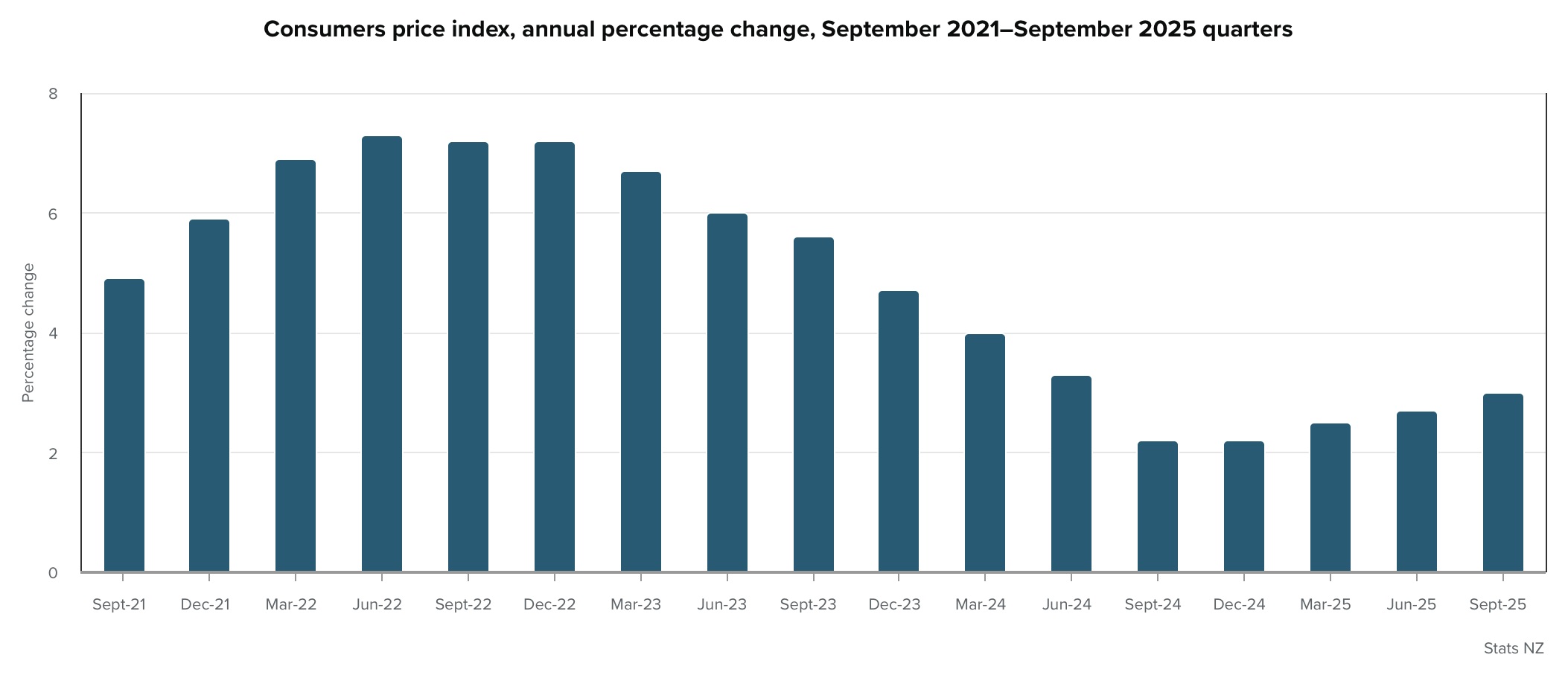
If we recall, the September quarter CPI showed annual inflation of 3.0%, up from 2.7% in June.
Last Friday's monthly release of Selected Price Index (SPI) figures, which contain around 47% of the CPI ingredients, showed some higher than expected inflationary pressures and as a result, major bank economists tweaked their forecasts for the CPI figure up a little.
Most expectations have settled for a figure of 3.0% for the coming Friday's figure, though I don't think anybody will be too surprised if its a little higher than that.
Well, the Reserve Bank might be a bit surprised, given that it has forecast a 2.7% figure - but in fairness that pick was made in November before much more recent information was available.
And of course these figures are of great interest to the RBNZ, given that it is charged with achieving inflation between 1% and 3%.
If we recall, in the wake of the pandemic disruptions, inflation charged away from mid-2021, reaching a peak in June 2022 of 7.3%.
The RBNZ brandished its main inflation weapon the Official Cash Rate, hiking it all the way from the pandemic emergency setting of 0.25% to a high of 5.5% by May 2023. The consequent sharply higher mortgage rates crimped spending and ultimately took the steam out of the economy, leading eventually to a recession.
But we got inflation down. It dutifully trotted back into its 1% to 3% box in the September 2024 quarter, actually falling as low as 2.2%. Within that 1% to 3% range the RBNZ explicitly targets 2% inflation and it looked in late 2024 as though that was going to be achieved. But events haven't panned out like that.
The big drops in inflation that were seen during 2024 were in large part driven by so-called tradable inflation (think imports and things like oil prices), while the domestically generated (non-tradable) inflation was slower to react. Well the domestic inflation has continued to fall - albeit not as quickly as would have been liked (and shoppers can quickly point to the fact that annual food price inflation was still running at 4.0% as of December). And this stubborn domestic inflation has now been joined by firming tradable inflation as well, with petrol prices notably rising.
So, assuming the annual inflation rate at the December quarter comes in at 3.0%, if not even a touch higher, where to from here?
Well, that's the interesting bit.
New Reserve Bank Governor Anna Breman fronts her first Official Cash Rate review on February 18. This will give us our first serious reading on what to expect. Is Breman a dove? A hawk? Neither? We'll get some clues from the tone, particularly of the accompanying media conference after the decision is released. And I'll have more to say on what we might expect closer to the time.
This may therefore be the moment to bring in some of the major bank economists and see what they are expecting from the inflation figures.
The Kiwibank economics team of chief economist Jarrod Kerr, senior economist Mary Jo Vergara and economist Sabrina Delgado, are picking 3% annual inflation.
"Increases across some of the more volatile items of the [CPI] basket are likely to keep the headline rate elevated. But under the surface Kiwi inflation remains soft with further cooling in domestic inflation expected," they say.
"While such a read [of 3% annual inflation] would top the RBNZ’s 2.7% forecast, we don’t expect the overshoot to set off any alarm bells at the Reserve Bank. Continued strength in imported inflation, exacerbated by a weaker Kiwi dollar, is the main culprit. And we’ve seen increases in some of the more volatile and seasonal prices, including petrol, airfares, and accommodation. We’re expecting tradable inflation to have lifted 2.4% over the year. Domestic price pressures, however, continue to cool given excess capacity in the economy. We expect non-tradables inflation eased to 3.3% from 3.5%. And we expect core measures of underlying inflation to continue following the same downward path."
The Kiwibank economists say while Friday’s release "will show some annoying hot spots of lingering inflationary pressures" the underlying trend should still be one of disinflation.
"Spare capacity still teeming in the Kiwi economy should see further generalised cooling in domestic inflation over the medium term. While a forecast recovery in the Kiwi dollar this year should relieve some of the offshore inflationary pressures. Put together we continue to expect inflation to fall back to the RBNZ's 2% [targeted] mid-point over 2026."
ANZ senior economist Miles Workman, also picking a 3.0% figure, says stronger inflation than the RBNZ's November MPS forecast is likely to keep the RBNZ Monetary Policy Committee [which makes the OCR decision] cautious, "but with underlying inflation still going the right way, the bar for delivering anything other than a hold [at the current 2.25% OCR rate] in February remains high".
"As always, the detail will be key in assessing the monetary policy implications. The RBNZ will be focused primarily on the signals these data provide regarding the trajectory of underlying inflation – particularly those emerging from non-tradable, services, and core inflation measures.
"Core inflation indicators produced by Stats NZ are expected to remain within the 1- 3% target band, with the weighted median, 30% trimmed mean and ex-food, fuel and energy measures anticipated to drop to close to 2%," Workman says.
ASB senior economist Mark Smith is picking a 3.1% inflation figure.
"After helping to dampen overall inflation in 2024 and early 2025, annual tradable inflation is climbing towards 3%," he says.
"Domestically generated inflation is slowing, with elevated costs keeping annual inflation rates above 3%."
Smith says economic spare capacity should work to eventually ease inflationary pressures.
"However, there is the risk that annual CPI inflation will remain somewhat firmer than the circa 2% expectation by the RBNZ over 2026.
"We don’t envisage the RBNZ will be in a rush to change the 2.25% OCR and have pencilled in 50bp of OCR tightening from early 2027, Smith says.
He says, however that the concern is that domestically generated inflation rates are close to plateauing at around 3%, with the risk that they accelerate as the economic expansion continues.
"We don’t envisage the RBNZ will be in a rush to change the 2.25% OCR, but caution that the RBNZ may step in if the NZ economy heats up too quickly."
Okay, so, back to me to finish.
At the moment financial markets are expecting the OCR to be on hold in February, but market pricing is suggesting the OCR may start to move up again in the September quarter of this year, with a 25 basis point rise in the OCR about 80% priced in by the start of September.
Any significant surprises in Friday's inflation figures would be sure to get that market pricing moving forward.
One thing is for sure. Further falls in the OCR now seem off the table.
We welcome your comments below. If you are not already registered, please register to comment
Remember we welcome robust, respectful and insightful debate. We don't welcome abusive or defamatory comments and will de-register those repeatedly making such comments. Our current comment policy is here.