

Summary of key points: -
- The Australian dollar breaks the shackles and posts impressive gains
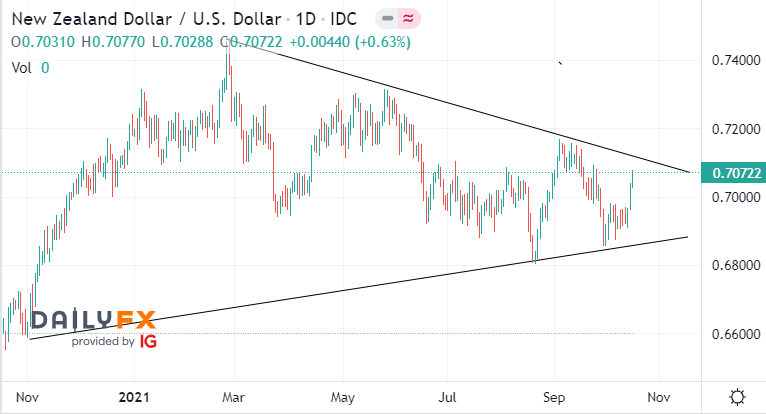
- NZD/USD “converging wedge” formation highlights upside NZD risk
- New Zealand: “From envy of the world, to a laughing stock”
The Australian dollar breaks the shackles and posts impressive gains
Having visited the bottom end of the current trading range at 0.6880 against the USD on 6th October (immediately following the “dovish” RBNZ 0.25% OCR hike), the Kiwi dollar has posted strong gains to now test the upper end of the trading range at 0.7100.
However, it is not independent NZ dollar appreciation on specific and positive New Zealand-centric economic data that we are witnessing here. The higher NZD/USD rate is entirely due a marginally weaker USD against the Euro on global forex markets and more importantly on the Australian dollar breaking up above through key resistance levels at 0.7350 against the US dollar.
Our column has highlighted the case recently for a potentially strong rebound upwards in the Aussie dollar against the USD as it appeared to have reached an over-sold position at 0.7200, having depreciated consistently downwards from the 0.8000 level back in March. US dollar strength over that six month period, weaker Chinese economic data, Covid lockdowns and a turn lower in the key iron ore commodity price were all factors that justified a weaker AUD.
Adding to the propensity for a rapid AUD rebound was the fact the fund managers and hedge funds in the US had entered into very large “short-sold” AUD speculative positions in expectation of continuing AUD depreciation.
The events of the last few weeks have proven that the AUD selling is now exhausted and the punters holding short-sold AUD positions will be forced to buy back the AUD in large quantities to unwind.
Announcements by the Australian Government on the re-opening from lockdowns in Victoria and New South Wales which were conditional on threshold Covid vaccination rates being achieved (which have now been met) has added to the more positive sentiment towards the Australian economy and Aussie dollar over recent weeks.
The AUD always stood out as a currency that had been sold down over the first nine months of this year to a low point and therefore offered attractive entry points for global investors seeking an alternative currency to the USD to buy.
These investors and currency traders are now looking to reduce their weightings of US dollar assets and positions as they strategise ahead in the expectation that the USD will weaken in 2022 and 2023.
We have held the currency view for some time that all the positive USD news (tapering of QE from November to mid-2022 and interest rate increases in late 2022) will be fully built into the USD currency value by this time and from here the USD is likely to reverse to a weakening trend on the back of the large dual deficit problem the US economy has.
Global funds moving out of the USD, as they price-in the future 12 months ahead in time, are already pinpointing the AUD as a preferred major currency to be in.
There is a fair argument that the AUD cannot really appreciate until the Reserve Bank of Australia (“RBA”) change their stance on not lifting their interest rates until 2024.
The RBA have stuck to their guns that they will not increase interest rates until they see more permanent inflation trends from persistent increases in wages.
To date they have not seen the lift in wages, however the severe labour shortages that every western economy is currently experiencing must at some point in the next six months start to increase wages in Australia.
We are already seeing strikes at their ports, so the labour market pressure is building, and therefore the RBA may well be forced to relent at some point soon. When they do, the Aussie dollar will have another positive string to its bow.
NZD/USD “converging wedge” formation highlights upside NZD risk
The AUD/USD rate has climbed to 0.7425, which in turn has dragged the NZD/USD up to 0.7070. The evolving “converging wedge” chart formation for the NZD/USD trading pattern that we highlighted in our 3rd October column is now even more acute.
The NZD/USD dip to 0.6880 two weeks ago bouncing immediately back up from the rising support line. A movement above the current 0.7100 resistance point would suggest further gains for the NZD as the rate breaks above the down sloping resistance line.
Local USD exporters have had two bites at the cherry over recent times (at 0.6820 on 21 August and at 0.6880 in early October) to enter long-term hedging against the forecast general USD weakness in 2022. The USD exporters may not get another chance if the AUD makes further gains to 0.7500/0.7600 and the Kiwi dollar follows.
Daily exchange rates
Select chart tabs
*Roger J Kerr is Executive Chairman of Barrington Treasury Services NZ Limited. He has written commentaries on the NZ dollar since 1981.
We welcome your comments below. If you are not already registered, please register to comment
Remember we welcome robust, respectful and insightful debate. We don't welcome abusive or defamatory comments and will de-register those repeatedly making such comments. Our current comment policy is here.