

By David Hargreaves
It is always incredibly difficult to know how seriously to take surveys of expectations.
Economists tend to take them very seriously, hence in the case of the ANZ's Business Outlook Survey we get the interesting situation where a survey written up by economists is then reviewed and commented on by OTHER economists.
The Reserve Bank takes its own Survey of Expectations, a quarterly survey of business managers and professionals pretty seriously and has been known to be very strongly influenced in terms of its decision making by sudden swings in inflation expectations in this survey.
I'm not sure if the RBNZ's Household Survey of Expectations is quite as influential within the bank, but for sure the RBNZ will have noted the collapse in house price expectations in the latest survey out last week.
Clearly the RBNZ's household survey (which takes in a sample of 750 views) has not proven that accurate in the past (since 2011) at predicting what house prices would actually do.
So, probably it's biggest value - and it's not alone in this in terms of expectations surveys - is gauging the temperature of people; how they are feeling about things and how they might react in future.
What therefore do we make of a finding that for the first time in the six years the question has been asked that the respondents see essentially no house price growth in the next year?
And is the logical next step that we'll see respondents in this survey next time around (the surveys are quarterly, so it will be into next year) predicting actual falls in prices of houses? Certainly a fair few of our readers - based on the comments stream here - would concur with such a view if it emerges.
The big question then would be how homeowners might react to sitting on a property that might begin falling in value. And while that's still a very big if in my view, look, it's possible isn't it?
(I would stress I think the longer term outlook for house prices in New Zealand and particularly Auckland is very good - particularly given the shortages. But that wouldn't necessarily stop short-term volatility.)
Coincidentally, and the timing possibly isn't great, we've had the new Auckland valuations come out, amid huge interest. And sure enough of course these reflect the massive gains in Auckland property values in recent years.
From a pure investment perspective, it's generally wise if one has had a good 'run' with an investment - but then sees flat times ahead - to 'cash in' and bank some profits.
Houses of course are quite a bit different. Everybody would like to live somewhere and in New Zealand the preference is very much to own your own home. So, the idea of taking profits now, putting them in the bank and say renting while seeing if the house market does indeed fall probably wouldn't hold too much appeal for many.
What though of people who have bought investment properties? This could be more interesting, particularly in the case of people who might have bought properties that don't have great rental yields because they believed they would get capital gains on the properties.
Might the combination of the strong recent gains in house prices and the fact that prices are expected to be flat at best from here prompt a fair few investors to seek to cash in?
The RBNZ itself is not forecasting house price falls, but is picking house price inflation of only something like 2% a year over the next three years.
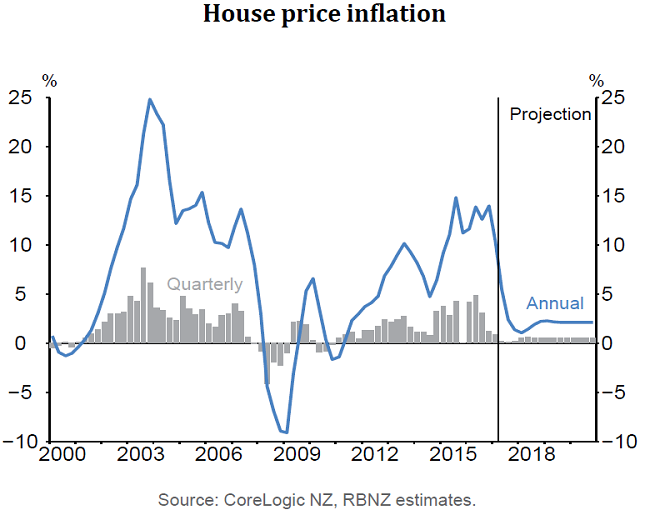
The RBNZ has also signalled it will have something to say about its limits on high loan to value lending in its latest Financial Stability Report being released on Wednesday, November 29.
This would suggest that the central bank is at the very least going to give some indication as to when the limits may start to be relaxed. The RBNZ has clearly indicated on several occasions that it would not lift the measures all in one go.
With the way the housing market is now looking, I would suggest the most urgent priority is easing the 40% deposit limit for investors.
As indicated earlier in this article, I would see owner occupiers as more impervious to possible short term adverse movements in house prices than those holding investment properties - particularly ones that don't have a great rental yield.
Keeping the market as tight as it now is for housing investors then actually runs the risk of the very thing the RBNZ had wanted to avoid - which is a lot of houses coming on to the market at the same time, putting downward pressure on the market and prices, and therefore putting pressure on the banks and ultimately the supply of credit.
A somewhat complicated emerging situation is further complicated by the fact that the RBNZ is still looking for a new Governor. Acting Governor Grant Spencer reiterated recently that it is still his intention to be out of the door of the RBNZ when his official term as Acting Governor ends on March 26.
It falls to the RBNZ board therefore to recommend a new Governor to Minister of Finance Grant Robertson, with him then officially making the appointment.
At the moment the process is in the RBNZ board's hands. The official word from the RBNZ as of this week is: "The Board is working to enable an appointment to be made so that the new Governor can take up the role when Grant Spencer’s term ends on 26 March 2018. Any announcement is for the Minister to make, after he has agreed to a recommendation from the Board. The Board won’t be giving out possible timing of any steps along the way."
Well, they had better get on with it. The problem for the board of course is that we've had a change of Finance Minister and with that a proposal for some changes in how things work at the RBNZ.
The question is whether these changes make a difference in terms of who the RBNZ board feels is the best candidate to recommend (because it's to be presumed the board absolutely would not want a situation in which the Finance Minister rejected their pick). Then there's the matter of whether the preferred candidate still wants the job given the looming changes.
With the housing market moving into an interesting phase (not to mention a lot of other issues up in the air too) it would certainly help to get a new Governor on deck as soon as practicable.
I think the house market is going to need watching closely next year. Any sign that particularly investors have 'tipped' in favour of selling would need reacting to.
The summer housing market is always intriguing anyway. This one promises to be particularly so.
A few nerves may already be jangling out there. Further signs of softness in the market as we get into the New Year may just make that worse.
We welcome your comments below. If you are not already registered, please register to comment
Remember we welcome robust, respectful and insightful debate. We don't welcome abusive or defamatory comments and will de-register those repeatedly making such comments. Our current comment policy is here.