
"It's the economy, stupid," was a famous political slogan in Bill Clinton's ultimately successful 1992 US presidential campaign. And as 2026 gets underway in this New Zealand election year, the economy is likely to be an important factor in determining the outcome.
We saw some notable economic data this week, some of which suggested signs of life in the economy. At the same time, a political poll, very early in election year, suggested a tight election outcome is on the cards.
On the face of it, news of some improvement in the economy should be good news for incumbent politicians.
However, four questions come to mind.
Firstly, how much is the economy really improving?
Secondly, will stronger/improving economic data flow through to voters actually feeling and believing things are getting better?
Thirdly, if inflation pushes through the top of the Reserve Bank's target, which it might do, will we see an Official Cash Rate (OCR) increase, or even increases, before the election?
And fourthly, looking overseas, what the heck is going to happen in the world this year and what impact might it have on NZ?
On the data and economic indicators, the New Zealand Institute of Economic Research's Quarterly Survey of Business Opinion suggested business confidence was at its highest level since 2014.
Quotable Value (QV) said "clear majority" of the areas it measures recorded quarterly growth in residential property values, indicating "value movements are now occurring across a broader range of regions."
The latest BNZ-BusinessNZ Performance of Manufacturing Index (PMI) recorded a seasonally adjusted PMI for December of 56.1, with a PMI reading above 50.0 indicating manufacturing is generally expanding and below 50.0 that it's declining. This was 4.4 points higher than November, and above the survey's average of 52.5.
Statistics NZ reported 35,969 new homes consented over the year ended November, a 7% increase on the year ended November 2024.
Those sets of data are encouraging, especially given the headlines last year about high numbers of New Zealanders leaving the country, albeit these numbers were dropping by year's end, high levels of company liquidations and rising unemployment.
Meanwhile, Friday's Statistics NZ Selected Price Indexes (SPI) raised concern Consumers Price Index (CPI) inflation may have ended 2025 above 3%, which is the top of the Reserve Bank's target band.
While the Westpac-McDermott Miller Employment Confidence Index rose 3.9 points to 93.8 in the December quarter, its highest reading since March 2024, it remains subdued with a level below 100 showing more households are pessimistic about the outlook than optimistic.
And then there was consumer spending data from Worldline's payments network during December. This came in at $4.702 billion, down 0.2% on December 2024.
Roy Morgan's political poll suggested the election outcome will be tight. It had the National-NZ First-ACT government coalition winning 62 seats, and the Labour-led Opposition winning 58 seats. It also showed 2.5% support for The Opportunity Party, and 4.5% of those surveyed not naming a party.
In terms of elections, a humming economy, or even an improving one, typically benefits incumbents. However, after an economically tough couple of years, will enough people believe things are getting better for them even if the data says they are?
Politicians will, of course, highlight what they think will benefit their cause. And there were aspects of this week's data both government and opposition politicians could sell to the public.
Hot on the heels of the SPI release, Labour's finance and economy spokesperson Barbara Edmonds trumpeted big increases in some key food prices.
“Today’s statistics show grocery prices continuing to climb, while wages fail to keep up. Milk is up 15.8 percent, beef steak has jumped 21.7 percent, and white bread has surged a staggering 58.3 percent in just a year.
“These aren’t luxuries, they’re the basics families rely on. New Zealanders are working hard, but under National they’re going backwards.
The SPI also noted a 12.2% increase in annual electricity prices, and a 17.5% rise in gas prices, highlighting power prices remain a key cost of living issue.
Meanwhile, National's Small Business and Manufacturing Minister Chris Penk was quick to trumpet the improved PMI.
“This is an incredibly positive signal, as a PMI reading above 50.0 indicates the manufacturing industry is generally expanding. The data suggests New Zealand manufacturing growth is outperforming major economies including the United States, China, Japan, the United Kingdom, and Australia,” Mr Penk says.
“The success of manufacturing is central to the health of the New Zealand economy. The sector directly employs more than 220,000 people, contributes around eight percent of GDP and accounts for 60 percent of our exports./p>
Ultimately will people feel the economy is improving for them, in the areas that matter to them, and anecdotally will they hear it's doing so for the people they mingle with and care about? Will people feel better off, or will cost of living issues remain front of mind for many?
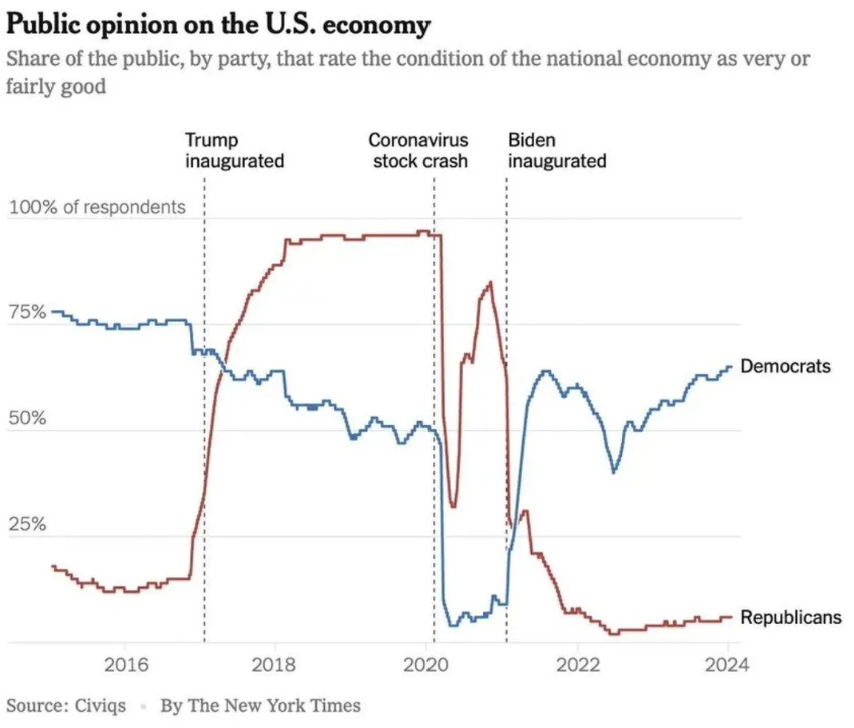
We are all products of our own environment, experiences and beliefs. Political leanings, influences, and where we get our news and information from come into too. While NZ's not as polarised as the United States, witness the NY Times chart below, in the social media age this is a bigger factor than it once was.
At the last election, as people battled high inflation and cost of living challenges, Christopher Luxon and Nicola Willis pledged to "fix the economy."
Leaving aside the limitations of how much influence politicians actually have, now Luxon and Willis are Prime Minister and Finance Minister, how the public perceives how challenging cost of living issues still are, is likely to be important. To what extent have they improved since 2023?
Luxon and Willis have cheered Reserve Bank OCR cuts, and claimed credit for lower inflation.
Thus any OCR increase in election year would not be good news for them. An early indication of whether inflation may be a fly in the ointment for Luxon and Willis will come on Friday, January 23, when Statistics NZ releases the December quarter Consumers Price Index.
Interestingly this week we saw central bank independence in focus. New Reserve Bank Governor Anna Breman threw her support behind US Federal Reserve Chairman Jerome Powell, who is under attack from President Donald Trump. Foreign Minister and NZ First leader Winston Peters promptly told Breman to stay in her lane.
So if the data is suggesting, as the election nears, that an OCR increase should be made, will the Reserve Bank push ahead and do it?
Trump, of course, adds a significant layer of uncertainty and unpredictability over the global economy and geopolitics, which could have significant impact here in NZ.
It could even be that whatever the local economy's doing, a fractious international picture becomes the focus of election attention. International events may overtake, or exacerbate, domestic economic concerns.
While 2026 remains a very young year, it appears to have a sense of the dramatic and there are numerous existing and potential flashpoints. (Think Venezuela, Iran, Greenland, the Israeli-Palestinian conflict, Russia's war in Ukraine and US-China relations).
So buckle in and get ready for what could be a rollercoaster ride.
We welcome your comments below. If you are not already registered, please register to comment
Remember we welcome robust, respectful and insightful debate. We don't welcome abusive or defamatory comments and will de-register those repeatedly making such comments. Our current comment policy is here.