

RBNZ officials have gone out of their way in media briefings since the shock Monetary Policy Statement on 7th August to reassure all and sundry that they are not intentionally or deliberately seeking to wrong-foot the FX market and cause surprise reactions.
However, the evidence over the last 18 months since Governor Adrian Orr has been in the hot seat is that the RBNZ are causing extreme short-term exchange rate volatility after their statements.
They are consistently surprising the markets with statements at odds to the prior expectations.
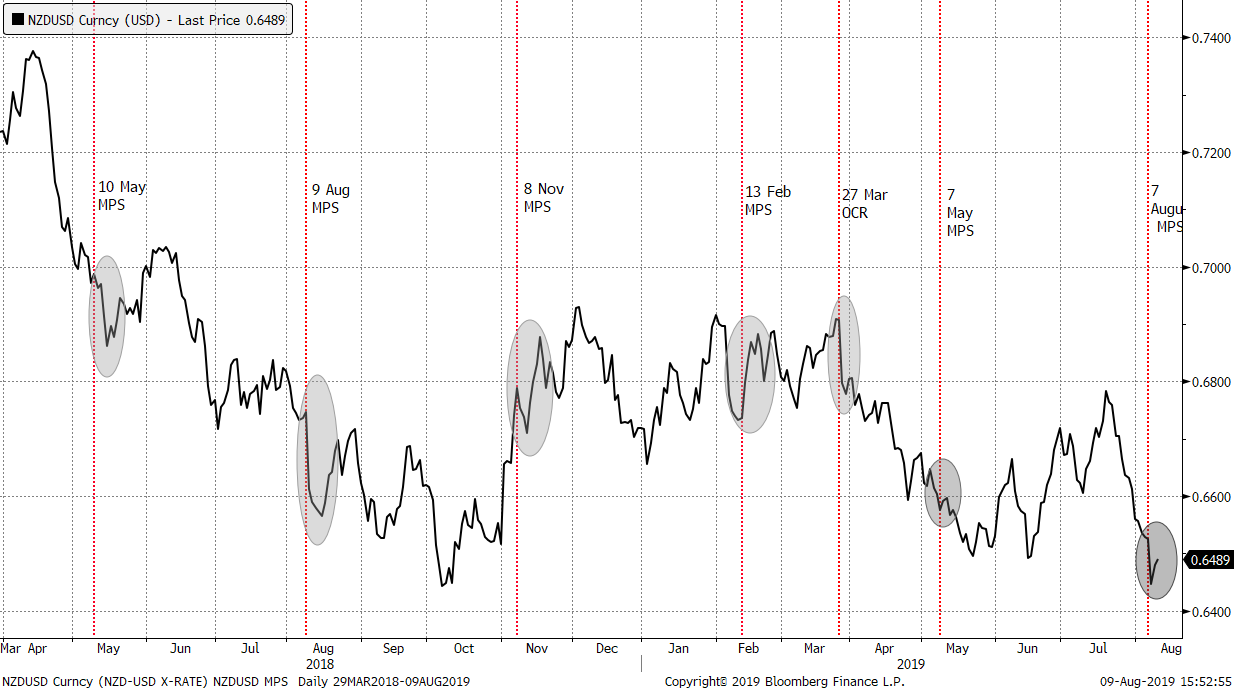
The chart below highlights the NZD/USD movements subsequent to the various RBNZ statements.
What is obvious is that in their continuing desire to drive the NZ dollar lower, the RBNZ do cause a short-term deprecation of the currency, however the impact is not long-lasting or sustainable with other economic/market forces soon taking over. Often the Kiwi dollar is soon bouncing back upwards as the FX market day-traders who initially sell on the dovish words from the Governor, do not continue their short-sold NZD positions and rapidly buy the NZD’s back.
Why the RBNZ chose to go with a 0.50% OCR cut seems to be related to “getting ahead of the curve” in ensuring that interest rate decreases in New Zealand keep pace with further reductions offshore (particularly the US).
The RBNZ clearly believe that the NZ dollar will appreciate (and that somehow is a bad thing!) if our interest rates are left well above those prevailing elsewhere in the world.
Again, the evidence to support this stance is not strong.
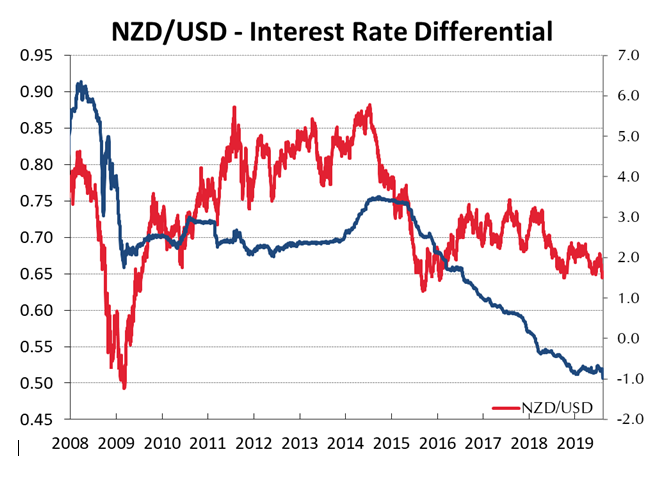
The second chart below confirms that interest rate differentials have not been driving the NZD/USD exchange rate value for more than 10 years now.
There are no longer carry-trade investors or hot-money punters holding NZ dollar deposits to receive a higher interest yield.
Those funds no longer come into New Zealand. So, when our interest rates are cut, there is no money to suddenly depart to send the Kiwi dollar permanently lower.
The Kiwi dollar dropped 1.5 cents to below 0.6400 on the “Shock & Orr” statement last week, however follow-though selling failed to materialise and the rate has already recovered to above 0.6470.
The pattern of the last 18 months seems likely to continue, with the RBNZ causing short-term market volatility but not a lot more.
The RBNZ Governor’s contract with the Minister of Finance states that monetary policy needs to be managed without causing undue volatility in interest rates and the exchange rate. The results of the last 18 months would suggest that this is not being achieved.
RBNZ provide impression that there is something seriously wrong in the economy
Business folk and household investors/borrowers could be excused for interpreting the RBNZ’s surprise 0.50% cut to the OCR as signalling that they know something about the economy that we do not know, and we are all headed into the abyss.
However, the RBNZ do not have any special insights about the economy that will unfold over coming months. Quite the opposite is the case.
Over last 12 months the New Zealand economy has performed quite well (2.5% GDP growth) despite the China/US trade wars and employment policy uncertainties.
The RBNZ and most bank economists have been universally pessimistic on the economic outlook for the last 18 months. Those gloomy forecasts have been proven to be wide of the mark as many parts of the economy remain robust. The very low level of business confidence has also been a totally false predictor of actual economic activity.
Business investment has been low, however that is due to the trade war uncertainties, not the cost of debt. The reduction in interest rates will make no difference to business investment at this point in time, not until the trade wars are resolved. Monetary policy as a tool to change behaviour (spending, saving and investment) in the economy has totally lost its potency and far too much fan-fare is made of changes to monetary policy that actually do not amount to anything.
Last week’s RBNZ prognosis on the economy was heavy on a weak global economy, low business investment, compressed profit margins, slowdown in housing, the lack of pricing power and what overseas central banks are doing.
No mention of the booming horticulture and software export sectors.
No mention of the dairy farming milk solids payout being nearer $7/kg than $6/kg for the next season.
No mention of 48kg lambs cracking $200 each at the Fielding saleyards last Friday and thus one of our largest export industries (sheep meat) riding high on record prices.
These positive factors in the economy answer the question as to why our overall economic growth is holding up much better than most have predicted. Our terms of trade remain at near record high levels, therefore it is not difficult to forecast a much more positive NZ economic outlook, if and when the trade war uncertainty reduces.
Has Trump over-played his hand?
It now becoming more evident that upcoming US economic data will print on the weaker side as Trump’s tariffs and trade war antics damage US business investment, jobs and agriculture prices.
Some time over the next several weeks/months ahead Donald Trump will wake up to the fact that a weaker US economy will not get him re-elected as President next year.
At that point he will be keen to do a deal with the Chinese on the trade front, the Chinese are well aware of this and are just waiting. In the meantime, both China and Australia have reported stronger export figures, underlying the fact that not everything depends on the US economy.
The US dollar is set to weaken further as the Federal Reserve are forced by the data to cut interest rates earlier than anticipated.
Economies that can expand from fiscal policy simulation should stand out
As central bankers around the world race each other to slash their interest rates to zero, monetary policy becomes a totally ineffective tool to stimulate economic activity.
Reserve Bank of Australia Governor, Philip Lowe stated last week, that the onus is now on Governments to use fiscal policy to save and grow their economies.
Monetary policy can do no more.
Currencies that will stand out to global investors will be the countries that have capacity to loosen fiscal policy to stimulate their economies.
The US and Europe have no fiscal capacity due to high Government debt levels, whereas China, Australia and New Zealand have capacity and are already acting on major infrastructure developments (albeit far too slow in New Zealand due to resource consents and bureaucracy).
NZD/USD Exchange Rate
RBNZ Statements Highlighted
Daily exchange rates
Select chart tabs
*Roger J Kerr is Executive Chairman of Barrington Treasury Services NZ Limited. He has written commentaries on the NZ dollar since 1981.
We welcome your comments below. If you are not already registered, please register to comment
Remember we welcome robust, respectful and insightful debate. We don't welcome abusive or defamatory comments and will de-register those repeatedly making such comments. Our current comment policy is here.