

The NZ dollar slid lower against the US dollar over this past week to new four-year lows, pushed down by the ongoing US/China trade wars, dismal NZ business confidence results and a stronger US dollar to below $1.1000 against the Euro.
Prior to the last week, the Kiwi appeared to be finding some support between 0.6400 and 0.6450 following the “front-running” and surprise 0.50% cut in the OCR earlier in the month. However, that tentative support caved-in and the NZD/USD exchange rate dipped to a low of 0.6285 on 31st August.
The local FX market certainly reacted negatively to the media headlines on 29th August that local business confidence had plunged further to levels of negativity not seen since the GFC in 2008/2009.
In slashing the OCR interest rate by 0.50% to 1.00% on the 7th of August, the Reserve Bank of New Zealand stated that they wanted to stimulate business investment and confidence by making the cost of debt cheaper.
So far, it seems that they have scored an “own goal” and achieved the exact opposite.
In surprising everyone and taking what appeared to be drastic action in easing monetary policy, the RBNZ gave the impression to many in the business community that something was seriously wrong with the economy and things were going to become much tougher going forward.
Rightly or wrongly, the RBNZ were signalling that they knew something bad was on the horizon for the economy that the rest of us were unaware of.
Hence the further drop in business confidence levels following the RBNZ’s interest rate cut.
Whilst the initial reaction by the FX markets was to sell the Kiwi dollar on the poor business confidence outcome, standing back from the daily news buzz reveals that the monthly ANZ business confidence survey has been a very inaccurate lead-indicator or predictor for economic activity levels over the last 18 months.
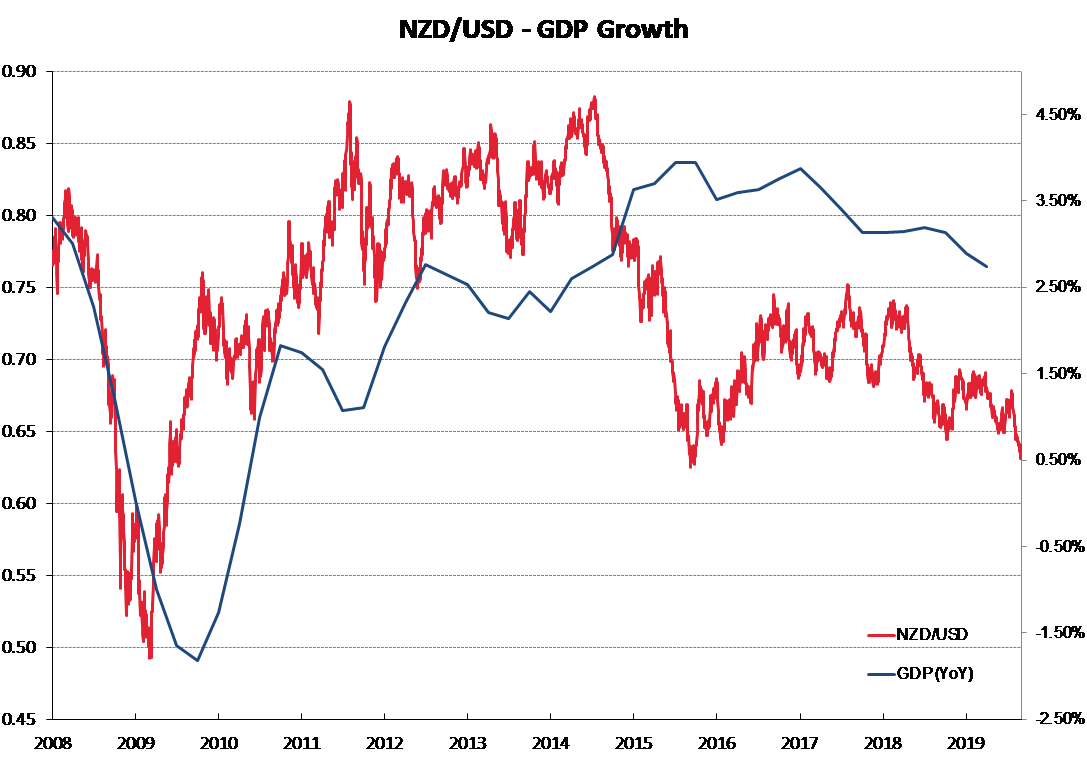
GDP growth has held up well at +2.50% over the last year despite the uncertainty of the trade wars and constant warnings from economists that the economy faces severe headwinds.
Manufacturing is one industry in New Zealand that has declined as the US tariffs cause all business expansion plans to be put on hold by customers around the world.
Export log prices did fall in July, however that was primarily due to a financing scam inside China with timber importers/wholesalers. Underlying demand for NZ logs does not appear to have reduced.
Activity levels across the rest of the economy in agriculture, retail, tourism and construction have not fallen away as some would make you believe.
Recent employment, building consents and retail sales data for the June quarter have been reasonably positive.
The New Zealand economy has held up very well over the last 12 months with still elevated export commodity prices underpinning the moderate expansion.
The very low business confidence levels are not about worries of weakening demand in the economy, instead they reflect business folks’ combined frustration with Government policy changes on regulation, employment laws and immigration. The uncertainty from the global trade wars also contribute.
Business confidence tumbled following the Labour-led coalition government coming to power in late 2017 and it has never really recovered. Low business confidence can become a self-fulfilling prophecy that pulls economic activity down, however to date that has not occurred. The low business confidence levels are unfortunately stemming from the actions of politicians and others in Wellington.
The implications for the Kiwi dollar from this misrepresentation of the true state of the NZ economy, is that at 0.6300 it is arguably under-valued vis-à-vis our economic fundamentals.
However, a recovery in the NZ dollar cannot occur until either the USD weakens, or the trade wars are resolved. The overall exchange rate value as measured by the TWI Index is now below 70.5. The current RBNZ economic forecasts over the next three years are based on the TWI averaging between 72.4 and 73.4, thus monetary conditions are already much looser than intended.
AUD outperforms the NZD, further gains likely
One of the reasons behind the NZ dollar sell-off over recent weeks has been the unwinding of speculative NZD/AUD FX market positions.
The NZD/AUD cross-rate has reversed sharply from highs of 0.9700 on 6th August to 0.9370 with the speculators selling the NZD against the AUD to unwind.
The NZD/USD rate has certainly underperformed the AUD/USD rate since the RBNZ cut the OCR. Looking ahead, Australian economic data being released on Tuesday 3rd September may well prompt further AUD gains ahead of the NZD.
Australia will record their first Balance of Payment Current A/c surplus since 1975 for the June quarter.
The Aussies are also on track to Government budget/fiscal surpluses as well. So, if it was not for the current global economic uncertainties caused by the US/China trade wars, the Aussie dollar would be posting serious currency gains against all currencies. Against its much-improved economic fundamentals the AUD would also have to be regarded as undervalued against the USD. The AUD/USD exchange rate is currently stable around 0.6750 against the USD, holding steady despite recent USD gains against the Euro.
US employment numbers key metric for the Fed
A slight thawing of trade tensions between the US and China since the blow-up in May sees them return to the negotiating table this month. However, an agreement on technology transfers and intellectual property seems a way off whilst import tariffs are both implemented and increased by both sides.
Global FX markets will be focusing on the next US employment data for the month of August on Friday 6th September. A monthly increase in new jobs below 160,000 will increase the chances of the Federal Reserve aggressively cutting their interest rates at their FOMC meeting on 18th September. The long-awaited USD weakness on world currency markets may then finally start to emerge.
Daily exchange rates
Select chart tabs
*Roger J Kerr is Executive Chairman of Barrington Treasury Services NZ Limited. He has written commentaries on the NZ dollar since 1981.
We welcome your comments below. If you are not already registered, please register to comment
Remember we welcome robust, respectful and insightful debate. We don't welcome abusive or defamatory comments and will de-register those repeatedly making such comments. Our current comment policy is here.