
The Kiwi dollar has shown some early signs of recovery over this last week from the “sell-off” funk it found itself in when the external coronavirus/economic shock hit global financial and investment markets six weeks ago.
The NZD/USD exchange rate has traded higher to 0.6350, recording a 1.6 cent bounce upwards from the lows of 0.6190 just a week ago. What provides further reassurance to the view that the Kiwi selling was overdone on the initial reaction to the coronavirus risk event, has been a dramatic reversal in the fortunes of the US dollar itself over the last seven days.
The USD has weakened further against the Euro to $1.1290 from $1.1130 a week ago, following the “emergency” 0.50% interest rate cut by the Federal Reserve in response to the potential negative consequences on the US economy from the coronavirus shock.
The EUR/USD rate is now threatening to break out of the top of the $1.0800 to $1.1400 trading band it has remained within over this last 12 months. The sudden change in sentiment towards the US dollar in global currency markets comes from the unexpected reduction in both US short-term and long-term interest rates now occurring. Investors were very happy to hold US dollars as a safe-haven and higher yielding currency through all the uncertainties of the trade wars last year, however the yield gap to other currencies has now narrowed considerably and the resolution of the trade wars is now off the front pages as the coronavirus dominates.
The long term expansion of the US economy and the related bull-run in the US share market over the last five years, both nearing the end of their respective cycles in any case, are now threatened by both US political and economic risks not even contemplated a few short weeks ago. In a perverse turn of events the US dollar as a currency now looks a lot less attractive in the face of negative investment returns and the US government fiscal stimulus required by the coronavirus impact constrained by a large budget deficit and high debt levels.
The overall value of the US dollar, the US Index against all the major currencies, has plummeted -2.4% from 98.50 on 20 February to 96.10 on Friday 6th March. In very short fashion the positive US economic story that President Trump has trumpeted on about incessantly over the last three years has turned to custard by a global health pandemic.
The total lack of positive response by equity, bond and currency markets to the very positive 275,000 increase in US jobs though the month of February released last Friday is very instructive and telling about the change in sentiment in the US financial and investment markets. Normally, such a positive economic number would have sent shares, interest rates and the US dollar values all higher.
The additional risk the markets are also now reflecting is an increased probability that Donald Trump will not be re-elected as President in November as the economy and Wall Street supports to his popularity are eroded away. Many investors will be running scared of the risk of what a Democratic President in the form of Bernie Sanders or Joe Biden will do to their portfolio values and returns. The markets are looking forward and representing a sharply increased risk of economic recession caused by the coronavirus stopping work, shopping, travel and holidays.
Over coming weeks, the new weaker direction and momentum of the US dollar is not expected to change from what we have witnessed over this last week. Therefore, a move up to $1.1400 and $1.1500 in the EUR/USD exchange rate should result in another two-cent gain for the NZD to above 0.6500.
Based on relative economic fundamentals and performance the Kiwi dollar is now considerably under-valued against the Euro at a 0.5630 cross-rate and the UK Pound at a 0.4870 cross-rate. As the coronavirus shock inevitably passes and reduces in intensity, a re-rating of the Kiwi dollar vis-à-vis the EUR and GBP appears very likely.
RBNZ OCR cut already priced-in
It is already priced-in to both local interest rate markets and the NZD/USD exchange rate that the RBNZ will follow the RBA and Fed with an interest rate cut on 23 March when their Monetary Policy Statement is released. The Aussie dollar strengthened on the RBA cut of 0.25% last week as it was a smaller reduction than the surprise 0.50% cut delivered by the Fed. Do not expect further NZD weakness on the local OCR cut.
The RBNZ’s messaging will be somewhat changed from their upbeat 12 February prognosis, as the coronavirus impact on the economy will be more long-lasting than the earlier assessment. It is a very long time from now until 18 June when the GDP growth numbers for the March quarter are released to gauge the full impact of the coronavirus shock onto the NZ economy. Whilst a low or negative quarterly result would be bad news for the Kiwi dollar, a lot can happen in the meantime with the more positive December 2019 quarter’s GDP figures being released on 19 March and developments globally with the coronavirus situation.
As yet, we do not know the timing of the peak or the timing of a vaccine treatment for the coronavirus that has slowed trade, travel and business globally. However, what we do know from past experience with SARS etc is the potential for a massive bounce-back and catch-up in economic activity once the risk event runs its course.
China has more fiscal stimulus ammunition to fire than the US
The strong linkages between the New Zealand and Australian economies with China caused the substantial sell down in both currencies through February. However, currency markets are now starting to realise that the Chinese Government is much better placed from a position of fiscal strength to rescue and re-stimulate their economy from the coronavirus shock than what the Americans are. New Zealand is also in a strong fiscal position to help affected industries as well.
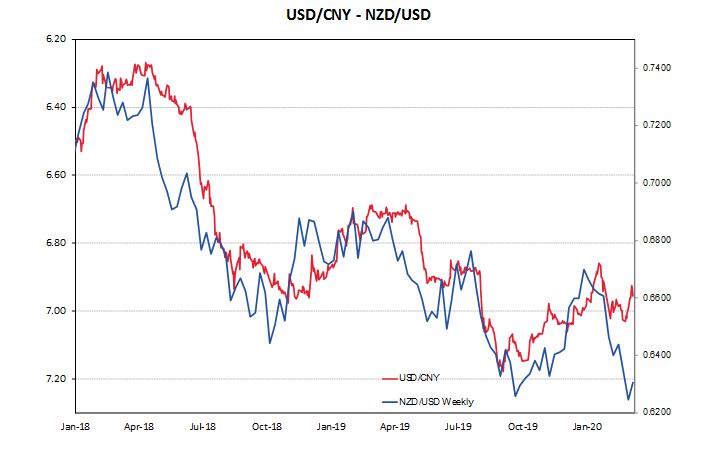
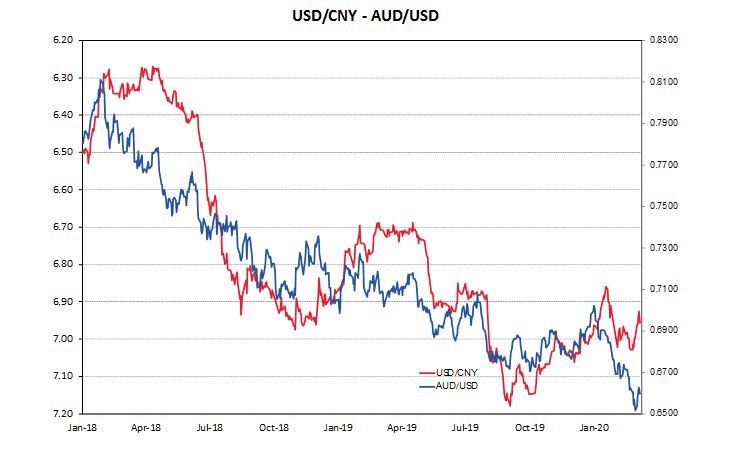
Both the Kiwi dollar and the Aussie dollar have some catching up to do on the Chinese Yuan which has strengthened against the USD to 6.9300, reflecting that Beijing has more economic options at its disposal from here than what Washington has.
Sign up for our daily Currency email.
Daily exchange rates
Select chart tabs
*Roger J Kerr is Executive Chairman of Barrington Treasury Services NZ Limited. He has written commentaries on the NZ dollar since 1981.
We welcome your comments below. If you are not already registered, please register to comment
Remember we welcome robust, respectful and insightful debate. We don't welcome abusive or defamatory comments and will de-register those repeatedly making such comments. Our current comment policy is here.