

- Too much leverage and not enough liquidity cause inevitable blow-ups
- The US Federal Reserve continues its hardline monetary stance
- Political risk on the Kiwi dollar likely to improve
Too much leverage and not enough liquidity cause inevitable blow-ups
Leverage and liquidity, too much of the former and not enough of the latter, are consistently the two conditions behind every financial boom and bust shockwave over the last 30 years.
From the demise of the original arbitrage hedge fund, Long Term Capital Management Limited in the late 1990’s, to the US residential property sub-prime loan crisis that triggered the GFC in 2008 to the current post-Covid inflation shambles, the stand-out features are the same, too much easily acquired credit/leverage causes the boom, however when it comes to unwind the over-leveraged deals, insufficient market liquidity causes the bust. Bond and equity investors around the globe are all now under enormous strain as we suffer the inevitable backlash and repercussions from the “over exuberant” deal making stimulated by the central banks’ 0% interest rates and money printing in 2020 and 2021.
Too much leverage and insufficient market liquidity appeared to be a prominent part of the UK Gilts (UK Government Bonds) market blow-up two weeks ago. What was surprising is that UK pension funds with large bond investment portfolios were under severe liquidity pressure to the point of insolvency, largely as a result of margin calls from investment bankers and brokers. To be margin called for more cash collateral in extreme market movement conditions indicated that the pension funds were involved in highly leveraged derivative instruments that were rapidly turning sour on them. One wonders about the governance and control over these pension funds that allowed such leverage derivative instruments in the first place. The timely emergency Bank of England intervention in the Gilts market saved the financial and investment markets from a more catastrophic meltdown.
The pressures in the UK bond market came about from unprecedented rapid increase in 10-year yields from 1.85% to 4.50% over the months of August and September. The destruction in value in bond portfolios has been enormous and is has largely been caused by the belated, therefore severe, monetary tightening action by central banks to the supply-side driven inflation crisis.
The probability of a similar financial/investment market blow-up to what has just occurred in the UK on the other side of the Atlantic must be increasing. US long-term bond yields have increased from 2.55% to 3.90% over the same two-month period. Highly leveraged derivative investment deals designed to produce more positive returns when interest rates were 0% in 2020 and 2021 must now be on the point of implosion inside several US hedge and investment funds. Do not be too surprised to see the well-proven maxims of too much leverage and insufficient liquidity causing a financial shock sometime very soon in the US markets. A similar financial timebomb is ticking in the US market, similar to what we have witnessed in the UK. Whether it come from the high-yield bond market, or mutual funds or hedge funds remains to be seen. A major financial collapse due to someone’s failure to meet cash margin calls on extreme leveraged positions in equities or bonds is the sort of risk event just waiting to happen (in the author’s opinion).
Such a risk event or shock may turn out to be the trigger that causes the US Federal Reserve to pivot on their super-tight monetary stance as the resultant fall-out and contagion could undermine the entire financial system. The markets are currently not expecting the Fed to provide any signal of a pivot until there is several months of evidence of lower inflation and weaker labour market conditions. Given the recent UK experience, the Fed pivot could come a lot sooner than most believe via a financial/investment market blow-up, rather than from lagging economic data (inflation and employment). The Fed would have a responsibility to intervene and act to calm the markets in such an event, as they have caused the conditions for financial stress through their rapid interest rate increases.
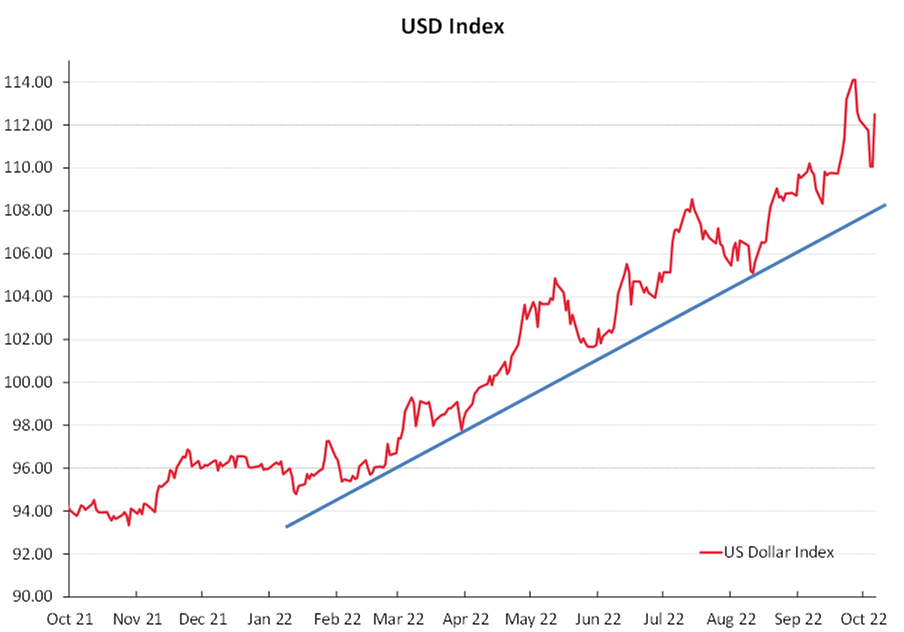
It is highly likely that there a similar highly leveraged positions stemming from the “one-way bet” that has been the US dollar appreciation over recent months. Whilst we have been stating it for some time, the day is getting closer to when the continuous USD currency market gains will simply run out of momentum and implode-in on itself. The traders and speculators currently holding enormous “long-USD” positions will have a strategy and plan not to sell out of those positions until there is a signal from the Fed to pivot on monetary policy. That signal may be forced on the Fed by a financial meltdown event that they did not see coming.
The US Federal Reserve continues its hardline monetary stance
The battle of words continues from Fed governors to ramp interest rates higher still, the theory being to reduce consumer demand to better meet lower levels of supplies of goods and services. The problem with the continuing US Federal Reserve jawboning of a hardline monetary stance is that the supply volumes have already dramatically increased with tumbling shipping/freight costs in the northern hemisphere and US retailers now heavily over-stocked. Price discounting before Christmas appears very likely.
RBNZ Governor, Adrian Orr was distinctly more hawkish on the inflation/monetary policy outlook last week. However, local New Zealand factors continue to have very little impact on the NZD/USD exchange rate value. The Kiwi dollar did recover up from 0.5600 to 0.5800 on weaker than expected US manufacturing data earlier last week, however the stronger US dollar from Friday’s US non-farm payrolls jobs has returned the Kiwi back to the lows of 0.5600 again. The USD “Dixy” Index has returned to above 112 from the earlier sell-off to 110 on the weaker manufacturing figures. Anecdotal evidence in the US economy is that many large corporates now have hiring freezes in place or are starting to lay off workers as consumer spending falls away due to the highest home mortgage interest rates (6.70%) since 2007. The US September jobs increase of 263,000 was well below the average monthly increases in the first half of 2022. However, the Fed still seem to want to drive employment levels lower to limit wage increases and therefore bring inflation down. Average hourly earnings (wages) increases in the US peaked at 5.60% pa in March and have steadily declined to 5.00% pa in September.
The week ahead will see the markets reacting to inflation data in the US. Ahead of the September CPI inflation data on Thursday night 13 October, there is a survey of consumer inflationary expectations and wholesale prices (PPI) data. The September quarter CPI inflation figures for New Zealand are released on Tuesday 18 October with a marginal reduction from 7.30% to 7.10% expected in the annual inflation rate.
Political risk on the Kiwi dollar likely to improve
Whilst the US side of the NZD/USD exchange rate is still expected to dominate movements over coming months, as we move into 2023 potential political changes in New Zealand could see a return of foreign investor interest in the NZ dollar. Over recent years, ideologically driven economic policies from the left-of-centre Ardern Announcement Government have deterred any offshore interest. A likely change to a more business-friendly, centre-right Government in a years’ time may spark more interest in the undervalued NZ dollar from overseas players. The mood of the nation is certainly changing judging by the outcome of this weekend’s local government elections (albeit a pathetic 40% voter turnout), where centre-right leaning Mayors have won convincingly throughout the country.
Daily exchange rates
Select chart tabs
*Roger J Kerr is Executive Chairman of Barrington Treasury Services NZ Limited. He has written commentaries on the NZ dollar since 1981.
We welcome your comments below. If you are not already registered, please register to comment
Remember we welcome robust, respectful and insightful debate. We don't welcome abusive or defamatory comments and will de-register those repeatedly making such comments. Our current comment policy is here.