

-
Summary of key points: -
- The Fed contemplate going slower as the RBNZ go faster and harder!
- The Chinese push more economic stimulation buttons
- Key chart support and resistance lines broken as the USD reverses engines
The Fed contemplate going slower as the RBNZ go faster and harder!
The monetary policy “penny-dropped” in both Wellington and New York for the RBNZ and US Federal Reserve respectively last week.
The need for higher NZ interest rates, sooner than previously indicated, was the hallmark of the RBNZ’s monetary policy statement – a belated recognition of the significant wage-push inflation stemming from the acute labour shortage situation New Zealand finds itself in. The hawkish statement was in stark contrast to the speech Governor Adrian Orr delivered less than two months ago where he indicated that he was nearing the end of the monetary tightening cycle!
The dramatic U-turn in outlook and comprehension of inflationary pressures was almost as good as the Reserve Bank of Australia’s U-turn on interest rate increases back in April. In addition to Governor Orr’s inconsistency in messaging, the monetary policy statement contained some weird claims that suggest the economic guru’s at the central bank are too tied to their economic models and don’t get out enough. The first erroneous statement was that house construction firms had full order books in front of them (page 12 of the statement). Anecdotal evidence from architects and engineers at the commercial coalface is that everything has come to a grinding halt in the residential building sector over recent months and forward orders for 2023 are close to zero. The second misguided statement was that export commodity prices had remained at elevated levels (also on page 12). Not sure that our dairy, apple and log exporters would agree with that given recent market price declines.
New Zealand’s economic outlook has certainly turned gloomier with this latest burst of monetary tightening. However, a contracting economy next year does not mean we are in store for a weaker NZ dollar. To the contrary, the NZD/USD rate looks set to make further gains towards 0.7000 as the US dollar weakens against all currencies and the widening NZ:US interest rate differential drives some capital flows into the Kiwi dollar on its own account.
The penny has also seems to have finally dropped at the US Federal Reserve judging by the change in tone in the minutes of their FOMC meeting held a few weeks back. More Fed members are now questioning the need for continuing interest rate hikes as more evidence becomes available that US inflation has peaked and other economic indicators (particularly housing) slump. Whilst Fed Chair Jerome Powell was still talking tough on monetary policy, inflation and interest rates at the media conference following the last Fed statement, the written monetary policy statement certainly laid the ground for a slowing or pause on interest rate hikes and an admission that are serious time-lags in a lot of their official economic data (particularly the shelter/rents component in their core CPI inflation figures).
There will again be a heavy markets focus on the November US inflation data, due for release on Wednesday 14 December. Another monthly increase in the core inflation below consensus forecasts of +0.40% will be further evidence to allow the Fed to go slower i.e. a weaker USD value. The Fed are also transfixed by the strong labour market, but another lower non-farm payrolls jobs increase for the month of November on Friday 2 December (lower than the +200,000 forecast) will also be USD negative.
The forward looking scenario that is being painted for the middle of the next year is one of the US bond and FX markets pricing-in upcoming interest rate cuts by the Fed, whilst at the same time the RBNZ need to hold our interest rates higher for longer as the domestic wage-push inflation proves difficult to pull back down. That is a recipe for NZ dollar gains on its own account in 2023.
The legacy being left by the Ardern Announcement Government, where their mis-management of employment and immigration policies has created a wage-push inflation fiasco which is now painful to fix, will be one of economic decline, rising unemployment and average households substantially worse off financially. The scary thing is that both Jacinda and Grant appear oblivious to what is happening in the deteriorating economy around them.
The Chinese push more economic stimulation buttons
Additional monetary policy loosening through cuts to official interest rates last week indicate that China is keener than ever ignite higher levels of economic activity as they show signs of emerging from the Covid lockdown problems. Further support is also being provided to second-tier lenders to the beleaguered property construction sector. As China re-opens to the world over coming months it has to be viewed as a net positive for the NZD and AUD currencies who are loosely tied to China’s fortunes.
Key chart support and resistance lines broken as the USD reverses engines
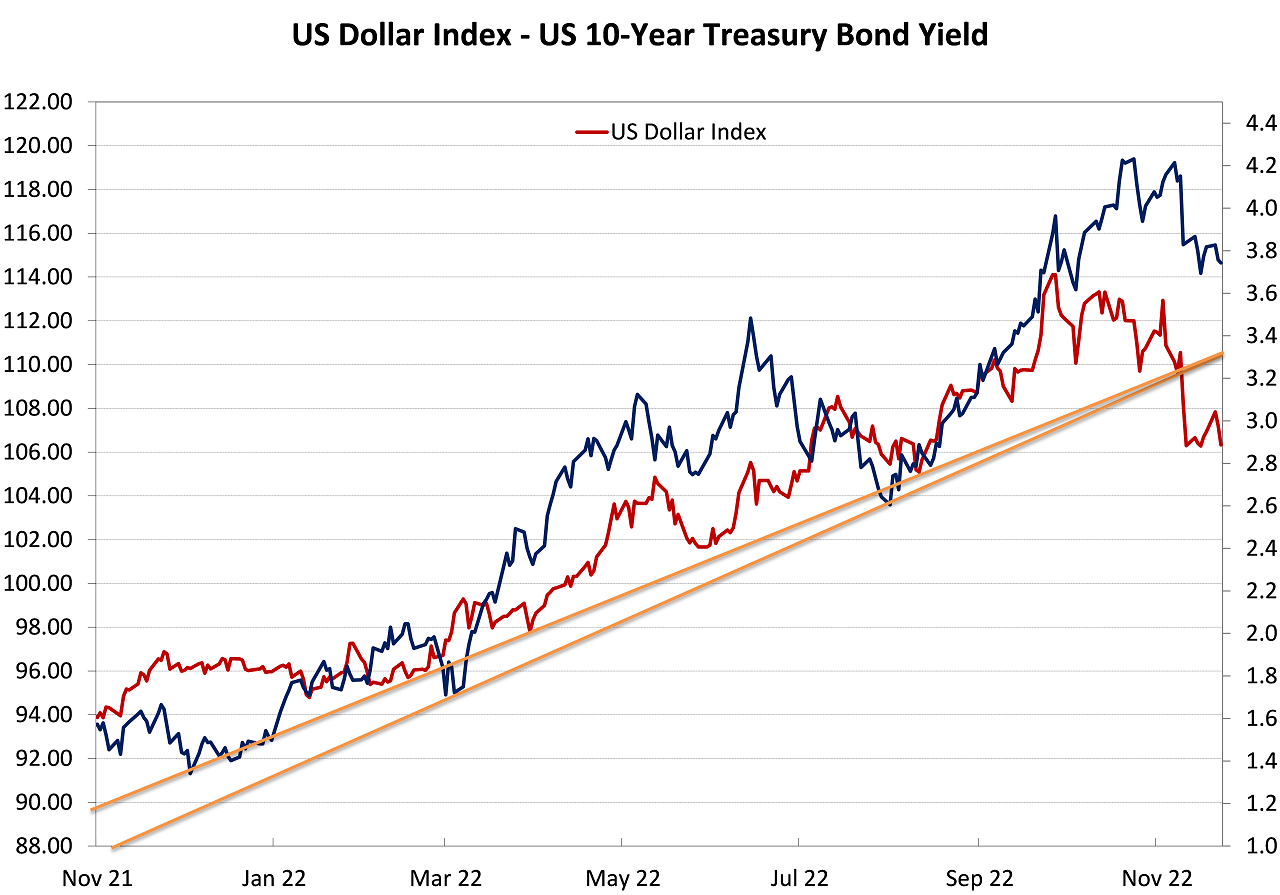
The turnaround in the US dollar’s direction over recent weeks has been swift and severe. As the chart below shows, the uptrend line that the US dollar index (red line) has held above all year since March has now been decisively broken to the downside. The depreciating USD broke below the uptrend support line at 110 and now trades below 106. It would not be surprising that the USD now depreciates all the way back to where it started at 96 on the index.
On this occasion the fall in the USD index has led the US 10-year Treasury Bonds yields lower. The bond yields (blue line on the chart) need to decrease to below 3.30% before their uptrend line is broken (currently 3.69%). A reducing US inflation rate and weaker data suggests that such a decrease is likely.
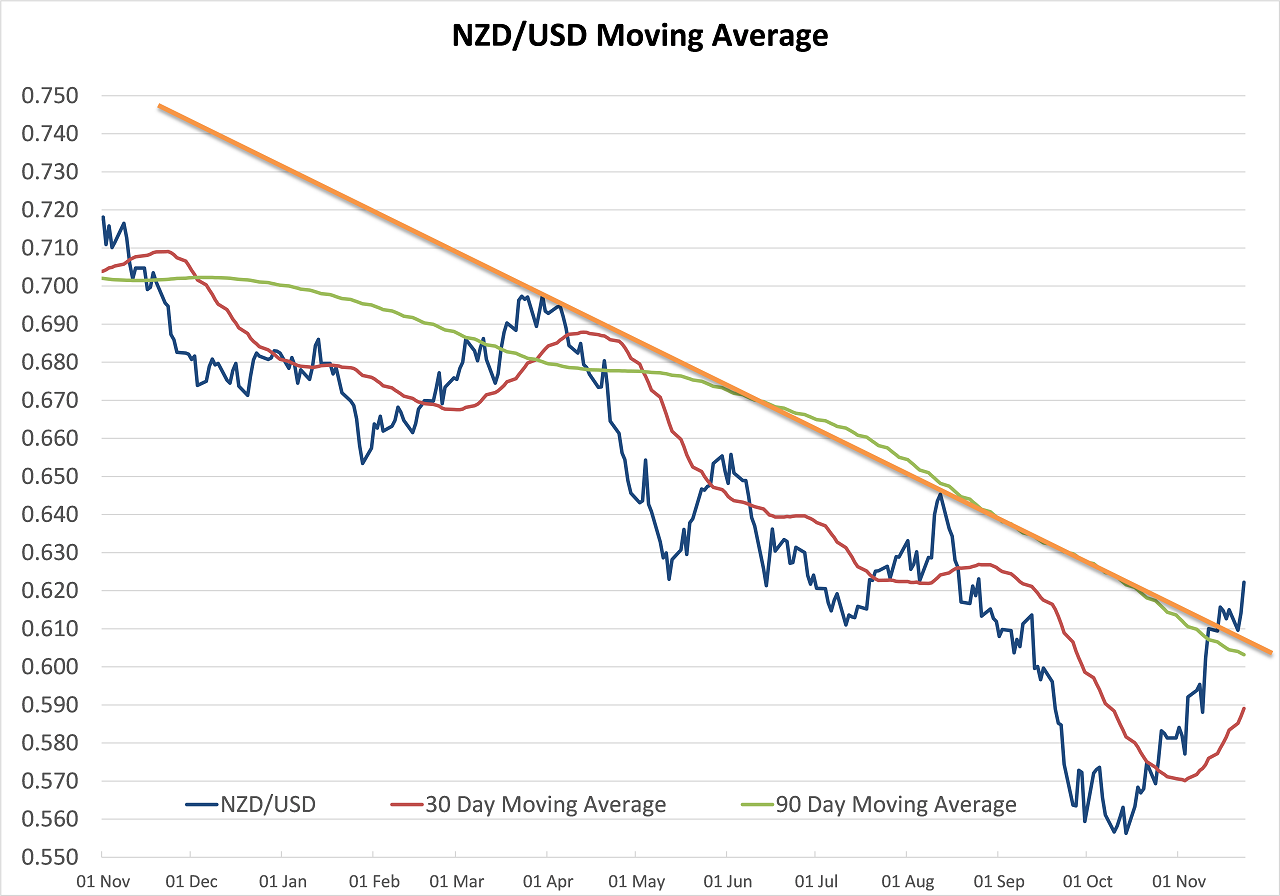
The NZD/USD gains over recent weeks to back above 0.6100 have broken above the NZD downtrend line (bold orange line) that has held firm over the last 12 months. Further Kiwi dollar gains over the next three weeks ahead of Christmas will see the 30-day moving average line (red) cross above the 90-day moving average line (green), a clear chart “buy NZD” signal that will prompt further buying.
Daily exchange rates
Select chart tabs
*Roger J Kerr is Executive Chairman of Barrington Treasury Services NZ Limited. He has written commentaries on the NZ dollar since 1981.
We welcome your comments below. If you are not already registered, please register to comment
Remember we welcome robust, respectful and insightful debate. We don't welcome abusive or defamatory comments and will de-register those repeatedly making such comments. Our current comment policy is here.