
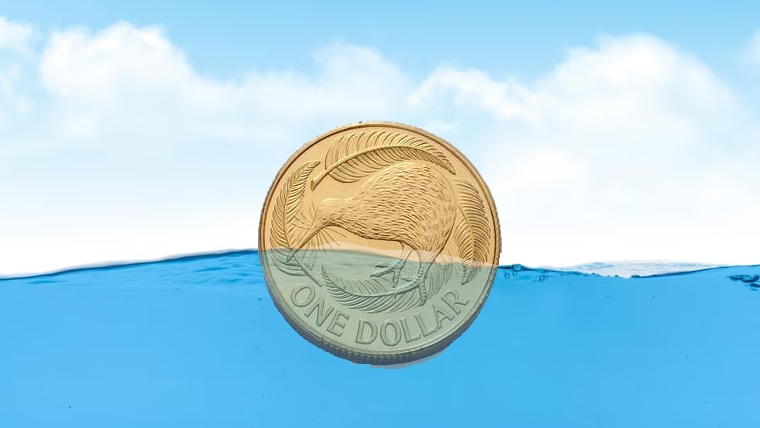
Market attention has been fixated on the war in the Middle East following the joint US-Israeli missile attack against Iran and Iran’s retaliation. The biggest reaction has been for commodity markets and bonds, with higher oil and gas prices adding to inflation concerns, and the stronger than expected US ISM manufacturing survey adding to the mix. The USD is broadly strongly, with the AUD and CAD falling the least since last week’s close. The NZD has weakened to 0.5935.
Market reaction has been contained to the extent that investors believe the US elections later this year mean that the US won’t want an enduring conflict that results in sustained higher oil prices, while Iran’s defence capability was severely curtailed after last year’s attacks. Brent crude opened Monday up 13% to over USD82 per barrel. After falling back down to USD76 yesterday afternoon, Brent crude currently has a USD77 handle, up 6% from last week’s close.
Updating developments, the Strait of Hormuz, which carries about 20% of oil and gas supplies, remains effectively closed as insurance companies won’t cover ships passing through, due to the risk of military attacks. Operations were paused at Saudi Arabia’s largest oil refinery after a drone strike.
Qatar suspended LNG production at the world’s largest export facility, which covers about 20% of global supply, after it was targeted in an Iranian drone attack. European gas futures rose over 50% and have since settled about 40% higher from last week’s close. The duration of the shutdown is unknown. A Qatari assessment shared with Bloomberg warned that if shipping lanes in the region remain severely disrupted by the middle of this week, they would expect to see a more significant gas price reaction.
In media interviews, President Trump said he expected the military operation to last about four to five weeks if necessary and called on Iran’s generals to either hand power to the nation’s people or embrace a model similar to Venezuela. Iran’s security chief said Tehran won’t negotiate with the US. Trump told CNN we haven’t even started hitting them hard…the big wave hasn’t even happened…the big one is coming soon”. In the last hour, Trump has been talking to reporters and regarding the timeline he said we’ll do “whatever it takes”, noting that US has the capability to go far longer than the four to five weeks noted.
Bloomberg reported that the UAE and Qatar are private lobbying allies to help them persuade President Trump to reach for an offramp that would keep US military operations against Iran short.
Most Asian and European equity markets closed lower, with Japan’s Nikkei down 1.3% and the Euro Stoxx 600 index down 1.6%. The US S&P500 opened down 1.2% but the fall faded and the index is flat in early afternoon trading, with the Nasdaq index up 0.4% as IT stocks outperform.
There has been more reaction in the global rates market, with US Treasury yields up 9-13bps across the curve, led by the belly. Investors see higher oil and gas prices adding to inflation pressure at a time when inflation is already trading above target in many places, including the US. Pricing for Fed rate cuts is 51bps through to the end of the year, 10bps less than at Friday’s close.
While the 10-year rate fell slightly when Asia trading opened on a safe-haven bid, the yield subsequently trended higher on inflation concerns and it currently sits at 4.05%, just off from the high for the day. Adding to upside pressure, the US ISM manufacturing index fell by only 0.2pts to 52.4 in February, following the surge in January, leaving the index near a 3½ year high, stronger than expected. The prices paid index surged 11.5pts to 70.5, likely reflecting the sharp lift in oil prices earlier this year.
In currency markets the USD is broadly stronger, with the DXY index up 0.9% for the day, while other USD indices are up 0.5-0.7%. While some of this reflects a safe-haven bid, it also likely reflects a closing of large short USD positions that have built up, given the tendency for traders to trim positions when uncertainty increases.
CAD and AUD have shown some of the smallest falls against the USD, being least affected by the impact of higher oil and gas prices. The AUD is down 0.5% from last week’s close at 0.7080. The NZD is down about 1% from last week’s close at 0.5935, after trading below 0.5920 overnight. After trading stronger yesterday, as investors closed short NZD/AUD positions, the cross rate has fallen through 0.8390.
JPY didn’t attract any safe-haven flows, given Japan’s high import exposure to oil and gas. USD/JPY is up 0.9% to 157.40 while NZD/JPY is only slightly weaker at 93.4. The notable outperformance of GBP versus EUR reflects the backdrop of higher oil and gas prices. NZD/EUR is little changed at 0.5075 while NZD/GBP has weakened to 0.4430.
In the domestic rates markets, NZ yields reluctantly pushed down from the open, on the back of global forces, but that all reversed during the afternoon as global rates lifted. NZGBs closed the day up 1-2bps across the curve. The 2-year swap rate rose 1bp to 2.95% while the 10-year rate rose 3bps to 3.97%. The Australian 10-year bond future is up about 6bps in yield terms since the NZ close, which will set the tone for the NZ open.
On the calendar today, RBA Governor Bullock will be giving a keynote speech at a business summit this morning. The key global economic release will be euro area CPI data tonight. However, rather than economic news, market focus will remain on developments in the Middle East.
Daily exchange rates
Select chart tabs
Jason Wong is the senior Markets Strategist at BNZ Markets.
We welcome your comments below. If you are not already registered, please register to comment
Remember we welcome robust, respectful and insightful debate. We don't welcome abusive or defamatory comments and will de-register those repeatedly making such comments. Our current comment policy is here.